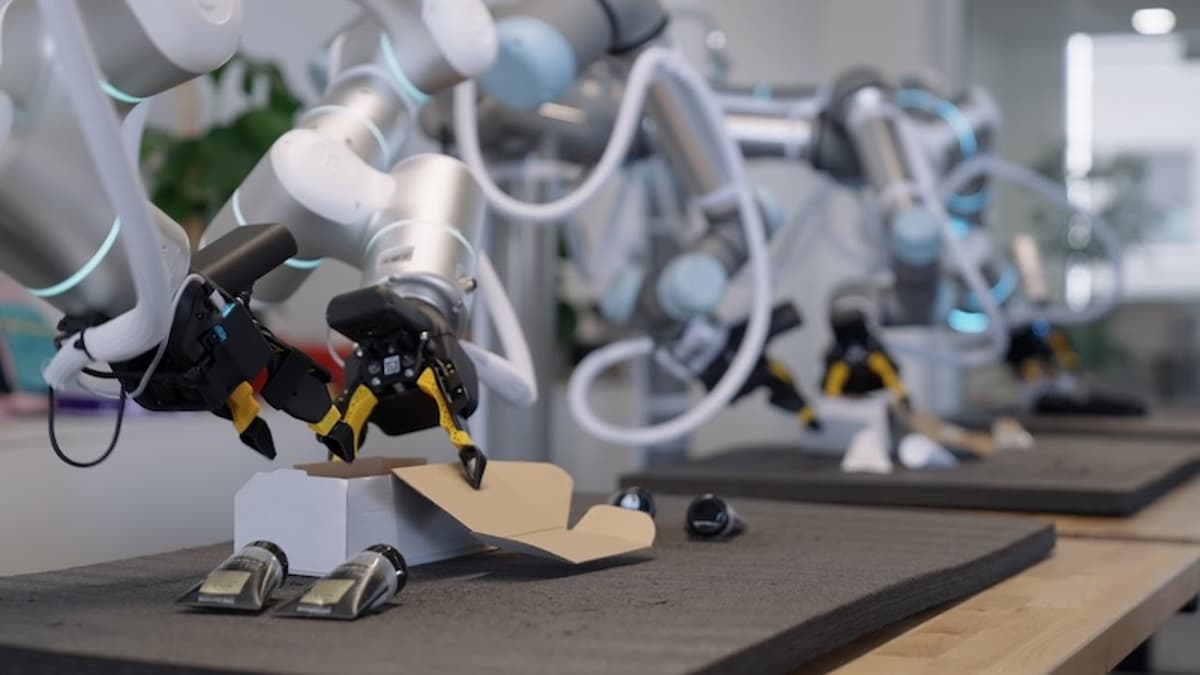
Generalist AI Unveils GEN-1 Model, Claiming Breakthrough in Real-World Robotic Task Performance
Why It Matters
GEN-1 demonstrates that scaling AI principles to physical robots can dramatically improve reliability and speed, opening pathways for more flexible automation across manufacturing, logistics, and service sectors.
Key Takeaways
- •GEN-1 hits 99% success on select tasks, up from 64%
- •Task completion speed up to three times faster than GEN‑0
- •Adapts to new tasks with roughly one hour of robot data
- •Trained on human‑activity wearables, reducing teleoperation costs
- •Early access granted to select partners for real‑world testing
Pulse Analysis
The launch of GEN-1 marks a pivotal moment in the convergence of artificial intelligence and robotics, echoing the scaling breakthroughs seen in large language models. By treating robot behavior as an "embodied foundation model," Generalist AI leverages massive datasets of human motion captured via wearables, allowing the system to learn perception, reasoning, and actuation in a unified framework. This approach sidesteps the costly, task‑specific teleoperation pipelines that have traditionally limited robot adaptability, suggesting a new paradigm where physical AI can be trained at scale much like text‑based models.
From a business perspective, GEN-1’s reported 99% success rate and three‑fold speed gains translate into tangible productivity gains for manufacturers and fulfillment centers. The model’s data efficiency—requiring only about an hour of robot‑specific interaction to master a new task—lowers the barrier to entry for smaller firms that lack extensive data collection infrastructure. As robots become capable of improvisational intelligence in unstructured settings, industries such as e‑commerce, warehousing, and even hospitality can envision deploying flexible automation without the need for extensive re‑programming, potentially reshaping labor allocation and cost structures.
Despite the hype, GEN-1 remains an early‑stage technology. Generalist AI admits that not all tasks meet production‑grade reliability, and real‑world deployment will demand further improvements in speed, safety, and regulatory compliance. Competitors like Boston Dynamics and OpenAI are also racing toward general‑purpose robotic agents, intensifying the race for data, compute, and partnership ecosystems. The next wave of physical AI will likely hinge on hybrid models that combine large‑scale pre‑training with domain‑specific fine‑tuning, and on standards that ensure interoperability across hardware platforms. GEN-1’s debut therefore serves both as a proof‑of‑concept and a catalyst for broader industry investment in adaptable, learning‑driven robots.
Generalist AI unveils GEN-1 model, claiming breakthrough in real-world robotic task performance
Comments
Want to join the conversation?
Loading comments...