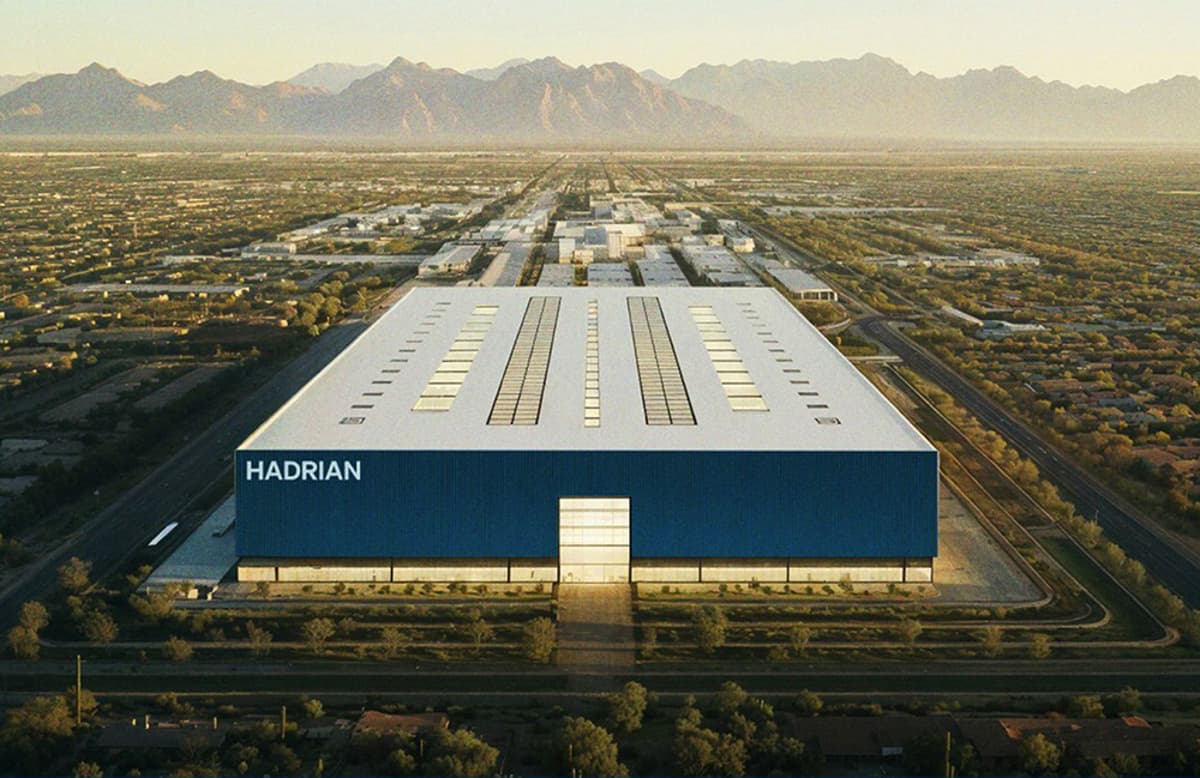
Hadrian Raises Funding for Automated Manufacturing, Bringing Valuation to $1.6B
•January 25, 2026
0
Companies Mentioned

Hadrian

T. Rowe Price Associates

Andreessen Horowitz

Construct Capital

Altimeter Capital

StepStone Group
STEP

1789 Capital

Founders Fund

Lux Capital

Cision PR Newswire
UBM
Why It Matters
The infusion accelerates U.S. domestic manufacturing capacity for defense and aerospace, reducing reliance on overseas supply chains. It also validates investor confidence in AI‑driven factory‑as‑a‑service models.
Key Takeaways
- •Valuation reaches $1.6 billion after latest funding round
- •Funding led by T. Rowe Price, includes a16z, Founders Fund
- •Opus platform launches factories in under six months
- •New Additive division adds 3D printing for defense programs
- •Expansion targets reshoring aerospace and defense manufacturing to U.S.
Pulse Analysis
The United States is witnessing a renewed push to bring critical aerospace and defense production back onto domestic soil, a trend accelerated by geopolitical tensions and supply‑chain disruptions. Companies that can combine rapid deployment with high‑mix, low‑volume capabilities are especially valuable, and artificial‑intelligence‑driven automation has emerged as a catalyst for this shift. Hadrian’s recent $1.6 billion valuation underscores investor belief that AI‑powered factories can deliver the speed and resilience that traditional OEMs struggle to achieve. This momentum also attracts strategic capital seeking long‑term industrial impact.
At the heart of Hadrian’s offering is Opus, a proprietary software stack that orchestrates robotics, vision systems and real‑time analytics to create production‑ready lines in less than six months. The platform treats each facility as a service, allowing customers to scale capacity without the capital outlay of building a plant from scratch. By pairing this technology with accelerated workforce training programs, Hadrian promises not only higher throughput but also a skilled labor pipeline that can operate sophisticated equipment, addressing a chronic talent gap in advanced manufacturing. The integration of digital twins further enhances predictive maintenance and quality control.
The latest funding round, led by T. Rowe Price and backed by a16z and Founders Fund, gives Hadrian the runway to expand its footprint and launch Hadrian Additive, a division focused on qualified 3D‑printing for defense contracts. This move positions the company to support the Department of Defense’s push for at‑scale, repeatable additive processes, potentially shortening the time from prototype to fielded hardware. As more programs adopt AI‑enabled factories, Hadrian could set a new benchmark for cost‑effective, secure manufacturing in the United States. If successful, the model could inspire similar initiatives across other critical sectors.
Hadrian raises funding for automated manufacturing, bringing valuation to $1.6B
0
Comments
Want to join the conversation?
Loading comments...