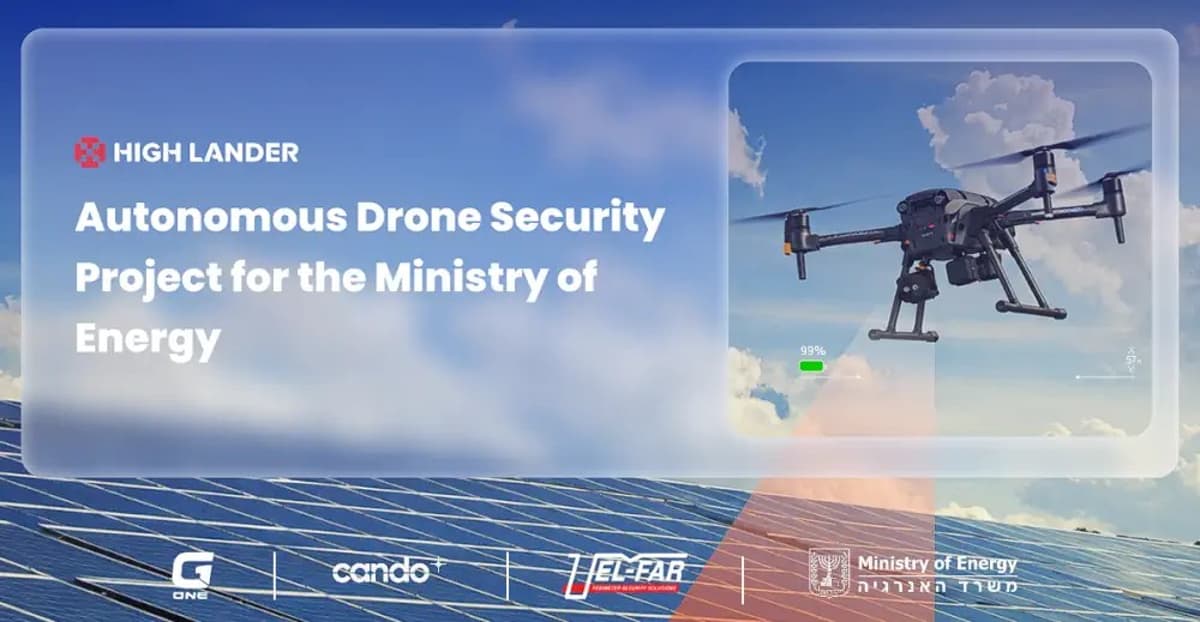
High Lander to Power Autonomous Aerial Security for Critical SolarInfrastructure

Why It Matters
The deployment demonstrates how AI‑enabled drone fleets can safeguard critical energy infrastructure, reducing response times and scaling security for expanding renewable sites. It signals a broader industry move toward autonomous, air‑based surveillance as a core component of infrastructure resilience.
Key Takeaways
- •High Lander provides autonomous drone software for Israel’s 150 MW Ta’anakh solar site.
- •Drones can launch within 15 seconds of an alert, enhancing response.
- •Integration with Cando Drones and G1 Group creates multi‑layered security.
- •Solution showcases shift to software‑driven protection for large renewable assets.
Pulse Analysis
Renewable‑energy hubs are becoming sprawling, high‑value targets, prompting operators to rethink traditional perimeter security. Ground patrols alone struggle to cover the extensive acreage of projects like Ta’anakh, which generates roughly 310 GWh of clean power annually—enough for tens of thousands of homes. By adding an autonomous aerial layer, operators gain continuous, real‑time situational awareness, allowing them to detect intrusions, fires, or equipment failures far faster than human‑only teams. This approach not only deters threats but also reduces labor costs and improves overall asset uptime.
High Lander’s Orion DFM platform orchestrates drone fleets without requiring proprietary hardware, while its Vega UTM system ensures safe, coordinated BVLOS flights under civil‑aviation authority approval. Integrated with smart fencing and sensor networks, the drones can autonomously execute patrol routes, respond to alerts, and stream live video to command centers. The 15‑second launch capability acts as a force multiplier, turning a single alert into an immediate aerial inspection, which then informs ground response teams. Such software‑first architectures enable rapid scaling across multiple sites, as the same cloud‑based control interface can manage fleets worldwide.
The Ta’anakh deployment is a bellwether for the global market, where utilities and governments are increasingly seeking AI‑driven, aerial security solutions. As solar and wind farms expand in size and geographic dispersion, the demand for scalable, low‑latency monitoring will rise sharply. Companies that combine robust drone‑management software with regulatory‑compliant traffic‑control platforms are poised to capture a growing share of the critical‑infrastructure protection market, driving further investment in autonomous aviation technologies.
High Lander to Power Autonomous Aerial Security for Critical SolarInfrastructure
Comments
Want to join the conversation?
Loading comments...