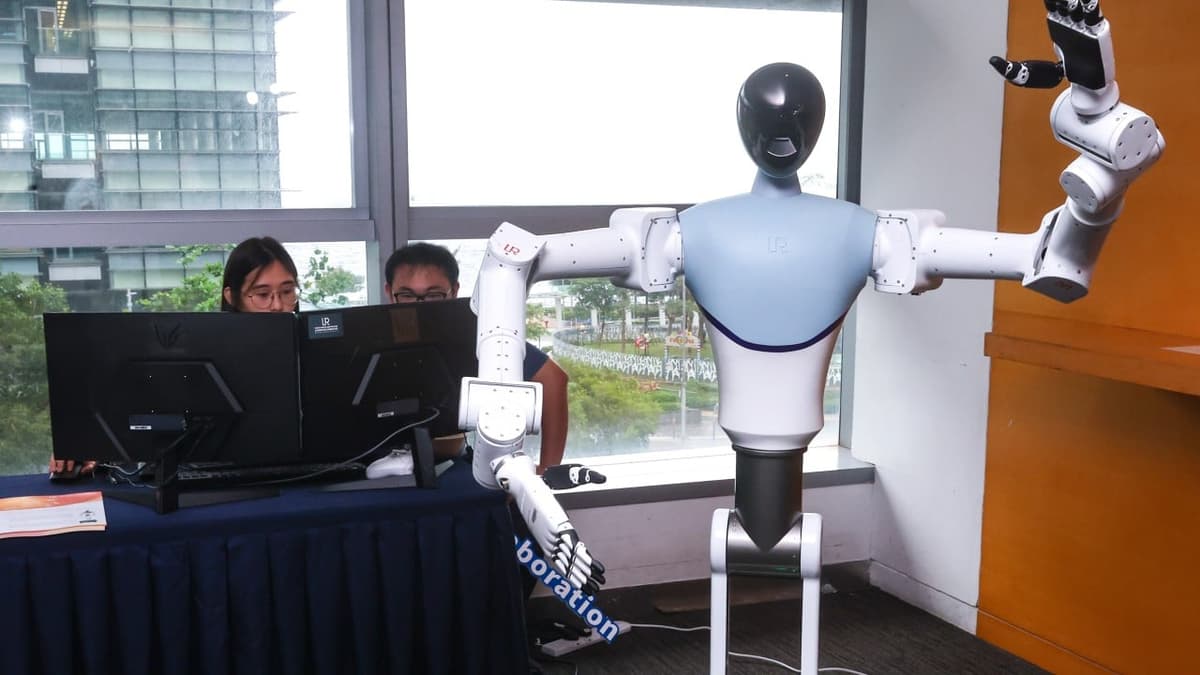
Hong Kong’s CUHK Aims to Bring AI to Life with Humanoid-Focused Robotics Lab
Companies Mentioned
Why It Matters
The lab positions Hong Kong as a bridge between international talent and mainland manufacturing, accelerating the region’s shift toward embodied AI and humanoid robotics with broad economic implications.
Key Takeaways
- •CUHK launches Hong Kong’s first full‑stack interactive robotics lab.
- •Lab partners with 24 firms, mainly mainland China, for humanoid research.
- •Upgraded AI robotic arm and quadruped robot demonstrated improved stability.
- •Over 40 PhDs and 10 professors will train talent for embodied AI.
- •Applications target healthcare, logistics, and Greater Bay Area infrastructure.
Pulse Analysis
The Chinese University of Hong Kong (CUHK) has taken a decisive step toward positioning the city as a hub for advanced robotics by opening the Hong Kong Embodied AI Lab, the first full‑stack interactive robotics facility in the territory. Funded under the government’s InnoHK programme, the lab brings together more than 40 PhD candidates, postdoctoral researchers and a cadre of senior professors to explore embodied artificial intelligence—a shift from purely data‑driven models toward machines that can perceive, act and interact with physical environments. This initiative aligns Hong Kong’s strategic goal of diversifying its economy beyond finance into high‑tech manufacturing and services.
The lab’s immediate deliverables include upgraded versions of locally developed AI‑powered robotic arms and a quadruped platform that now operates without GPS, demonstrating enhanced stability for confined‑space inspections. Partnerships with 24 technology firms—most notably mainland players such as AGIBOT, Deep Robotics and Yushu Technology, as well as local partners like Lenovo’s Capital and Incubator Group—provide low‑cost hardware and funding, creating a supply‑chain pipeline that mirrors mainland manufacturing efficiencies. By focusing on humanoid robot design, the research aims to bridge the gap between industrial automation and service‑oriented robots capable of delicate, human‑centric tasks.
Beyond research, the lab is positioned to feed talent into the Greater Bay Area’s burgeoning robotics ecosystem, offering curricula for undergraduates and even secondary‑school students. Potential applications span healthcare—where assistive robots could alleviate staff shortages—to logistics, where autonomous agents can handle repetitive loading and unloading. If successful, the venture could attract further private investment, stimulate local component production, and reinforce Hong Kong’s role as a conduit between international talent pools and the mainland’s cost‑effective manufacturing base, accelerating the region’s transition to an embodied‑AI economy.
Hong Kong’s CUHK aims to bring AI to life with humanoid-focused robotics lab
Comments
Want to join the conversation?
Loading comments...