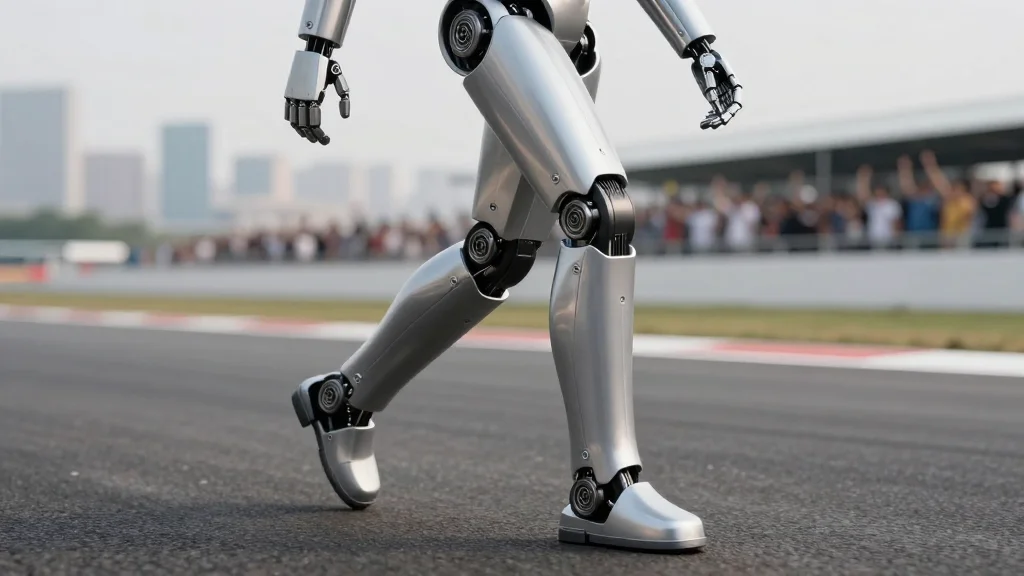
Honor Robotics D1 Sets Half‑Marathon Record in Beijing, Finishing in 50:26

Why It Matters
The D1’s record‑breaking run demonstrates that humanoid robots can now match, and even exceed, human athletic performance in endurance contexts. This milestone validates the viability of autonomous perception and high‑power density cooling systems for real‑world, long‑duration tasks, moving robotics from controlled labs into public arenas. Beyond the spectacle, the achievement signals a shift for industries reliant on manual labor. If a robot can sustain 15 mph over 13 miles while managing thermal loads, similar platforms could be adapted for parcel sorting, airport baggage handling, and on‑demand delivery, potentially reshaping labor economics and safety standards across sectors.
Key Takeaways
- •Honor Robotics D1 finished the Beijing half‑marathon in 50:26, beating the human record of 57:20.
- •Average speed of 15.6 mph (25.1 km/h) achieved via a proprietary liquid‑cooling system handling 6 L/min flow.
- •D1 has 20 degrees of freedom and autonomous perception, enabling real‑time navigation without remote control.
- •Previous year’s winning robot took 2 hours 40 minutes; the MWC prototype ran 48:19 but was penalized for lack of autonomy.
- •Honor plans further public demos and sees applications in urban runs, logistics, and airport ground services.
Pulse Analysis
Honor’s D1 marks a watershed in the commercialization of high‑performance humanoids. Historically, humanoid robotics has been dominated by research prototypes that excel in controlled environments but falter under sustained load. By integrating smartphone‑grade cooling and AI chips, Honor has effectively bridged the gap between consumer electronics thermal management and industrial‑grade actuation, a synergy that could lower the cost barrier for future deployments.
The competitive landscape now includes firms like Boston Dynamics, which focus on quadrupedal agility, and Unitree, which supplies smaller humanoids for airport trials. Honor’s strategy—leveraging brand recognition from its mobile division and showcasing public‑facing feats—creates a distinct market narrative that emphasizes entertainment‑driven adoption as a pathway to functional utility. This approach mirrors the early days of drone technology, where spectacle paved the way for commercial services.
Looking forward, the key question is scalability. The D1’s cooling system, while innovative, relies on a closed‑loop water circuit that may be impractical for mass‑produced units operating in varied climates. Moreover, regulatory frameworks for autonomous agents in public spaces remain nascent. If Honor can iterate on modular cooling and secure clear safety certifications, the D1 could become a template for the next generation of service robots, accelerating the shift from human‑intensive tasks to hybrid human‑robot workflows across logistics, entertainment, and public safety.
Honor Robotics D1 Sets Half‑Marathon Record in Beijing, Finishing in 50:26
Comments
Want to join the conversation?
Loading comments...