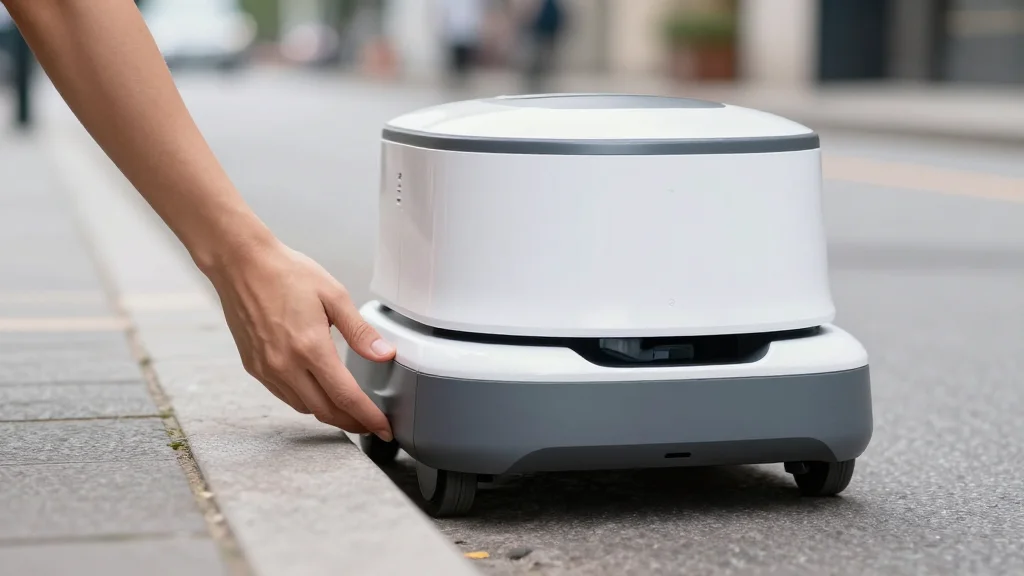
Human Helpers Rescue Finnish Delivery Robots After Curb Mishap, Fueling Safety Debate

Why It Matters
The Turku incident illustrates that autonomous delivery robots are still vulnerable to everyday obstacles like curbs, which are ubiquitous in urban landscapes. If such failures become commonplace, municipalities may impose restrictive regulations that could slow the rollout of low‑emission, last‑mile delivery solutions. Conversely, addressing these technical gaps could accelerate adoption, reducing reliance on motorized delivery vans and cutting urban congestion. Furthermore, the event highlights the need for a harmonized European approach to sidewalk robotics. While the U.S. has already seen city‑level bans, Europe lacks a cohesive policy, risking a patchwork of regulations that could hinder cross‑border scaling of robotic delivery services. A clear regulatory framework would provide certainty for innovators and investors, fostering a competitive market that can deliver safer, more reliable autonomous solutions.
Key Takeaways
- •Two Finnish delivery robots failed to clear a curb in Turku on April 15, 2026.
- •Passersby manually lifted the robots, resolving the blockage without injury.
- •Cities such as Chicago, Toronto and San Francisco have already banned sidewalk robots over safety concerns.
- •Finland currently lacks specific regulations for autonomous delivery robots on public sidewalks.
- •The incident may prompt a public consultation on robot navigation standards later in 2026.
Pulse Analysis
The Turku mishap is a microcosm of the broader friction between rapid robotics innovation and the slower pace of public‑policy adaptation. Historically, new mobility technologies—first bicycles, then e‑scooters—have outpaced municipal rule‑making, leading to reactive bans and safety campaigns. Delivery robots are following the same trajectory, but with a twist: they operate at walking speed and share the same space as pedestrians, making any navigation error more visible and potentially more disruptive.
From a market perspective, the incident could temper investor enthusiasm for low‑margin, high‑volume robot delivery startups unless they can demonstrate robust obstacle‑avoidance capabilities. Companies will likely double down on sensor fusion, AI‑driven perception, and real‑time mapping to avoid reliance on human rescue. The Finnish pilot’s willingness to share data publicly may set a precedent for transparency that could reassure regulators and the public alike.
Looking ahead, the key to scaling autonomous delivery will be a collaborative regulatory framework that defines acceptable performance metrics—such as curb‑climbing success rates—and mandates fail‑safe mechanisms. If European cities can co‑author standards, they could avoid the fragmented approach seen in the United States and create a unified market that attracts global players. Until then, each stumble, like the one in Turku, will fuel the debate and shape the pace at which robot couriers become a routine part of urban life.
Human Helpers Rescue Finnish Delivery Robots After Curb Mishap, Fueling Safety Debate
Comments
Want to join the conversation?
Loading comments...