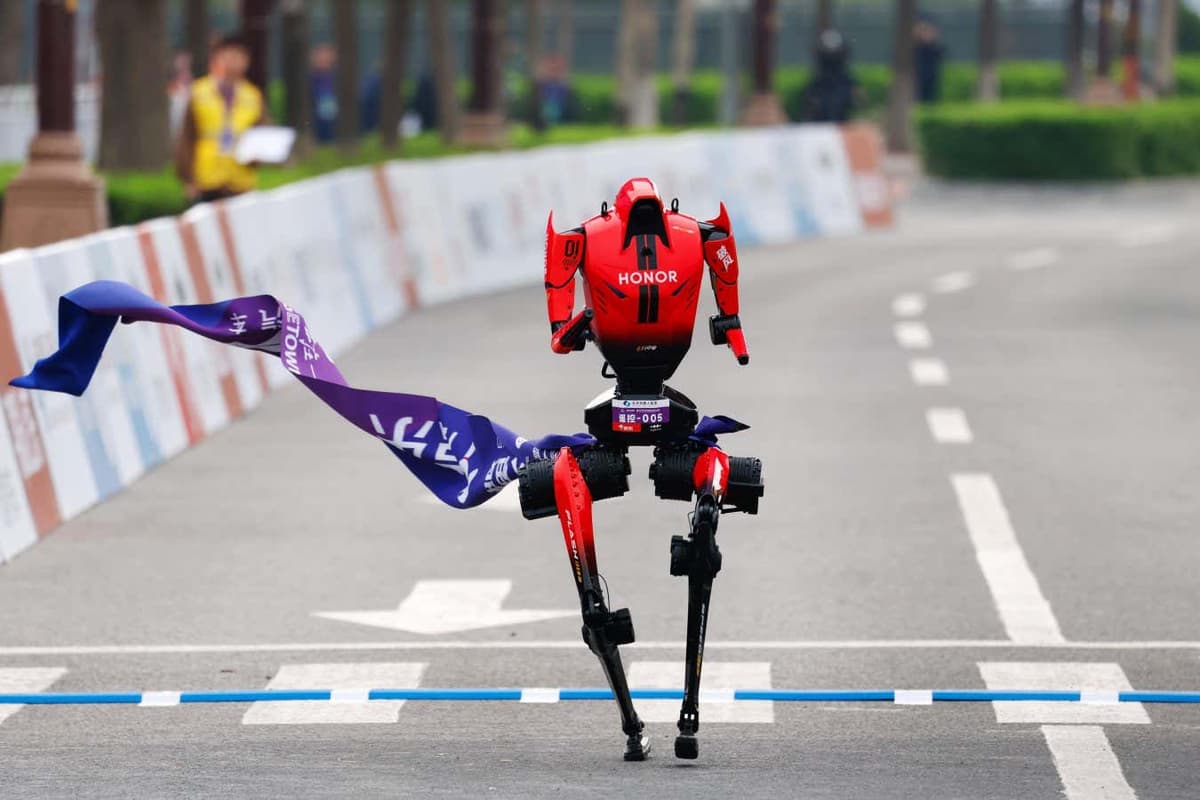
Humanoid Robots May Be About to Break the 100-Metre Sprint Record
Why It Matters
Breaking human speed barriers demonstrates that humanoid robots are moving from research labs toward real‑world utility, prompting new business models in logistics, emergency response, and entertainment. The competition accelerates investment and innovation across the robotics sector.
Key Takeaways
- •Honor's humanoid robot beat human half‑marathon record in April 2026
- •Unitree's robot ran 100 m within a second of the world record
- •Speed gains showcase advances in actuation, AI, and power‑density
- •Faster robots could transform logistics, emergency response, and entertainment
- •Industry rivalry spurs investment in high‑performance bipedal platforms
Pulse Analysis
The latest sprint from Honor’s humanoid marks a watershed moment for legged robotics. By integrating lightweight carbon‑fiber limbs, high‑torque electric actuators, and real‑time reinforcement‑learning controllers, the robot shaved seconds off the half‑marathon benchmark previously held by elite human athletes. Unitree’s 100‑metre run, clocking just under ten seconds, underscores that the same core technologies can be tuned for explosive speed, pushing the envelope of what bipedal platforms can achieve on flat terrain.
Beyond the headline‑grabbing records, these speed gains have tangible commercial implications. Faster bipedal robots could navigate crowded urban environments more efficiently than wheeled counterparts, opening doors for rapid parcel delivery, on‑site inspections, and disaster‑area search‑and‑rescue where agility matters. However, the energy demands of high‑velocity locomotion remain a hurdle; breakthroughs in battery energy density and regenerative braking are essential to translate sprint capabilities into sustained, practical operations without compromising safety.
The competitive surge between Chinese firms like Honor and Unitree is reshaping the global robotics investment landscape. Venture capital is flowing into startups that specialize in high‑performance actuation, AI‑driven gait optimization, and lightweight structural materials. As governments and enterprises eye the strategic advantage of ultra‑fast humanoids for both civilian and defense applications, regulatory frameworks and ethical guidelines will need to evolve in step with the technology. The next few years will likely see a cascade of specialized robots that blend speed with task‑specific functionality, redefining productivity benchmarks across multiple sectors.
Humanoid robots may be about to break the 100-metre sprint record
Comments
Want to join the conversation?
Loading comments...