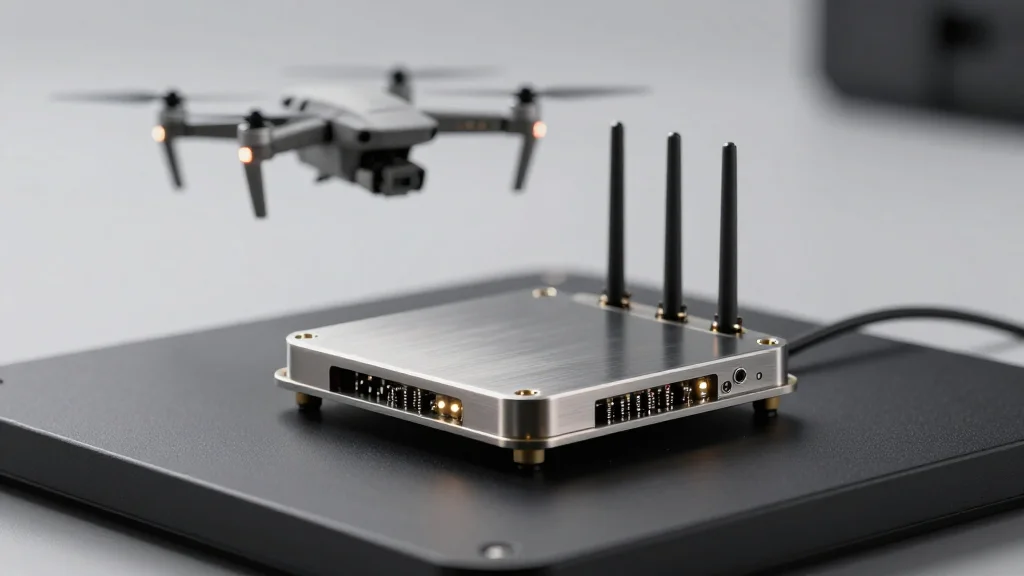
HYFIX Announces Availability of H1P Positioning, Navigation, and Open-Compute Module for Small Unmanned Systems
Companies Mentioned
Why It Matters
The H1P reduces parts count and reliance on foreign components, accelerating U.S. drone production and enhancing resilience against jamming and spoofing in contested environments.
Key Takeaways
- •H1P integrates positioning, navigation, and compute into 17×22 mm module
- •Supports dual‑antenna GNSS, LEO signals, and IMU sensor fusion
- •Replaces multiple discrete drone parts, improving supply‑chain security
- •Compatible with PX4 autopilot, offers onboard dual‑CPU compute resources
Pulse Analysis
The U.S. drone ecosystem is at a crossroads as policymakers push for greater supply‑chain resilience. Recent FCC Covered List rules and heightened concerns over foreign‑origin components have spurred manufacturers to seek domestically produced, trusted parts. HYFIX Spatial Intelligence, a home‑grown semiconductor firm, is answering that call with the H1P module, a single‑chip solution that consolidates the core functions traditionally spread across several boards. By delivering a U.S.-designed alternative to imported GNSS and flight‑control hardware, the H1P helps firms meet compliance requirements while reducing exposure to geopolitical risk.
The H1P packs a dual‑CPU architecture built around HYFIX’s H1 Autonomous Systems Chip into a 17 × 22 mm surface‑mount package. It offers dual‑antenna GNSS with more than 800 tracking channels, native support for low‑Earth‑orbit constellations such as Xona’s Pulsar, and an integrated inertial measurement unit for sensor‑fusion‑driven positioning. Coupled with trusted correction data from GEODNET, the module can deliver real‑time kinematic accuracy and robust anti‑spoofing protection, even in jammed or degraded environments. Its compatibility with the open‑source PX4 autopilot and NuttX OS gives developers a familiar software stack while retaining hardware flexibility.
For small‑unmanned‑system manufacturers, the H1P translates into fewer parts, shorter bill‑of‑materials, and faster time‑to‑flight. The reduction in board count not only cuts assembly cost but also simplifies certification and reliability testing, a critical advantage for high‑volume production lines. Early adopters at AUVSI XPONENTIAL 2026 are already evaluating the module for commercial delivery drones, agricultural sprayers, and tactical UAVs. If the H1P gains traction, it could set a new baseline for domestically sourced, resilient drone technology, encouraging further reshoring of autonomous‑systems hardware across the United States.
HYFIX Announces Availability of H1P Positioning, Navigation, and Open-Compute Module for Small Unmanned Systems
Comments
Want to join the conversation?
Loading comments...