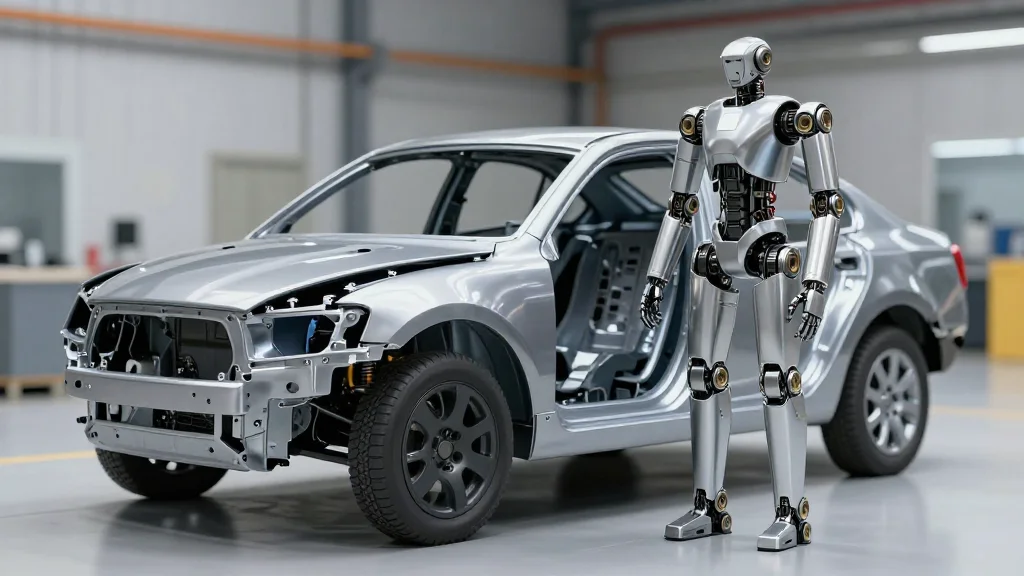
Hyundai Motor Group Ramps up Factory Robots, Igniting Labor‑management Clash

Companies Mentioned

Why It Matters
The deployment of humanoid robots in Hyundai’s assembly lines signals a watershed moment for automotive manufacturing, where AI‑driven automation moves beyond repetitive welding tasks to complex, dexterous operations. If successful, the technology could dramatically cut production costs and improve flexibility, giving Hyundai a competitive edge in a market increasingly defined by rapid model cycles and electrification. However, the labor backlash highlights a critical social dimension: the risk of widening inequality and eroding skilled jobs in a sector that has traditionally provided stable, well‑paid employment. The clash could set precedents for how labor policy adapts to the rise of physical AI across heavy‑industry supply chains. Moreover, Hyundai’s partnership with Boston Dynamics showcases the convergence of South Korean manufacturing expertise with cutting‑edge robotics, potentially reshaping global supply chains. The outcome will influence not only the automaker’s bottom line but also the broader debate on responsible automation, reskilling, and the future of work in advanced economies.
Key Takeaways
- •Hyundai to install Boston Dynamics humanoid robots at its Georgia plant starting in 2028
- •Labor unions warn the rollout could displace thousands of assembly workers worldwide
- •South Korean government funded a $33 million project to capture master technicians’ skills for AI robots
- •Billy Choi, Korea University professor, highlighted the focus on humanoids for manufacturing
- •Hyundai pledges dialogue and reskilling, but specifics remain undisclosed
Pulse Analysis
Hyundai’s decision to embed Boston Dynamics humanoids into its production lines reflects a strategic bet that physical AI will become a core differentiator in automotive manufacturing. The move aligns with South Korea’s broader ambition to leverage its semiconductor and manufacturing strengths to dominate the next wave of AI‑enabled robotics. Historically, the auto sector has been a bellwether for industrial automation, from the introduction of robotic arms in the 1980s to today’s collaborative cobots. By moving to humanoid platforms, Hyundai aims to tackle tasks that require fine motor skills and adaptability—areas where traditional industrial robots fall short. This could shorten model‑to‑market cycles for electric and autonomous vehicles, a crucial advantage as competition intensifies.
However, the labor response underscores a persistent tension: productivity gains versus employment security. The Samsung union’s threatened strike earlier this year illustrates how profit‑driven automation can quickly become a flashpoint when workers feel excluded from the upside. Hyundai’s lack of concrete reskilling commitments may fuel further unrest, especially in regions where unions hold significant sway. Companies that navigate this transition successfully will likely pair robot deployment with robust upskilling pathways, ensuring that displaced workers can transition into higher‑value roles such as robot supervision, data annotation, or maintenance.
In the longer term, Hyundai’s rollout could accelerate the diffusion of humanoid robotics across other high‑mix, low‑volume manufacturing sectors, prompting a cascade effect throughout the supply chain. If the Georgia plant demonstrates measurable efficiency gains without severe labor fallout, it may become a template for other OEMs. Conversely, a protracted labor dispute could deter peers and invite regulatory scrutiny, potentially slowing the broader adoption of physical AI in the industry. The coming years will reveal whether Hyundai can balance technological ambition with social responsibility, setting the tone for the next era of manufacturing.
Hyundai Motor Group ramps up factory robots, igniting labor‑management clash
Comments
Want to join the conversation?
Loading comments...