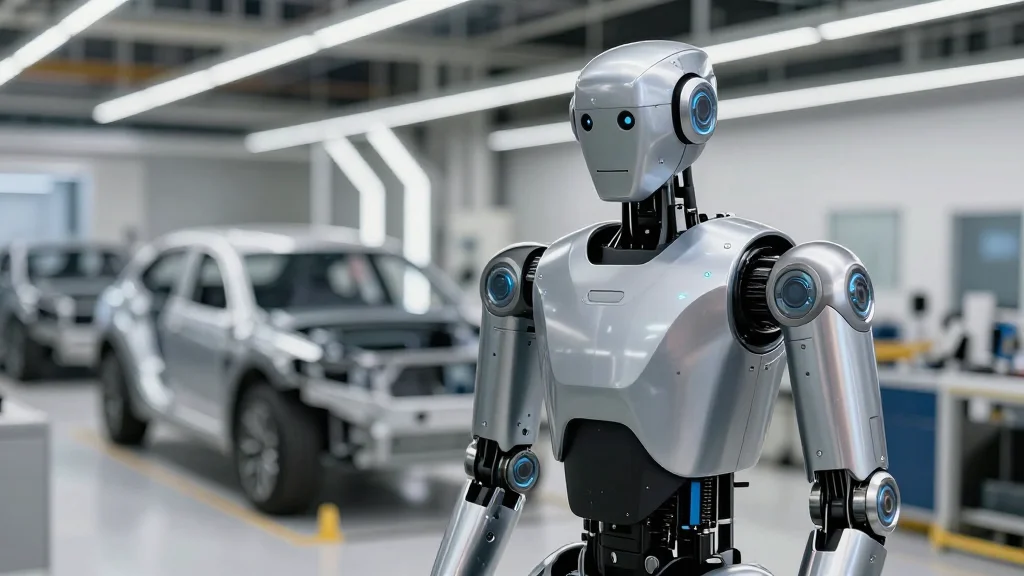
Hyundai Presses Boston Dynamics for Tens of Thousands of Atlas Robots by 2029

Companies Mentioned

Why It Matters
The push for mass‑produced humanoid robots marks a potential inflection point for industrial automation. If Hyundai can successfully integrate thousands of Atlas units into its factories, it could validate a new model of flexible, mobile automation that complements traditional fixed‑base robots, lowering change‑over times and enabling more complex assembly tasks. The move also signals that legacy automakers are willing to invest heavily—potentially $15‑$20 billion in robotics infrastructure—to stay competitive against tech‑driven entrants like Tesla. Beyond the factory floor, the pressure on Boston Dynamics highlights the growing tension between rapid commercialization and the deep R&D cycles required for safe, reliable humanoids. The outcome will influence how venture capital and corporate investors allocate capital across the robotics ecosystem, shaping the pace of innovation for the next decade.
Key Takeaways
- •Hyundai demands "tens of thousands" of Atlas robots, targeting 30,000 units per year.
- •Boston Dynamics currently produces four Atlas units per month while scaling up.
- •Kia plans to deploy Atlas at Metaplant America in 2028 and Kia AutoLand Georgia in 2029.
- •Leadership turnover at Boston Dynamics includes CEO retirement and CTO/CFO exits.
- •Hyundai’s robotics budget is part of a KRW 21 trillion ($15.8 billion) allocation for future tech.
Pulse Analysis
Hyundai’s aggressive Atlas order reflects a broader strategic gamble: replace static automation with mobile, human‑like workers capable of handling a wider variety of tasks. Historically, the automotive sector has relied on fixed‑point robots for welding and painting; introducing humanoids could reduce line reconfiguration costs and improve adaptability to model‑specific variations. However, the economics are still unproven—mass‑producing a complex robot like Atlas may drive unit costs down, but the initial capital outlay and integration challenges could be substantial.
The leadership churn at Boston Dynamics underscores a classic dilemma for deep‑tech firms transitioning to volume manufacturing: the need for disciplined execution often clashes with a culture of exploratory research. Hyundai’s pressure may force Boston Dynamics to prioritize engineering for manufacturability over experimental capabilities, potentially accelerating the commercialization timeline but also risking product robustness. Competitors such as Tesla, which is developing its own humanoid platform, will be watching closely; a successful Hyundai deployment could set a benchmark that forces rivals to accelerate their own programs.
Looking ahead, the success of Hyundai’s robot rollout will hinge on three factors: the ability to achieve the promised 30,000‑unit annual capacity without compromising quality, the integration of Atlas into existing production workflows, and the economic case—whether the productivity gains offset the high upfront costs. If these hurdles are cleared, the automotive industry could witness a paradigm shift, prompting other manufacturers to explore similar large‑scale humanoid deployments, thereby expanding the market for advanced robotics beyond niche applications.
Hyundai Presses Boston Dynamics for Tens of Thousands of Atlas Robots by 2029
Comments
Want to join the conversation?
Loading comments...