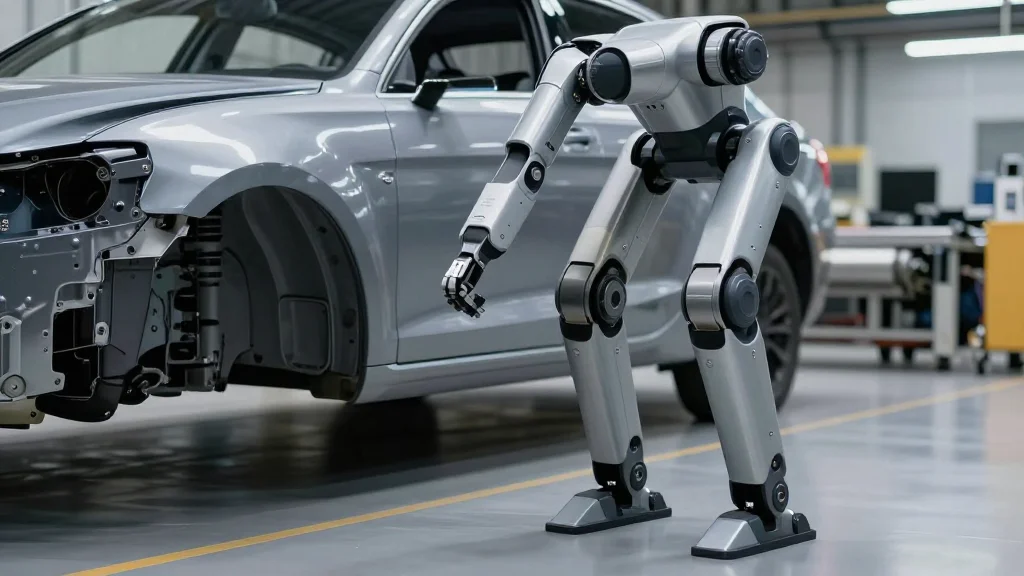
Hyundai to Deploy 25,000 Boston Dynamics Atlas Humanoids in U.S. Auto Plants

Companies Mentioned

Why It Matters
The introduction of tens of thousands of Atlas humanoids could redefine labor dynamics in U.S. auto manufacturing, offering a template for other sectors that rely on human‑centric factory layouts. By demonstrating that a mobile, balance‑aware robot can safely share space with workers, Hyundai may accelerate broader adoption of humanoid platforms in logistics, warehousing, and even construction. Beyond operational efficiency, the move underscores a strategic pivot toward vertical integration of advanced robotics components. Controlling actuator production domestically not only secures supply but also creates a new manufacturing ecosystem that could attract startups and established firms alike, potentially positioning the United States as a hub for next‑generation industrial robotics.
Key Takeaways
- •Hyundai plans to field >25,000 Boston Dynamics Atlas robots in U.S. auto factories.
- •Annual Atlas production capacity targeted at 30,000 units by 2028.
- •First deployment at Hyundai Metaplant America in Georgia slated for 2028; Kia Georgia plant follows in 2029.
- •Hyundai will produce >300,000 actuator units per year in the United States to support Atlas builds.
- •Deployment aims to address labor shortages, improve safety, and reduce retooling costs.
Pulse Analysis
Hyundai’s aggressive Atlas rollout reflects a convergence of two trends: the maturation of humanoid robotics and the automotive industry’s need for flexible, labor‑light production. Historically, automakers have relied on fixed‑base robotic arms that excel at repetitive welding or painting but struggle with tasks that require dexterity and navigation through human‑designed spaces. Atlas, with its proprioceptive balance system and reinforcement‑learning‑derived skill set, bridges that gap, allowing manufacturers to retrofit existing lines rather than rebuild them from the ground up.
From a competitive standpoint, Hyundai is positioning itself ahead of rivals such as Toyota and Volkswagen, which have announced pilot programs for collaborative robots but have not yet committed to large‑scale humanoid deployments. By securing a domestic actuator supply chain, Hyundai also mitigates geopolitical risks that have plagued other manufacturers dependent on Asian component imports. This vertical integration could lower unit costs over time, making the economics of humanoid robots more palatable for mass production.
Looking forward, the success of the Atlas program will hinge on three variables: safety validation, workforce acceptance, and measurable productivity gains. If Hyundai can demonstrate that Atlas units reduce injury rates and improve throughput without displacing large numbers of workers, the model could become a template for other labor‑intensive industries. Conversely, any high‑profile safety incident or cost overrun could stall broader adoption and reinforce skepticism about humanoid robots in shared workspaces. The next earnings season will be a critical barometer for investors watching the intersection of robotics and automotive manufacturing.
Hyundai to Deploy 25,000 Boston Dynamics Atlas Humanoids in U.S. Auto Plants
Comments
Want to join the conversation?
Loading comments...