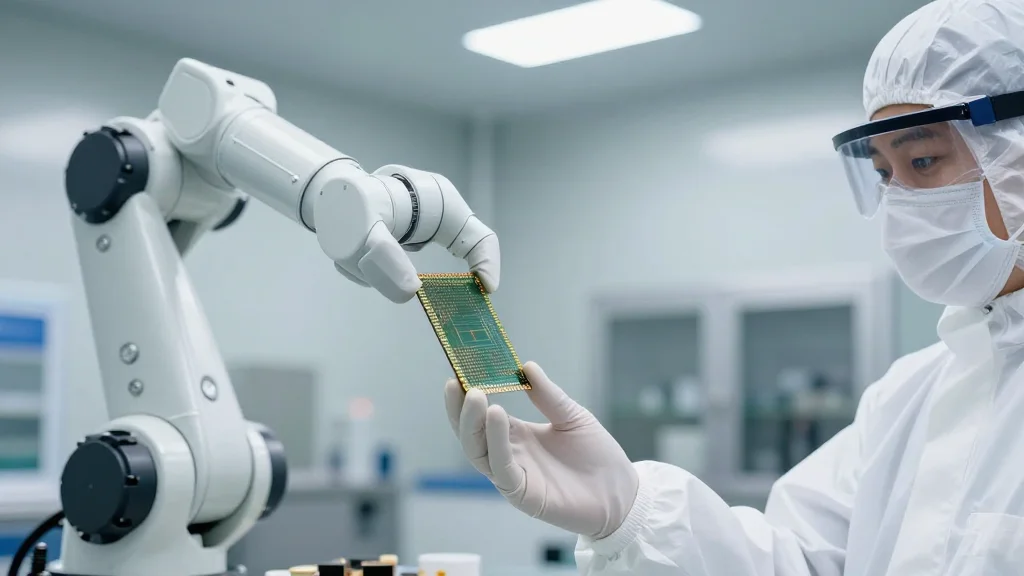
Intel Showcases Robot‑run AI Chip Fab, Stresses Strict Human Safety Protocols

Companies Mentioned
Why It Matters
The tour highlights how robotics is reshaping semiconductor manufacturing, a sector that underpins every AI application from autonomous vehicles to cloud services. By automating contamination‑prone steps, Intel reduces defect rates, lowers costs and accelerates time‑to‑market for AI chips, directly influencing the speed of AI innovation worldwide. Moreover, the rigorous human‑safety protocols set a new benchmark for worker protection in ultra‑clean environments, a concern that gains urgency as fabs become more densely packed with both robots and humans. The broader robotics community can draw lessons from Intel’s approach: integrating robots for precision tasks while establishing strict human‑machine interaction guidelines can unlock higher yields in other high‑value manufacturing domains, such as medical devices and aerospace. As AI workloads continue to dominate chip demand, the ability to safely scale robot‑driven production will be a decisive competitive advantage.
Key Takeaways
- •Intel's Hillsboro fab runs most steps with robots, limiting human exposure to contamination.
- •Cleanroom suits cost about $1,000 each; workers must forgo deodorant, lotion, and metal accessories.
- •Chris Auth warned that a single speck can ruin a multi‑dollar wafer.
- •Tyler Osborn explained the use of yellow lighting to prevent chip damage during fabrication.
- •Analysts project semiconductor sales to hit $1 trillion by 2027, driving rapid fab automation.
Pulse Analysis
Intel's robot‑centric fab is more than a showcase of cutting‑edge automation; it is a strategic response to a market that is expanding at an unprecedented pace. The $1 trillion sales forecast for semiconductors reflects not just consumer demand but the explosive growth of AI workloads that require specialized silicon. By investing heavily in robotics and cleanroom rigor, Intel is attempting to lock in higher yields and lower per‑chip costs, a necessity when margins are squeezed by the sheer volume of chips needed for data‑center AI training.
Historically, semiconductor fabs have relied on human technicians for the most delicate steps, a model that limited scalability and introduced variability. Intel's shift mirrors trends seen in automotive manufacturing, where collaborative robots have taken over repetitive, precision‑critical tasks while humans focus on quality control and exception handling. This hybrid model reduces the probability of human‑induced defects—a single hair can cost thousands of dollars—while preserving the flexibility to adapt processes as node sizes shrink.
Looking ahead, the success of Intel's approach will hinge on two factors: the ability to maintain ultra‑clean environments at scale, and the integration of AI‑driven monitoring systems that can predict and prevent contamination events before they occur. If Intel can demonstrate consistent high yields across its upcoming AI wafer lines, it will not only secure its position against rivals like Nvidia and AMD but also set a new industry standard for robot‑enabled, human‑safe semiconductor production. Competitors will likely accelerate their own automation roadmaps, sparking a wave of investment in cleanroom robotics that could redefine manufacturing across multiple high‑tech sectors.
Intel showcases robot‑run AI chip fab, stresses strict human safety protocols
Comments
Want to join the conversation?
Loading comments...