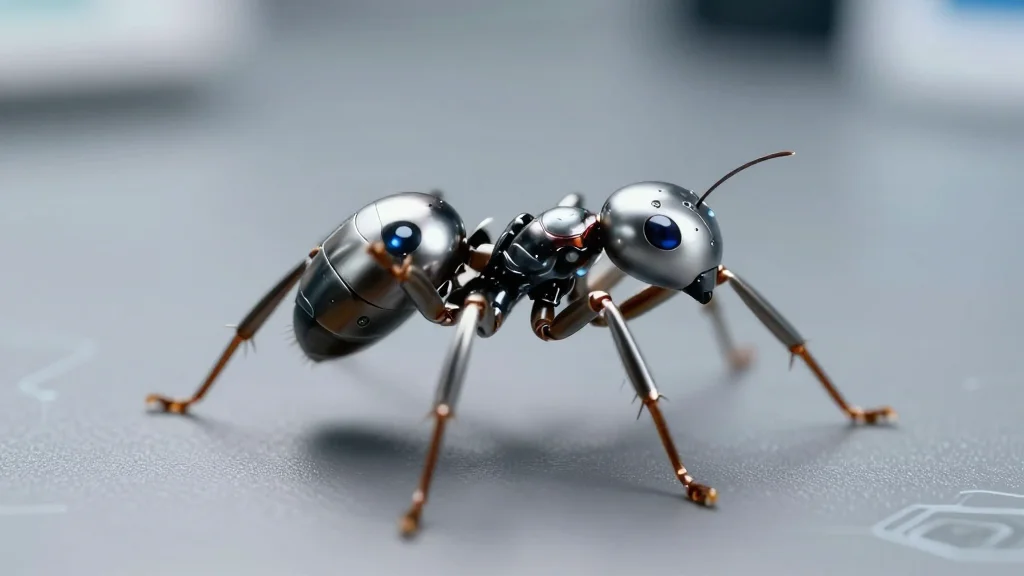
Just Call These Tiny Autonomous Construction Robots “Antdroids”
Why It Matters
The breakthrough shows that decentralized robot swarms can perform complex construction tasks, lowering the cost and risk of building infrastructure in hazardous or extraterrestrial sites. It paves the way for scalable, self‑organizing systems that could transform space‑habitat development and disaster‑response construction.
Key Takeaways
- •RAnts coordinate construction using only two adjustable parameters
- •Decentralized stigmergic signals enable self‑organized building without central control
- •Researchers demonstrated both assembly and demolition of structures in lab tests
- •Technology could support autonomous construction on Moon, Mars, and asteroids
- •Small swarm robots may evolve into mobile 3D‑printer rovers for space habitats
Pulse Analysis
The RAnts experiment underscores a shift from centrally programmed robots to swarms that rely on environmental cues for decision‑making. By embedding photormone markers—light‑based analogues of insect pheromones—the robots create a shared map that guides collective actions. This "exbodied intelligence" mirrors how ants lay trails, allowing the swarm to adapt instantly to changes in terrain or task demands. The simplicity of the underlying algorithm means the hardware can remain minimal, reducing cost and power consumption while still achieving sophisticated outcomes.
Beyond the laboratory, the implications for space exploration are profound. Autonomous construction is a critical bottleneck for lunar and Martian outposts, where transporting heavy equipment is prohibitively expensive. Swarm robots could lay foundations, erect communication towers, or even fabricate habitats using in‑situ resources, all before human crews arrive. The same principles apply to Earth‑bound scenarios such as disaster zones, underground mining, or deep‑sea installations, where human presence is risky and traditional machinery struggles to navigate confined spaces.
Industry players are already eyeing commercial pathways for these technologies. Companies developing mobile 3D‑printer rovers or large‑scale construction mechs can integrate stigmergic coordination to scale operations without complex central oversight. However, challenges remain in scaling swarm size, ensuring reliability in extreme environments, and establishing standards for inter‑robot communication. Continued interdisciplinary research—combining robotics, materials science, and AI—will be essential to translate RAnts’ laboratory success into robust, market‑ready solutions that redefine how we build in the most demanding settings.
Just call these tiny autonomous construction robots “antdroids”
Comments
Want to join the conversation?
Loading comments...