Robotics News and Headlines
  • All Technology
  • AI
  • Autonomy
  • B2B Growth
  • Big Data
  • BioTech
  • ClimateTech
  • Consumer Tech
  • Crypto
  • Cybersecurity
  • DevOps
  • Digital Marketing
  • Ecommerce
  • EdTech
  • Enterprise
  • FinTech
  • GovTech
  • Hardware
  • HealthTech
  • HRTech
  • LegalTech
  • Nanotech
  • PropTech
  • Quantum
  • Robotics
  • SaaS
  • SpaceTech
AllNewsDealsSocialBlogsVideosPodcastsDigests

Robotics Pulse

EMAIL DIGESTS

Daily

Every morning

Weekly

Sunday recap

NewsDealsSocialBlogsVideosPodcasts
RoboticsNewsKiwi Charge Takes EV-Charging Robot to Showroom Floor with $1.7-million Pilot Project
Kiwi Charge Takes EV-Charging Robot to Showroom Floor with $1.7-million Pilot Project
EntrepreneurshipRobotics

Kiwi Charge Takes EV-Charging Robot to Showroom Floor with $1.7-million Pilot Project

•February 9, 2026
0
BetaKit (Canada)
BetaKit (Canada)•Feb 9, 2026

Companies Mentioned

General Motors

General Motors

GM

Why It Matters

The solution could dramatically lower infrastructure costs for EV adoption in dense residential and retail settings, accelerating market penetration. It also showcases Canada’s growing role in autonomous mobility innovation.

Key Takeaways

  • •Pilot funded with $1.7M, $500K government grant
  • •Robot charges vehicle in 30 minutes, self‑charges 30 minutes
  • •Dealerships avoid dedicated EV infrastructure, use single charging zone
  • •Customer convenience drives EV adoption in multi‑unit housing
  • •Kiwi secured US lead investor, $1M seed round pending

Pulse Analysis

The Kiwi Charge robot addresses a core bottleneck in electric‑vehicle deployment: the high capital expense of installing multiple fixed chargers in apartments, condos, and dealership lots. By centralising power in a mobile battery that autonomously navigates to parked cars, property owners can offer "white‑glove" charging without rewiring parking structures or allocating scarce curb space. This model aligns with urban densification trends, where space is at a premium and tenants expect seamless, on‑demand services. Moreover, the technology dovetails with emerging smart‑city initiatives that integrate vehicle‑to‑infrastructure data, allowing the robot to schedule charging during off‑peak hours and optimise grid load.

Government backing through the Ontario Vehicle Innovation Network underscores the strategic importance of autonomous charging solutions for Canada’s climate goals. The $500,000 grant signals confidence that such innovations can reduce reliance on traditional grid expansions while supporting local manufacturing ecosystems. Partnerships with GM Canada and Pfaff Automotive provide real‑world validation, demonstrating that major OEMs see value in flexible, scalable charging alternatives for both retail showrooms and future dealership networks. As automakers roll out higher‑capacity batteries, the ability to deliver a full charge in half an hour without dedicated hardware could become a differentiator in customer experience.

Looking ahead, Kiwi’s upcoming seed round and its exposure at the Canadian International AutoShow position the company to attract further strategic investors and expand beyond pilot sites. If the robot proves reliable at scale, it could catalyse broader adoption of EVs in multi‑unit dwellings, where charging access remains a primary barrier. The model also opens pathways for subscription‑based charging services, turning a one‑time hardware purchase into recurring revenue. In a market where infrastructure lag threatens to slow EV growth, Kiwi’s autonomous charger offers a pragmatic, cost‑effective bridge toward a fully electrified transportation ecosystem.

Kiwi Charge takes EV-charging robot to showroom floor with $1.7-million pilot project

Sometimes you just need to get home and decompress after work. Sure, your car is low on fuel and needs to be topped up, but who cares? When you wake up the next morning, it will magically be full, and you can watch TV guilt-free, right?

“It’s white-glove service: you park your car, you go upstairs, you come back, and your car is fully charged.”

Abdel Ali, Kiwi Charge

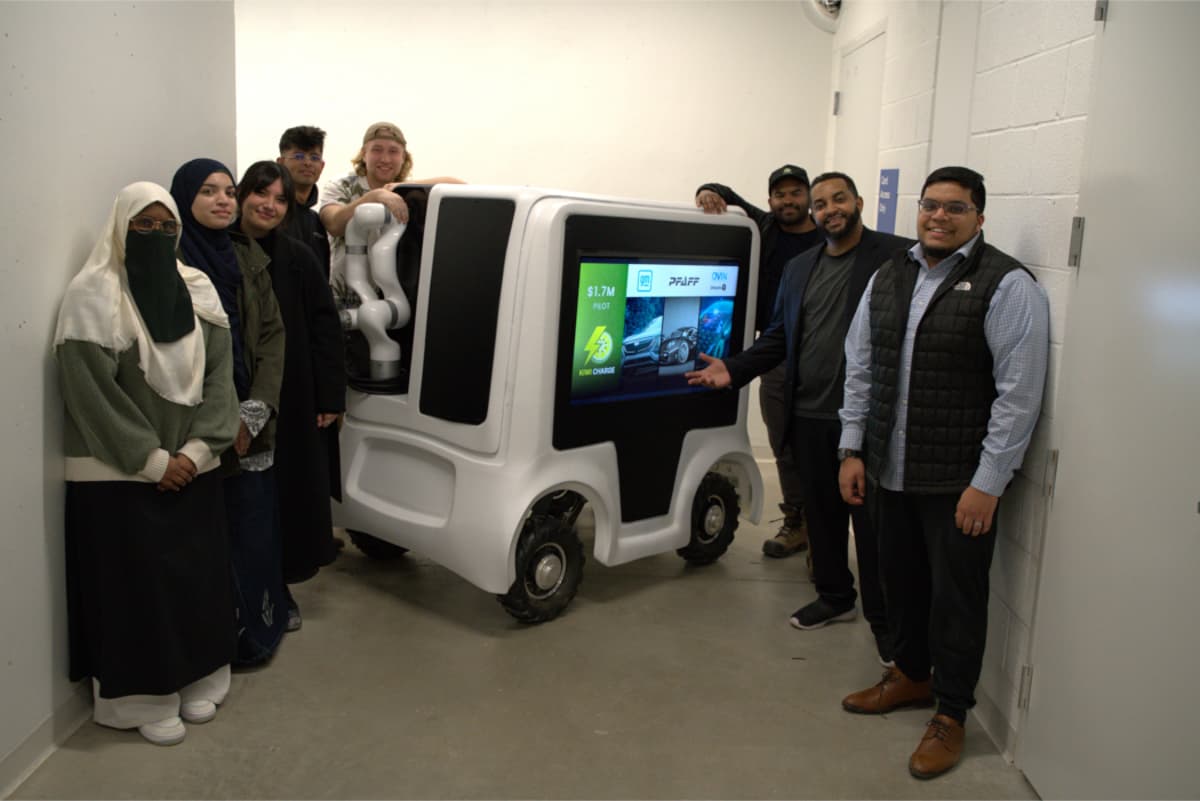
That’s the tiny utopia Toronto-based Kiwi Charge is trying to create with its electric vehicle (EV) charging robot— the “R2-D2 for EV charging.” According to Kiwi, the robot can help multi-unit housing complexes and car dealerships do away with the need to install dedicated charging infrastructure for vehicles. Instead of tenants competing for EV charging spots, a building could have a single charging zone for the Kiwi robot, which knows when a car needs a charge, what parking spot the car is in, and can roll up to fill it outside of active hours. 

The robot takes about 30 minutes to charge itself and 30 minutes to charge a vehicle, Kiwi Charge co-founder and CEO Abdel Ali told BetaKit in an interview on Friday.

“It’s white-glove service: you park your car, you go upstairs, you come back, and your car is fully charged,” Ali said. “It’s like magic.” 

This week, Kiwi is unveiling a $1.7-million pilot project with automotive manufacturer General Motors Canada and Pfaff Automotive, which owns 15 automotive dealerships across Canada. The project, which has been ongoing since the summer, is helping Kiwi rapidly prototype and test its flagship robot at Pfaff’s Porsche dealership in Vaughn, Ont., where it will charge vehicles all day and all night without the need for an attendant to rotate which cars are in the designated EV charging spot. 

RELATED: Ontario invests $56 million to power “homegrown” automotive and mobility companies amid trade war

The project is supported by a $500,000 grant from the provincial government’s Ontario Vehicle Innovation Network (OVIN), $250,000 of in-kind contributions from Pfaff and GM, and capital from Kiwi itself.

The autonomous charger is a big step up from Kiwi’s 2023 beginnings, when Ali and his co-founders, Aamir Abubakkar and Jumana Fathima, were manually providing the service to apartment complexes just to see if the concept had value. They would haul a giant mobile battery around, charging people’s cars in the dead of night, just to see if the demand was there. 

“From the customer perspective, they don’t really care if it’s a robot that charged their car, or someone came at night and charged their car,” Ali said. “They just want it at a good price, and they want that convenience.” 

It was successful enough that the team found people in the buildings they served became more likely to buy an EV. 

“Once you solve that big barrier, charging at home and access to charging, people started flocking and reaching out to us and asking us ‘what cars do you recommend?’” Ali said. 

Ali said that Kiwi has secured an undisclosed American lead investor for a $1-million seed round, which he expects to close sometime in March. For now, he’s excited to showcase Kiwi alongside Project Arrow, which will be on display at the Canadian International AutoShow this week. Arrow is an all-Canadian EV from the Automotive Parts Manufacturers’ Association (APMA). Prime Minister Mark Carney sat in the vehicle after announcing Canada’s reformed EV incentives last week.

APMA head Flavio Volpe has said that Project Arrow is supposed to show that Canada has the technology and the people to build an all-Canadian car. On the show floor, Kiwi will be charging it. 

“There’s gonna be a lot of press coverage around this, and here is this little startup,” Ali said. “The team at APMA took a chance with us … they saw the potential, they saw past the duct tape of the prototype, so we’re very grateful for the team.” 

“The exposure that they’re providing us is incredible,” he added. 

Feature image courtesy Kiwi Charge.

The post Kiwi Charge takes EV-charging robot to showroom floor with $1.7-million pilot project first appeared on BetaKit.

Read Original Article
0

Comments

Want to join the conversation?

Loading comments...