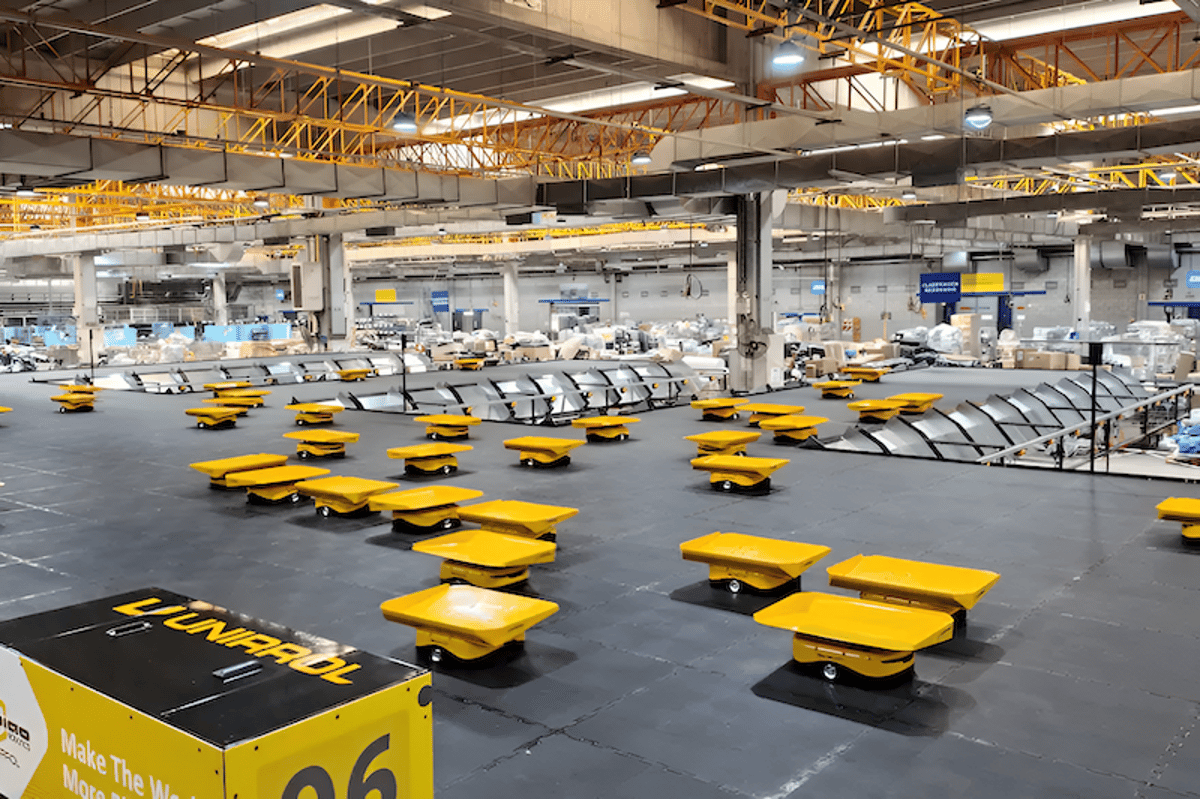
Libiao Robotics Installs 240 Robots at Parcel Hub in Argentina
•February 2, 2026
0
Companies Mentioned

Why It Matters
The deployment dramatically boosts sorting speed and accuracy, lowering operational costs while enabling Argentina’s postal network to keep pace with accelerating e‑commerce demand. It also showcases a scalable model that other Latin American logistics providers can replicate.
Key Takeaways
- •240 robots sort 9,000 parcels hourly, tripling capacity
- •First AI‑driven robotic sorter deployed in Latin America
- •Modular design enables rapid scaling without major infrastructure changes
- •Improves sorting accuracy, lowering mis‑sorts and rehandling costs
- •Supports Correo Argentino’s e‑commerce growth and future automation plans
Pulse Analysis
Latin America’s logistics landscape is undergoing a rapid digital transformation, driven by surging online retail volumes and rising consumer expectations for same‑day delivery. Traditional conveyor‑based sortation struggles with space constraints and inflexible layouts, prompting postal operators like Correo Argentino to seek more adaptable solutions. By introducing a dense fleet of 240 autonomous robots, Libiao Robotics delivers a compact, high‑throughput hub that can handle the diverse parcel mix typical of e‑commerce, positioning Argentina’s postal network alongside global best‑in‑class operations.
The core of the installation is Libiao’s T‑Sort Sorting System, which blends artificial intelligence, advanced vision sensors, and dynamic routing algorithms to achieve precise, high‑speed sortation. Unlike fixed‑conveyor lines, the modular robot platform can be reconfigured on‑the‑fly, adding new destination chutes or scaling robot counts without major civil works. This flexibility reduces capital expenditure and shortens deployment timelines, while the AI‑driven error detection cuts mis‑sort rates, translating into lower rehandling costs and higher customer satisfaction. The system’s ability to process 9,000 parcels per hour within a 1,180 m² footprint exemplifies how intelligent automation can maximize output in urban, space‑limited facilities.
Strategically, the project reinforces Correo Argentino’s broader modernization agenda, which includes upcoming larger‑parcel sorters, RFID tracking, and robotic container handling. By automating the bulk of small‑to‑medium parcel flows, the postal service can reallocate human labor to value‑added tasks, mitigating the impact of rising wage pressures. The successful rollout also serves as a proof point for other Latin American carriers facing similar e‑commerce growth challenges, potentially accelerating regional adoption of robotic sortation and reshaping the competitive dynamics of the parcel delivery market.
Libiao Robotics installs 240 robots at parcel hub in Argentina
0
Comments
Want to join the conversation?
Loading comments...