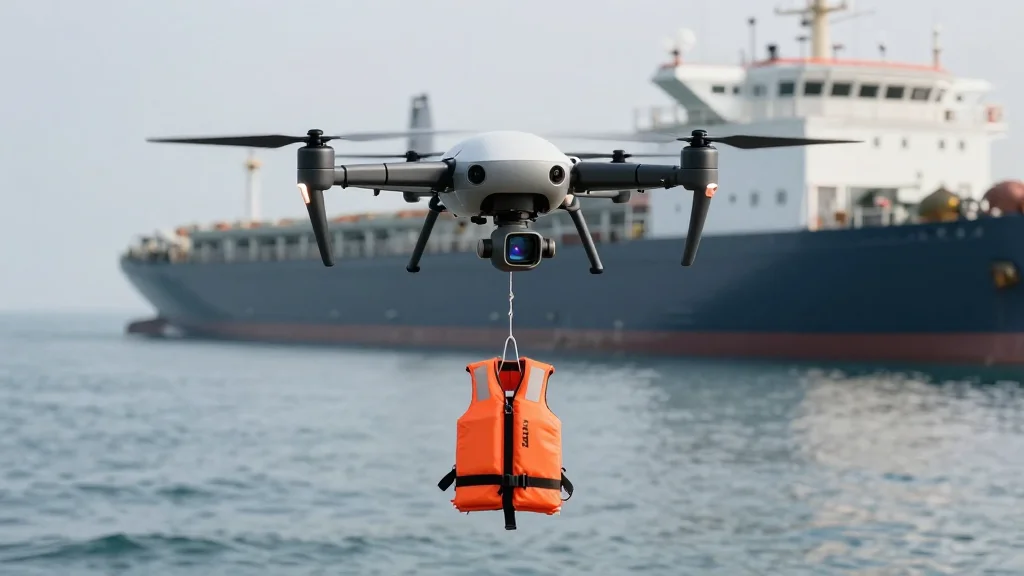
Life-Saving Autonomous Drone Could Find People Who Fall Off Ships
Why It Matters
By delivering flotation and precise GPS coordinates within minutes, the drone can increase survival odds and reduce rescue boat deployment time, addressing a high‑mortality problem in maritime safety.
Key Takeaways
- •DTU prototype weighs 24.8 kg, carries 20 kg payload, 30‑minute flight
- •Drone uses RGB, infrared, thermal cameras to detect persons in water
- •AI algorithms predict drift zone, improving search efficiency over traditional patterns
- •Tests show over 80% detection rate in sea trials
- •GPS‑enabled life jacket can extend survival to three hours in cold water
Pulse Analysis
Man‑overboard incidents remain one of the deadliest hazards at sea, with more than 70% of victims between 2009 and 2019 succumbing to exposure, hypothermia, or drifting out of sight. Traditional rescues rely on a ship stopping, deploying a boat, and sweeping the area in a triangular pattern—a process that can take several minutes, time that a distressed person rarely has. The urgency of rapid flotation and precise location data has driven researchers to explore aerial solutions that can bridge this critical gap.
The DTU drone tackles the problem from three angles: speed, perception, and intelligence. Weighing 24.8 kg and capable of carrying a 20 kg payload, it can launch from a moving vessel, fly for roughly 30 minutes, and scan up to one square kilometre. Its sensor suite—combining RGB, infrared, and thermal imaging—lets it spot a human silhouette even in low‑light or rough sea conditions. Behind the lenses, machine‑learning algorithms ingest real‑time wind, current, and elapsed‑time data to predict the most probable drift zone, directing the drone along an optimized search path rather than a blind sweep. In sea‑trial simulations over the Kattegat strait, the system located more than 80% of mannequin targets, a performance level far above conventional boat searches.
If adopted widely, the technology could reshape maritime safety protocols. Cruise lines and commercial vessels could carry the drone as a mandatory first‑responder, while coast guards might deploy it for rapid flotation in offshore emergencies. Regulatory approval will be a hurdle, but the prototype’s demonstrated efficacy and the clear cost‑benefit of preventing loss of life make a compelling case. As the industry moves toward autonomous safety solutions, DTU’s drone may become the new standard for man‑overboard rescue, turning minutes‑long response windows into survivable opportunities.
Life-saving autonomous drone could find people who fall off ships
Comments
Want to join the conversation?
Loading comments...