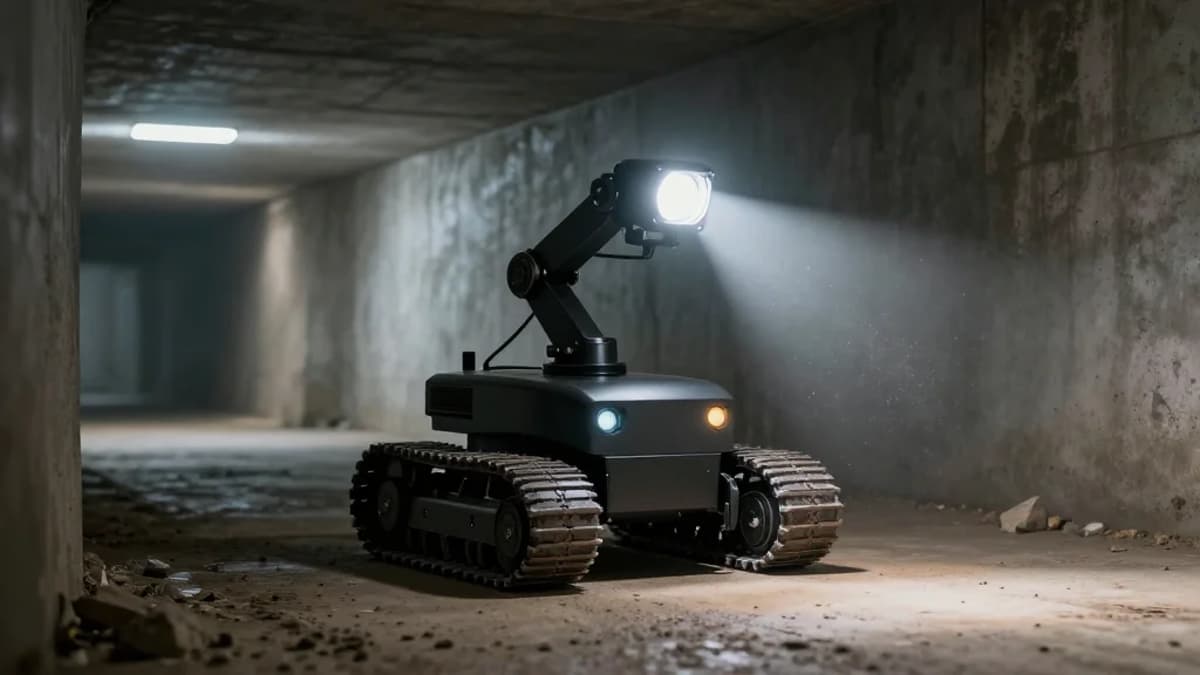
Machine Learning Helps Robots See Clearly in Total Darkness Using Infrared
•December 23, 2025
0
Why It Matters
The breakthrough lowers hardware and software costs for autonomous systems, expanding their utility in high‑risk, low‑light scenarios. It also accelerates time‑to‑market for robots needed in emergency response and exploration.
Key Takeaways
- •Infrared cameras paired with AI reconstruct visible-light images.
- •Robots retain existing vision algorithms unchanged.
- •Deployment costs drop, speeding field operations.
- •Method adaptable to sonar and thermal sensors.
- •Enables autonomous missions in disaster zones.
Pulse Analysis
Robots operating in environments lacking visible light have long faced a fundamental limitation: conventional cameras produce unusable data in darkness. By leveraging infrared sensors that capture thermal signatures and applying deep learning models trained to translate these signatures into photorealistic images, the Manchester team bridges this gap. The AI‑driven reconstruction restores texture, contrast, and color cues, effectively granting machines a “night‑vision” capability that mirrors human perception, while preserving the rich detail needed for downstream computer‑vision tasks.
The practical advantage of this approach lies in its compatibility with existing vision pipelines. Because the output mimics standard RGB imagery, developers can reuse mature object‑detection, mapping, and navigation algorithms without extensive re‑engineering. This reduces both the computational overhead—since the inference step is lightweight compared to building bespoke low‑light models—and the overall development budget. Faster integration translates to quicker field deployments, a critical factor for time‑sensitive operations such as search‑and‑rescue or infrastructure inspection after natural disasters.
Looking ahead, the underlying framework is sensor‑agnostic, opening pathways to fuse data from sonar, lidar, or thermal cameras. Such multimodal extensions could empower autonomous platforms to navigate not only darkness but also smoke, dust, or underwater environments. As industries—from mining to defense—seek resilient robotic solutions, the CLEAR‑IR technology positions itself as a catalyst for broader adoption, promising safer, more cost‑effective autonomous operations across a spectrum of extreme conditions.
Machine learning helps robots see clearly in total darkness using infrared
0
Comments
Want to join the conversation?
Loading comments...