
Why It Matters
The deployment of humanoid robots in a high‑traffic consumer setting demonstrates that service‑oriented robotics is moving from pilot labs into everyday commerce. Success could accelerate investment in similar systems for hotels, airports, and retail, expanding the addressable market for firms like Keenon Robotics. Conversely, visible automation in a globally recognized brand spotlights the social and policy challenges of replacing human workers with machines, especially in economies where service jobs are a major source of employment. For the robotics industry, the McDonald’s trial provides a real‑world benchmark for reliability, human‑robot interaction, and scalability. Positive consumer response could validate business models that monetize robot leasing or software platforms, while backlash could prompt stricter labor regulations or demand for hybrid staffing models that blend human and robotic workers.
Key Takeaways
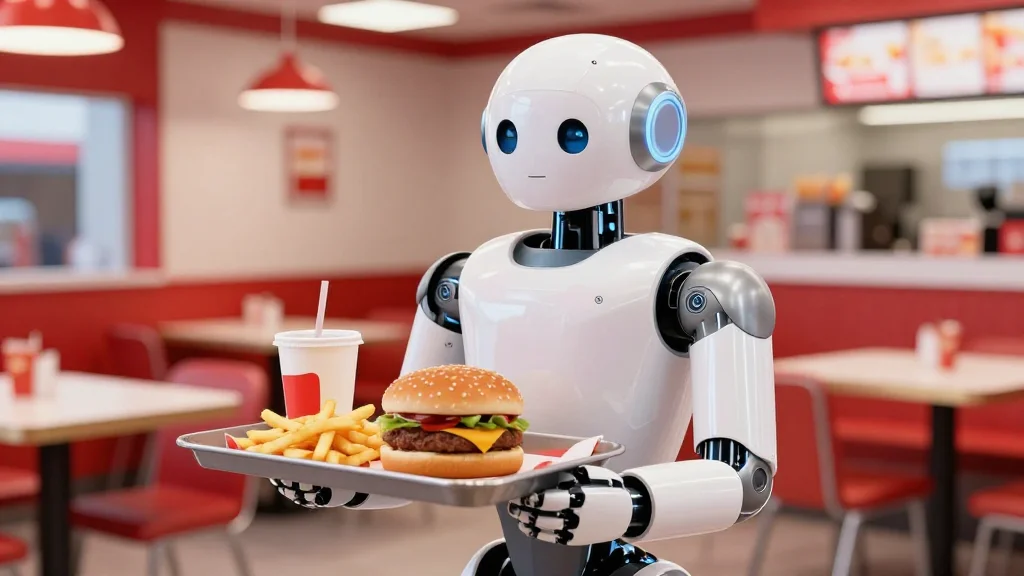
- •McDonald’s launched a humanoid robot pilot at a Shanghai Pudong restaurant
- •Robots supplied by Chinese firm Keenon Robotics
- •CEO Chris Kempczinski highlighted China’s growth importance in a China Daily interview
- •Amazon operates over 1 million warehouse robots, with 75% of orders assisted by robots
- •The trial has sparked employee concerns about job security and broader labor‑market implications
Pulse Analysis
McDonald’s entry into humanoid service robotics is less a novelty than a strategic test of cost structures in a market where labor costs are rising and consumer expectations for speed are intensifying. By automating greeting and order‑delivery tasks, the chain can potentially reduce labor hours per transaction, a metric that directly influences same‑store profitability. However, the real value proposition hinges on the robots’ uptime, maintenance costs, and the ability to integrate with existing point‑of‑sale systems—factors that have historically slowed adoption in fast‑food environments.
The pilot also serves as a litmus test for brand perception. McDonald’s has cultivated a family‑friendly image; introducing playful, animal‑styled robots may reinforce that narrative, but any perception of replacing human staff could erode goodwill, especially in a market where service jobs are a social safety net. Competitors watching the rollout will weigh the trade‑off between operational efficiency and potential consumer backlash, likely prompting a wave of limited‑scope trials rather than immediate large‑scale rollouts.
Looking ahead, the outcome of the Shanghai experiment could shape the next wave of consumer‑facing robotics. If McDonald’s reports measurable gains—shorter queue times, higher order accuracy, or lower labor spend—it may accelerate partnerships between restaurant chains and robotics firms, spurring a market for modular, plug‑and‑play service bots. Conversely, if employee unrest or technical glitches dominate headlines, the industry may pivot toward hybrid models that keep humans in high‑touch roles while delegating only repetitive tasks to machines. Either scenario will inform investors and policymakers about the realistic pace of automation in the service sector.
McDonald’s Tests Humanoid Robots in Shanghai Restaurants
Comments
Want to join the conversation?
Loading comments...