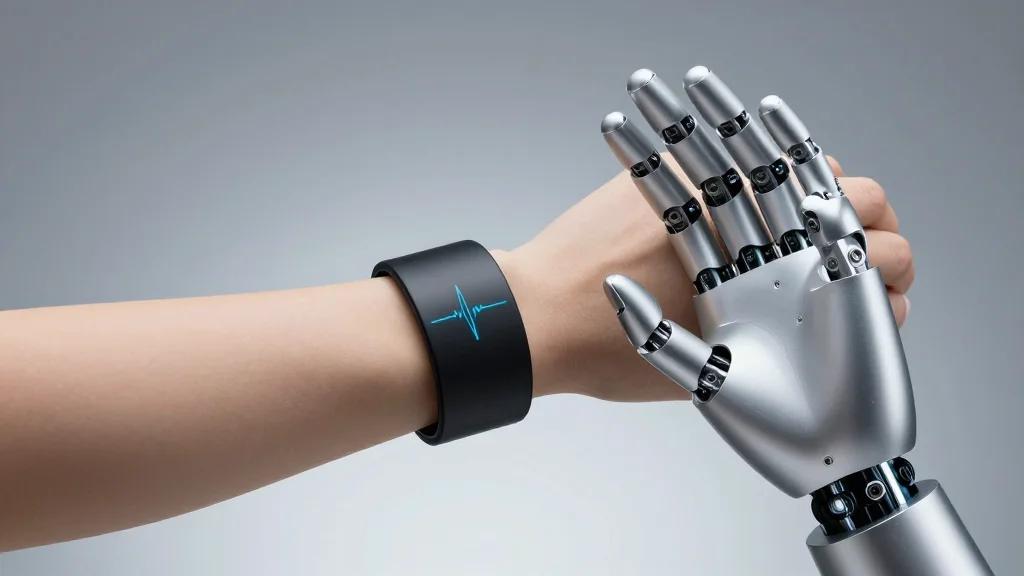
MIT Researchers Channel AI to Turn Hand Gestures Into Robot Training Data
Why It Matters
The technology bridges the gap between human dexterity and robotic manipulation, accelerating the deployment of robots in homes, healthcare and manufacturing. By generating large, precise motion datasets, it reduces the reliance on costly manual programming and speeds up AI‑driven robot learning.
Key Takeaways
- •Ultrasound wristband captures muscle motion for robot training.
- •AI decodes 22 hand degrees of freedom in 120 ms.
- •System mimics ASL letters, enabling remote dexterous control.
- •Dataset potential accelerates humanoid robots for household and surgical tasks.
Pulse Analysis
Robotic hands have long struggled to match the nuanced motions of a human grip, limiting their usefulness in everyday chores and delicate procedures. MIT's new ultrasound wristband tackles this bottleneck by providing a non‑invasive window into the hand’s internal biomechanics. By emitting high‑frequency sound waves, the device visualizes muscle and tendon dynamics, producing data streams that traditional optical trackers cannot capture. This richer sensory input feeds machine‑learning models, granting robots a more faithful representation of human intent.
The core of the system is an AI algorithm trained to translate ultrasound imagery into the hand’s 22 degrees of freedom—each joint’s possible rotations and bends. In controlled experiments, the algorithm reproduced the full alphabet of American Sign Language within 120 milliseconds, a speed comparable to natural human response times. Wireless connectivity means the wearer and the robotic hand can be in separate rooms, opening possibilities for remote tele‑operation in hazardous environments or assistive care settings. The precision and latency achieved mark a significant leap over earlier motion‑capture solutions that could only track a fraction of these movements.
Beyond immediate demonstrations, the wristband promises to generate massive, high‑fidelity datasets of human hand motion. Such repositories could serve as the training ground for next‑generation humanoid robots, enabling them to learn complex tasks—like folding laundry, assembling delicate components, or performing minimally invasive surgery—through imitation rather than explicit programming. As AI continues to ingest real‑world sensory data, the line between human and robotic dexterity narrows, heralding a new era of collaborative automation across households, clinics, and factories.
MIT researchers channel AI to turn hand gestures into robot training data
Comments
Want to join the conversation?
Loading comments...