Motion Tracking System Shows Robots the Path Most Traveled by, Keeping Them on Task
Why It Matters
CALM’s ability to adapt on‑the‑fly reduces downtime and reprogramming costs, accelerating robot integration in dynamic settings such as warehouses and homes. Its data‑efficient learning lowers the barrier for small‑business automation and personalized robotics.
Key Takeaways
- •CALM learns from as few as six human demonstrations
- •It averages motion clusters into a flexible mean trajectory
- •Robots maintain a belief of task progress, not just position
- •Outperforms time‑dependent and time‑independent baselines in obstacle tests
- •Future work aims to handle 3D rotations and verbal cues
Pulse Analysis
Robotic automation has long wrestled with the trade‑off between precision and flexibility. Traditional controllers either lock robots to rigid time‑based schedules or rely on static spatial waypoints, both of which crumble when unexpected obstacles appear. These limitations have slowed adoption in environments where human interaction is frequent, such as collaborative factories or domestic assistants. Researchers have therefore pursued learning‑from‑demonstration techniques that can generalize from limited data while preserving safety and reliability.
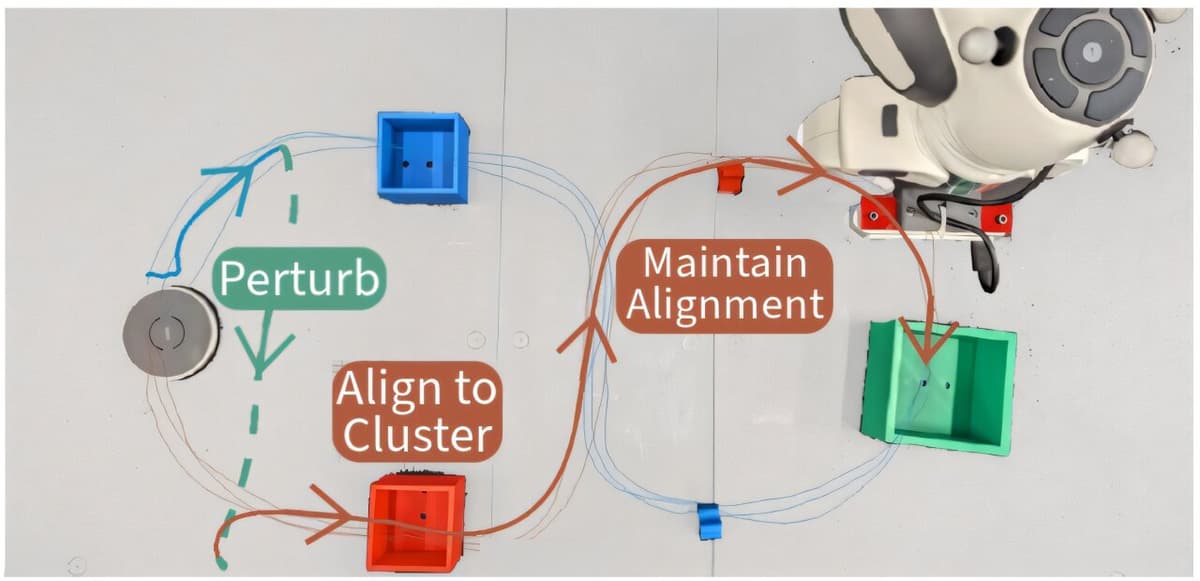
CALM addresses this gap by clustering multiple kinesthetic demonstrations into a single, probabilistic trajectory. The system computes a belief state that indicates where along the learned path the robot currently resides, allowing it to re‑enter the task after a deviation. In laboratory trials, a robotic arm taught to wipe LEGO bricks with six demonstrations continued operating smoothly even when a human nudged it, whereas conventional baselines faltered. Similar robustness was observed in writing letters and painting shapes, demonstrating CALM’s versatility across disparate motion patterns.
The broader impact of CALM extends to any sector seeking agile, low‑cost robot integration. By requiring only a handful of demonstrations, manufacturers can program new tasks without extensive data collection or specialist programmers, shortening deployment cycles. Moreover, the algorithm’s roadmap—incorporating 3D rotational dynamics, vision‑based cueing, and verbal instructions—promises robots that can adapt to complex, unstructured environments. As the technology matures, it could accelerate the shift from isolated industrial cells to collaborative, human‑centric automation across logistics, healthcare, and home services.
Motion tracking system shows robots the path most traveled by, keeping them on task
Comments
Want to join the conversation?
Loading comments...