Robotics News and Headlines
  • All Technology
  • AI
  • Autonomy
  • B2B Growth
  • Big Data
  • BioTech
  • ClimateTech
  • Consumer Tech
  • Crypto
  • Cybersecurity
  • DevOps
  • Digital Marketing
  • Ecommerce
  • EdTech
  • Enterprise
  • FinTech
  • GovTech
  • Hardware
  • HealthTech
  • HRTech
  • LegalTech
  • Nanotech
  • PropTech
  • Quantum
  • Robotics
  • SaaS
  • SpaceTech
AllNewsDealsSocialBlogsVideosPodcastsDigests

Robotics Pulse

EMAIL DIGESTS

Daily

Every morning

Weekly

Sunday recap

NewsDealsSocialBlogsVideosPodcasts
RoboticsNewsNissan Silent & Measured Path Toward Autonomous Public Transportation in Japan
Nissan Silent & Measured Path Toward Autonomous Public Transportation in Japan
EnergyAIRobotics

Nissan Silent & Measured Path Toward Autonomous Public Transportation in Japan

•February 10, 2026
0
CleanTechnica
CleanTechnica•Feb 10, 2026

Companies Mentioned

Nissan Canada

Nissan Canada

Waymo

Waymo

Tesla

Tesla

Why It Matters

By treating autonomy as a transport‑as‑a‑service model, Nissan positions itself to capture early market share in regulated public mobility, influencing Japan’s rollout timeline and setting a template for global expansion.

Key Takeaways

  • •Nissan targets autonomous mobility services, not vehicle sales
  • •First driverless public road test in Japan using Serena
  • •Multi‑month pilot operated five vehicles on fixed routes
  • •Small‑scale Kobe trial explored tourism‑focused on‑demand service
  • •Remote monitoring center PLOT48 ensures safety oversight

Pulse Analysis

Japan’s autonomous mobility landscape is moving beyond proof‑of‑concepts, and Nissan’s methodical approach is reshaping expectations. Rather than marketing a robotaxi spectacle, the company has treated autonomy as a service design problem since 2017, integrating passenger behavior studies, municipal coordination, and cross‑regional trials. This service‑first mindset aligns with Japan’s cautious regulatory environment, where public trust and safety oversight are prerequisites for deployment. By embedding remote monitoring through its PLOT48 hub, Nissan creates a scalable safety net that can be replicated across cities.

The technical progression from a Level‑2 Leaf prototype to a driverless Serena platform demonstrates Nissan’s layered strategy. The Serena’s expanded sensor suite and AI‑driven perception enable complex urban navigation, while redundancy and emergency‑stop mechanisms satisfy stringent safety standards. Pilot programs in Yokohama and Kobe serve distinct purposes: the former validates high‑frequency, fixed‑route operations with hundreds of riders, and the latter explores niche tourism demand with a low‑capacity loop. These pilots generate granular data on traffic interaction, passenger onboarding, and operational costs, informing a roadmap that targets commercial launch in 2027 and broader rollout by 2030.

For the broader industry, Nissan’s incremental rollout offers a blueprint for balancing innovation with regulatory compliance. Its focus on public‑sector partnerships and measurable service outcomes could accelerate policy frameworks, encouraging other OEMs to adopt similar service‑oriented models rather than pure vehicle sales. As cities worldwide grapple with congestion and aging populations, Nissan’s emerging autonomous transit network may become a template for integrating driverless technology into existing public‑transport ecosystems, potentially reshaping mobility economics on a global scale.

Nissan Silent & Measured Path Toward Autonomous Public Transportation in Japan

Will Nissan Quietly Lead the Path to Autonomous Public Transport in Japan?

The question surrounding autonomous mobility in Japan is no longer whether the technology works, but which companies are structuring it in a way that cities, regulators, and passengers can realistically adopt.

On that front, Nissan has emerged as one of the most methodical—and least noisy—players.

Since 2017, Nissan has treated autonomy as a transport service problem, not a product feature. Early work in Yokohama’s Minato Mirai district and the ongoing Namie Smart Mobility program in Fukushima focused on service design, passenger behavior, and municipal coordination. Parallel trials in the UK and research work in Silicon Valley broadened exposure to different traffic, legal, and operational environments. By the time Nissan formally published its commercialization roadmap in February 2024, the plan was already grounded in operational experience rather than speculative timelines.

That roadmap made two things clear. First, Nissan intends to launch autonomous mobility services—not sell autonomous cars—starting in fiscal year 2027. Second, autonomy would be introduced incrementally, with capability increases tied to public acceptance and regulatory readiness rather than technical bravado.

The transition from planning to proof began in mid‑2024. A LEAF‑based prototype equipped with an expanded sensor suite was demonstrated on Yokohama’s public roads under Level 2 conditions. The test focus was pragmatic: interaction with pedestrians, judgment at intersections, and smooth merging in live traffic. These demonstrations validated system behavior in dense urban settings rather than edge‑case theatrics.

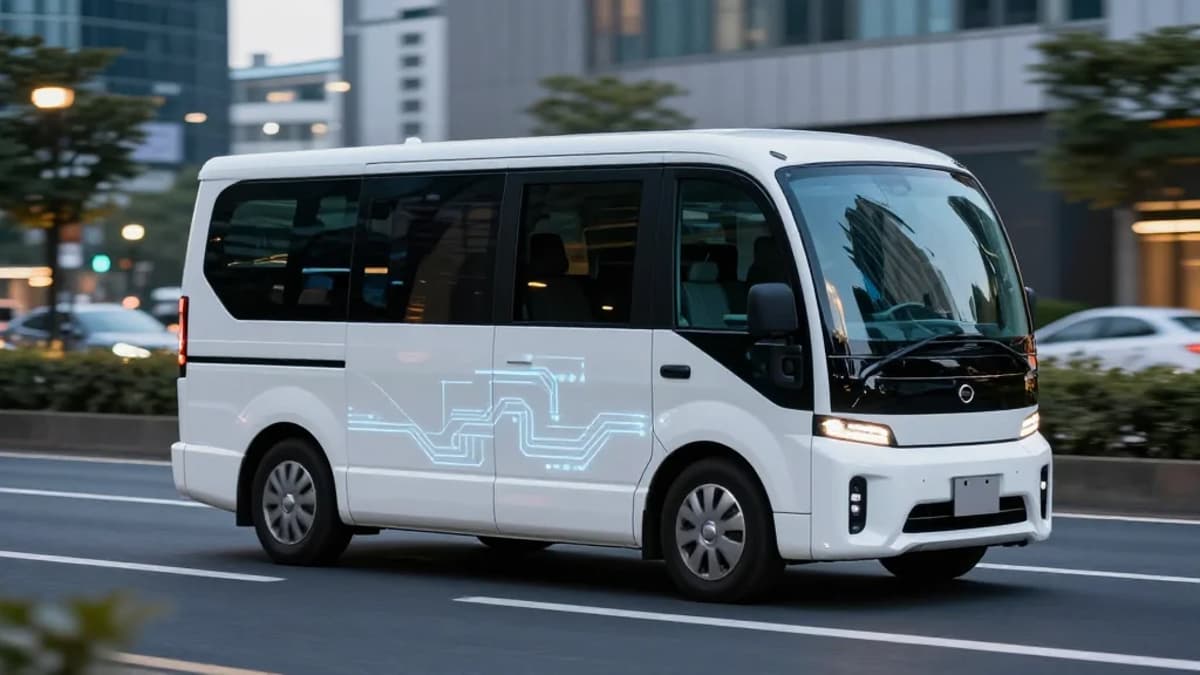
In March 2025, Nissan crossed a more consequential threshold. A Serena‑based vehicle navigated complex public roads in Minatomirai with no driver onboard—the first such test in Japan. The Serena platform enabled higher sensor placement and wider detection fields, while AI‑driven perception and prediction systems handled real‑world complexity. Redundancy, remote oversight concepts, and emergency‑stop mechanisms were engineered into the system from the outset. This was not framed as a robotaxi reveal, but as a safety and architecture validation exercise.

The practical implications became visible later that year. In Yokohama, Nissan and partners BOLDLY, Premier Aid, and Keikyu launched a multi‑month autonomous mobility service pilot from November 2025 to January 2026. Five Serena‑based vehicles operated on fixed routes across Minatomirai, Sakuragi‑cho, Kannai, and Chinatown, supported by a dedicated remote monitoring center, PLOT48. This was not a demo loop; it was a transit‑style operation with defined hours, boarding points, passenger limits, and structured public feedback from roughly 300 trial participants.

At the same time, Nissan deliberately tested a different model in Kobe. The Nada Gogo pilot, announced in late November 2025 and conducted in January 2026, used a LEAF to operate a short loop connecting major sake brewery destinations. The scale was small—one vehicle, two passengers per trip—but the intent was precise. Kobe examined whether autonomous mobility could enhance tourism, improve local circulation, and generate experiential value beyond basic transport. Nissan has already outlined a path from this pilot toward on‑demand services, paid operations from 2027, and potential commercial deployment by around 2030.

Taken together, these parallel programs answer the central question more clearly than any formal press statement. Nissan is not pursuing autonomy as spectacle or technological theater. Instead, it is assembling a layered operating model in which the level of automated driving is deliberately matched to route complexity, remote monitoring is integrated from the outset, and municipal partnerships are shaped around concrete transportation gaps rather than experimental use cases. Public participation is treated as a validation tool for trust and usability, not merely as a measure of technical performance, reinforcing the company’s focus on deployable, service‑ready autonomy rather than headline‑driven demonstrations.

There is no public commitment to a Waymo‑ or Tesla‑style robotaxi network. Yet engineers close to the programs have been careful not to rule it out. The consistent internal message is conditional rather than dismissive: higher autonomy is feasible if regulation, validation, and acceptance converge.

So, will Nissan quietly lead the path to autonomous public transport in Japan (and later globally)?

The evidence suggests it already is—by avoiding grand claims, by sequencing deployments city by city, and by treating autonomy as civic infrastructure rather than a consumer disruption. If large‑scale autonomous transport becomes normalized in Japan later this decade, it may trace back not to a single breakthrough moment, but to this slow, deliberate accumulation of trust, data, and operational discipline.

Read Original Article
0

Comments

Want to join the conversation?

Loading comments...