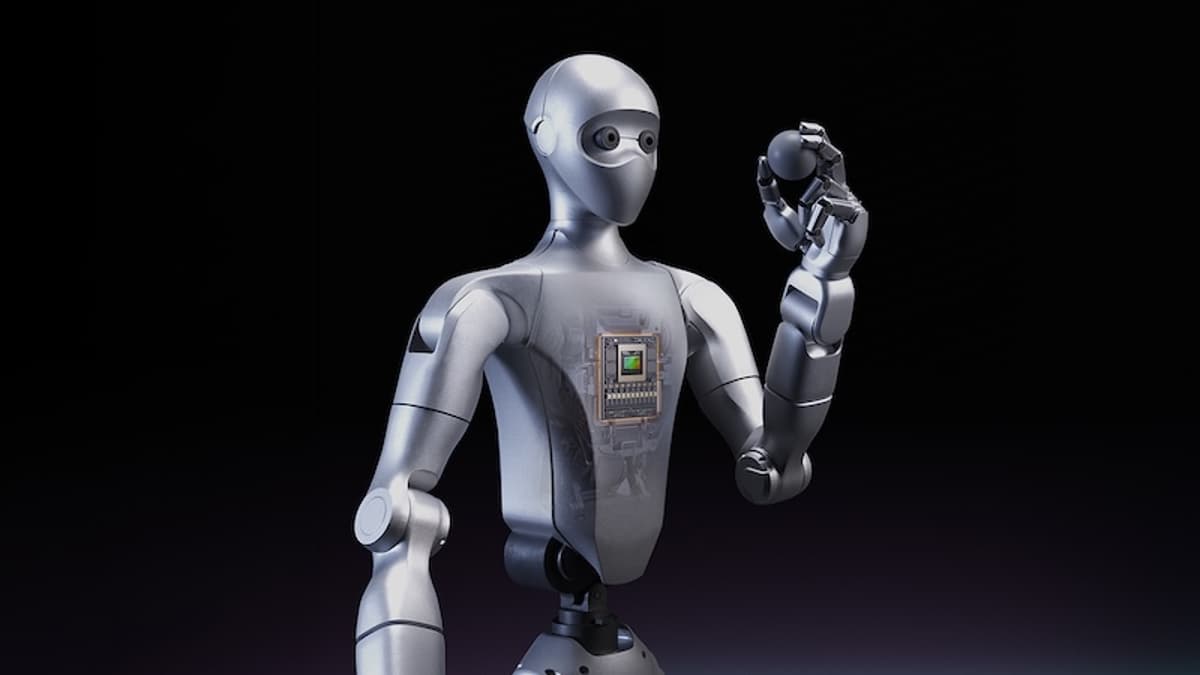
Nvidia Unveils Open Humanoid Robot Platform for Robotics Research
Companies Mentioned
Why It Matters
By providing a unified hardware‑software reference, Nvidia lowers barriers for humanoid‑robotics research, accelerating breakthroughs that could unlock a multitrillion‑dollar physical AI market.
Key Takeaways
- •Nvidia's Isaac GR00T combines Unitree H2, Jetson Thor, tactile hands.
- •Open software stack streamlines data collection, simulation, training, and deployment.
- •Researchers at Stanford, ETH Zurich, UCSD adopt platform for humanoid AI.
- •Platform targets multitrillion‑dollar market by accelerating physical AI breakthroughs.
- •Availability slated for late 2026 via Unitree, expanding global access.
Pulse Analysis
Nvidia’s entry into humanoid robotics reflects a broader shift toward integrating high‑performance AI compute with embodied platforms. The Isaac GR00T reference robot pairs the agile Unitree H2 chassis—offering 31 degrees of freedom—with Nvidia’s Jetson AGX Thor, the first Blackwell‑GPU‑based edge processor. This combination delivers the horsepower needed for real‑time perception, planning, and control, while the Sharpa Wave tactile hands add dexterity previously limited to research labs. By packaging these components into a single, open reference design, Nvidia eliminates the fragmented integration steps that have long hampered rapid prototyping in the field.
The accompanying Isaac GR00T software ecosystem is equally pivotal. It unifies data‑capture tools (Isaac Teleop), high‑fidelity simulation environments (Isaac Sim, Isaac Lab), and a ROS‑compatible middleware layer, enabling researchers to iterate from virtual models to physical deployment without rewriting code. Early adopters—including Stanford’s Robotics Center, ETH Zurich’s Robotic Systems Lab, and UC San Diego—are already leveraging the stack to train foundation models for humanoid reasoning and behavior. This collaborative, open‑source approach promises faster knowledge sharing, reproducible experiments, and a lower entry threshold for universities and startups alike.
From a market perspective, Nvidia’s move positions the company at the nexus of AI and robotics, sectors projected to generate trillions of dollars in combined economic impact. The platform’s availability in late 2026 could catalyze a wave of commercial applications—from warehouse automation to service robots—by providing a ready‑made, scalable foundation. Competitors will need to match Nvidia’s blend of cutting‑edge compute and open software to stay relevant, while investors will watch closely for the emergence of new venture‑backed startups built on the Isaac GR00T ecosystem.
Nvidia unveils open humanoid robot platform for robotics research
Comments
Want to join the conversation?
Loading comments...