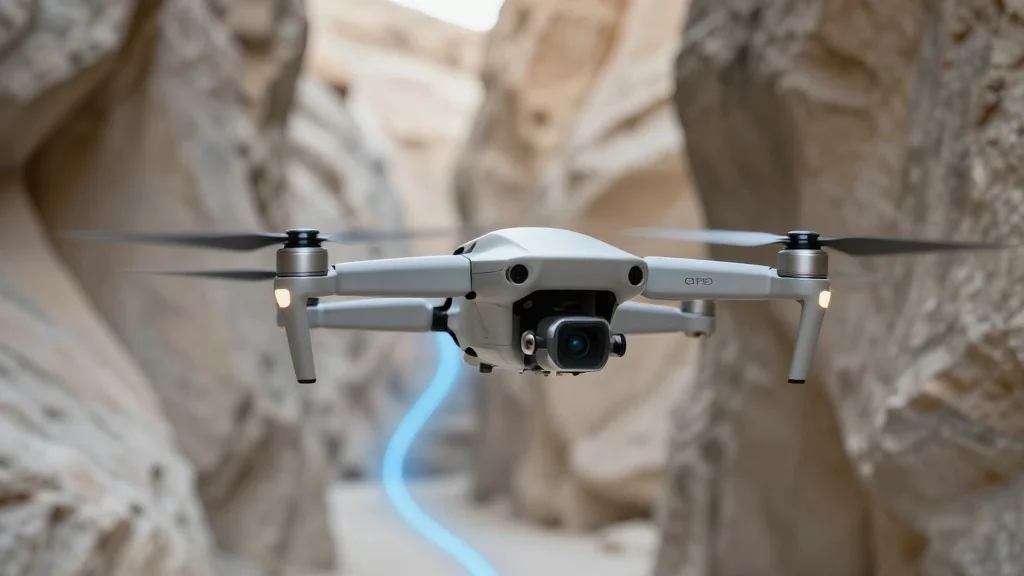
Open-Source Framework Lets Drones Dodge Obstacles in Milliseconds While Minimizing Travel Time
Companies Mentioned
Why It Matters
MIGHTY democratizes high‑performance UAV navigation, lowering barriers for emergency responders and commercial operators while delivering faster, safer flights. Its open‑source nature could accelerate innovation across the rapidly growing drone market.
Key Takeaways
- •MIGHTY plans UAV trajectories in milliseconds, cutting reaction time
- •Uses Hermite spline to jointly optimize path and travel time
- •Runs on onboard sensors, avoiding costly proprietary software
- •Demonstrated 15% faster travel and 90% lower compute than rivals
Pulse Analysis
The ability of unmanned aerial vehicles to navigate cluttered, dynamic environments has long been a bottleneck for time‑critical missions such as post‑disaster search and rescue. Traditional planners either sacrifice speed for safety or rely on expensive commercial solvers that demand powerful ground‑based compute. MIGHTY reshapes this trade‑off by delivering millisecond‑scale obstacle avoidance while preserving a smooth, time‑optimal flight path, enabling drones to enter collapsed structures or congested urban canyons without human intervention.
At the core of MIGHTY is a novel Hermite‑spline representation that simultaneously optimizes spatial geometry and temporal allocation. Rather than estimating travel time first—a practice that forces speed spikes when detouring around obstacles—the framework treats path and timing as a single, larger optimization problem. To keep the computation tractable, the researchers seed the solver with an initial guess derived from lidar‑generated maps and refine it iteratively. This approach slashes processing demands to roughly 10% of state‑of‑the‑art methods, allowing the algorithm to run entirely on the UAV’s onboard computer. By being fully open‑source, MIGHTY eliminates the multi‑hundred‑thousand‑dollar price tag of proprietary alternatives, opening high‑performance navigation to startups, academic labs, and NGOs worldwide.
The broader impact extends beyond emergency response. Faster, cheaper trajectory planning can accelerate the rollout of last‑mile delivery drones in dense cities, where navigating around buildings, power lines, and pedestrians is essential. Industrial inspections of wind turbines or bridges also stand to benefit from real‑time, on‑board path computation. As the drone ecosystem matures, tools like MIGHTY will likely become foundational building blocks, fostering a more competitive market and spurring further advances in autonomous flight. Future work targeting multi‑robot coordination could amplify these gains, positioning open‑source navigation as a cornerstone of the next generation of aerial robotics.
Open-source framework lets drones dodge obstacles in milliseconds while minimizing travel time
Comments
Want to join the conversation?
Loading comments...