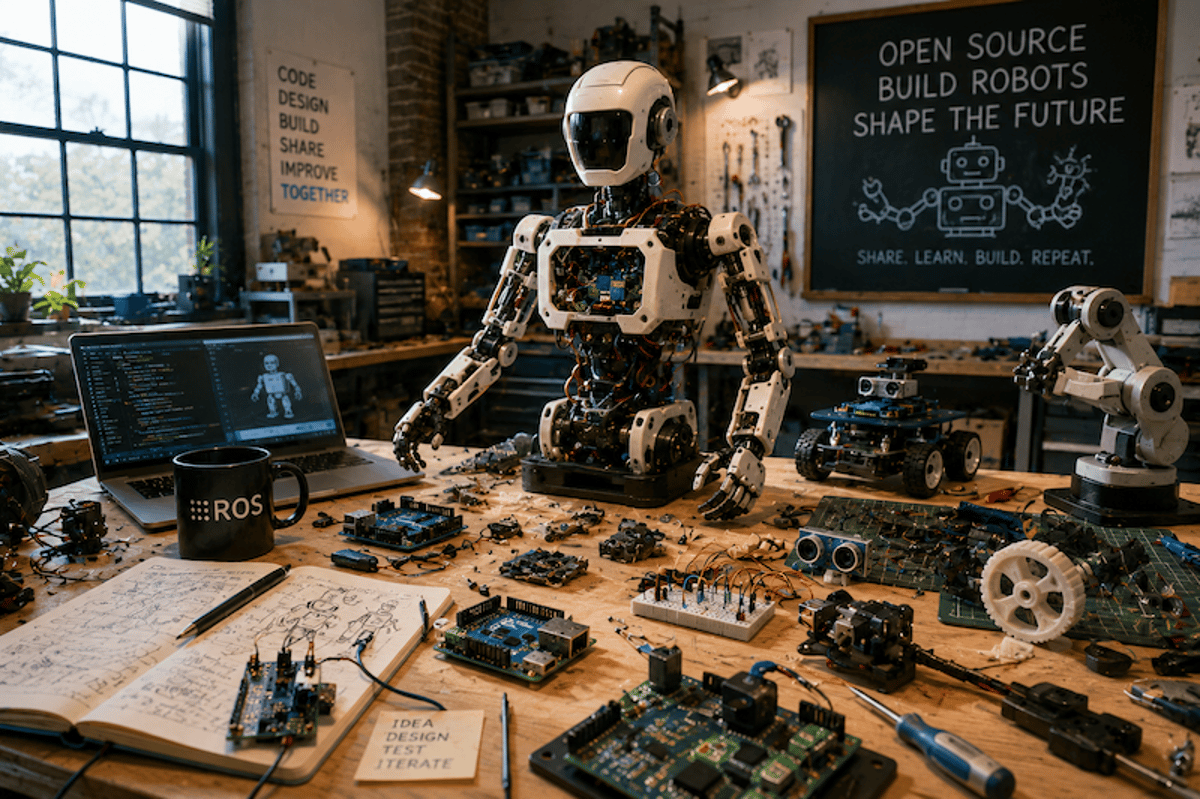
Open Source Hardware for Robotics: Democratizing Robot Building
Companies Mentioned

Why It Matters
Lower entry costs accelerate experimentation, driving faster innovation cycles and attracting investment across robotics sectors. The blend of open and proprietary hardware expands both creative development and scalable deployment.
Key Takeaways
- •Arduino and Raspberry Pi lowered entry cost for robot prototypes
- •TurtleBot provides a standard ROS‑compatible platform for education and research
- •3D printing enables rapid, low‑cost custom robot parts
- •Startups can launch robots for thousand dollars versus hundreds of thousands
- •Open hardware complements proprietary systems, driving both innovation and industrial scale
Pulse Analysis
The rise of open‑source hardware in robotics echoes the personal‑computer revolution of the 1980s. By publishing schematics, firmware and CAD files, projects like Arduino and Raspberry Pi turned complex electronics into plug‑and‑play building blocks. Coupled with affordable sensors, low‑cost microcontrollers and community‑maintained libraries, developers can assemble complete robots without bespoke engineering. This openness has created a shared foundation that speeds learning, reduces duplication, and fuels a global maker culture.
For investors and entrepreneurs, the impact is tangible. Where a research robot once cost six figures, a functional prototype can now be assembled for under $5,000 using off‑the‑shelf parts and 3D‑printed structures. Universities integrate platforms such as TurtleBot into curricula, producing graduates fluent in ROS and hardware integration. Startups leverage these tools to focus on domain‑specific algorithms—whether for warehouse picking, precision agriculture or autonomous drones—rather than reinventing basic hardware, shortening time‑to‑market and improving capital efficiency.
Looking ahead, open hardware will be the testbed for embodied AI. Initiatives like Open X‑Embodiment and Hugging Face’s robotics projects rely on inexpensive, modular robots to train and evaluate large‑scale models. As foundation models become capable of learning physical tasks, the need for affordable, reproducible platforms grows. While proprietary systems will continue to dominate safety‑critical deployments, the open ecosystem ensures a pipeline of innovation, democratizing access to the next generation of intelligent machines.
Open source hardware for robotics: Democratizing robot building
Comments
Want to join the conversation?
Loading comments...