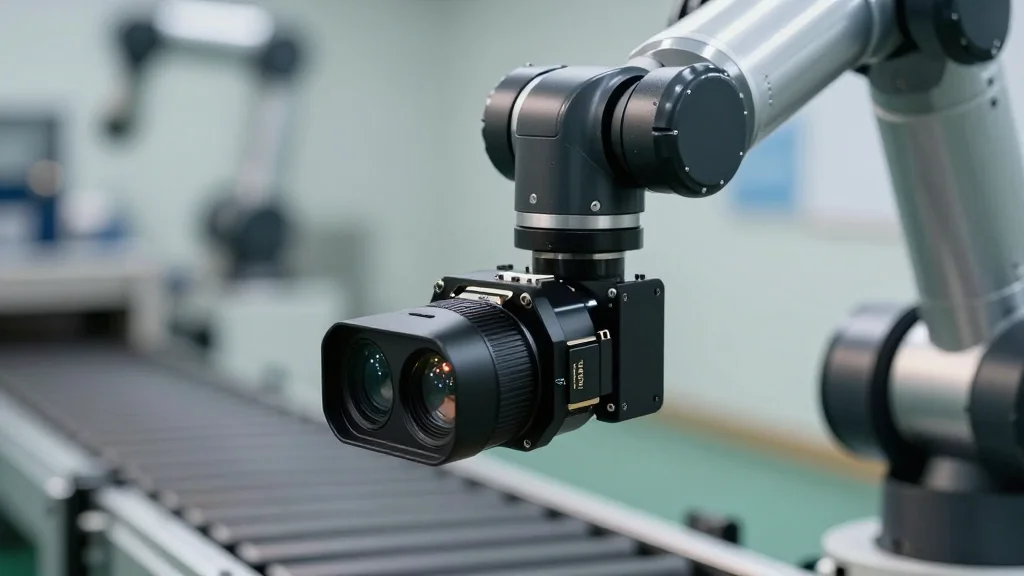
Ouster Launches Stereolabs ZED X Nano: A Wrist-Mount Stereo Camera Built for Robotic Manipulation and Physical AI
Companies Mentioned
Why It Matters
By delivering high‑resolution, low‑latency vision in a compact, rugged package, the ZED X Nano removes a key bottleneck for robot‑arm learning and precision manipulation, accelerating the rollout of Physical AI solutions across industry.
Key Takeaways
- •40% smaller form factor fits directly on robot wrists.
- •Zero‑copy pipeline streams frames to GPU, cutting latency.
- •Neural Depth Engine delivers sub‑millimeter Z‑axis accuracy.
- •GMSL2 link supports 15 m rugged cable, replacing fragile USB‑C.
- •Native support for NVIDIA Isaac, ROS, and ROS 2 accelerates deployment.
Pulse Analysis
Robotic manipulation has long been constrained by vision systems that trade off size, speed, and durability. Traditional USB‑C cameras often deliver only 720p resolution and rely on CPU‑mediated pipelines, introducing latency that hampers real‑time imitation and reinforcement learning. As data‑hungry Physical AI models demand richer, higher‑frequency inputs, manufacturers are seeking sensors that can sit directly on a robot’s wrist without compromising performance.
The ZED X Nano addresses these gaps with a suite of technical upgrades. Its 40 % reduced height lets it mount on end‑of‑arm tooling, while the GMSL2 interface provides a rugged, 15‑meter link immune to EMI and mechanical stress. The zero‑copy capture path bypasses the host CPU, feeding raw frames straight into NVIDIA encoders and GPU‑based inference, which boosts throughput and frees compute for more complex perception models. Coupled with Stereolabs’s Neural Depth Engine, the camera achieves sub‑millimeter depth precision, a decisive advantage for tasks like grasp‑pose estimation and fine assembly.
Beyond hardware, Ouster’s strategy leans heavily on ecosystem integration. Native support for NVIDIA Isaac Sim, Isaac Lab, and both ROS versions streamlines the sim‑to‑real pipeline, letting developers train on high‑fidelity synthetic data and deploy identical sensor models on physical robots. This alignment lowers development costs and shortens time‑to‑market for AI‑driven automation. As enterprises scale Physical AI deployments in manufacturing, logistics, and beyond, the ZED X Nano positions Ouster as a pivotal supplier, potentially reshaping the competitive landscape for edge vision in industrial robotics.
Ouster Launches Stereolabs ZED X Nano: A Wrist-Mount Stereo Camera Built for Robotic Manipulation and Physical AI
Comments
Want to join the conversation?
Loading comments...