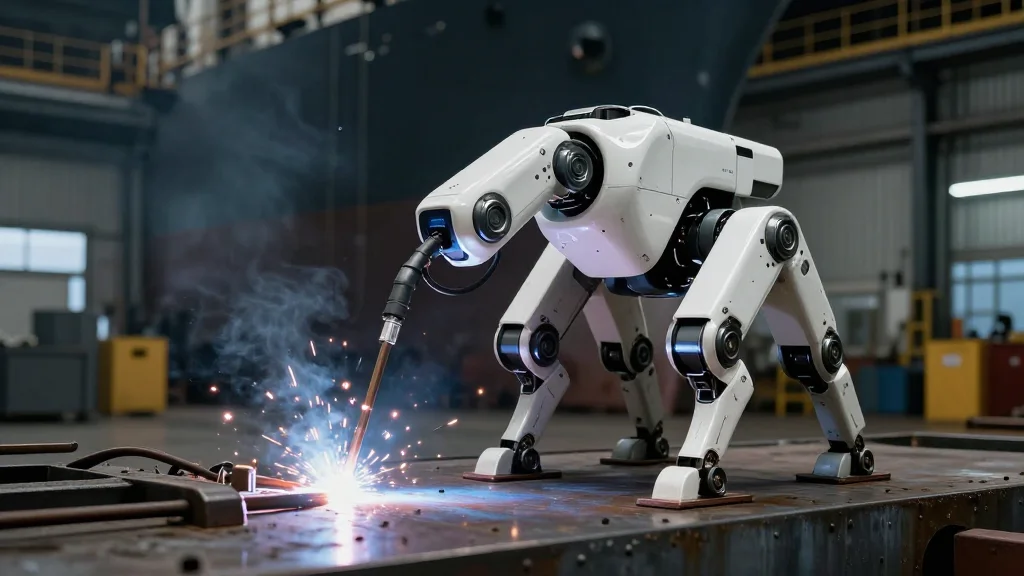
Path Robotics Launches Rove, Bringing Mobility to Welding Automation Powered by Physical AI
Companies Mentioned
Why It Matters
Rove brings intelligent welding to locations where traditional automation cannot reach, unlocking productivity gains for capital‑intensive industries facing labor scarcity. Its success could reshape how large‑scale fabrication adopts AI‑driven robotics.
Key Takeaways
- •Rove pairs Obsidian AI with a quadruped robot for mobile welding
- •Targets shipbuilding, heavy construction, and large‑scale fabrication environments
- •Addresses skilled welder shortage by automating hard‑to‑reach welds
- •Early adopter Saronic Technologies evaluating Rove for autonomous vessel production
Pulse Analysis
Path Robotics’ Rove™ marks a pivotal shift in welding automation by marrying its proven Obsidian physical AI with a quadruped robot platform. While traditional robotic welders are confined to fixed cells, Rove can navigate uneven shop floors and shipyards, delivering real‑time perception and adaptive control to complex, large‑scale assemblies. This mobility addresses a long‑standing bottleneck: the inability to automate welds on parts that are too big, heavy, or irregular to be moved into a cell, opening new productivity frontiers for manufacturers.
The timing aligns with acute skilled‑welder shortages across heavy industries. Shipbuilders and construction firms grapple with inconsistent fit‑up and limited fixturing options, forcing reliance on manual labor for high‑precision welds. Rove’s AI‑driven vision and force feedback enable it to maintain weld quality comparable to human experts, while operating in environments previously deemed too unstable for legged robots. Early trials by Saronic Technologies illustrate how autonomous vessel programs can integrate mobile welding to accelerate production cycles and reduce labor costs, setting a template for broader adoption in offshore and infrastructure projects.
From a market perspective, Rove expands Path Robotics’ addressable market beyond its existing cell‑based customers, positioning the company as a leader in mobile AI‑powered manufacturing. With over $300 million raised since 2018, the firm now leverages that capital to scale hardware production and software refinement. Competitors are watching closely, as the convergence of physical AI and legged robotics could redefine automation standards across sectors that have historically resisted robotization. Companies that adopt Rove early may gain a competitive edge through higher throughput, improved weld consistency, and reduced dependence on scarce human talent.
Path Robotics Launches Rove, Bringing Mobility to Welding Automation Powered by Physical AI
Comments
Want to join the conversation?
Loading comments...