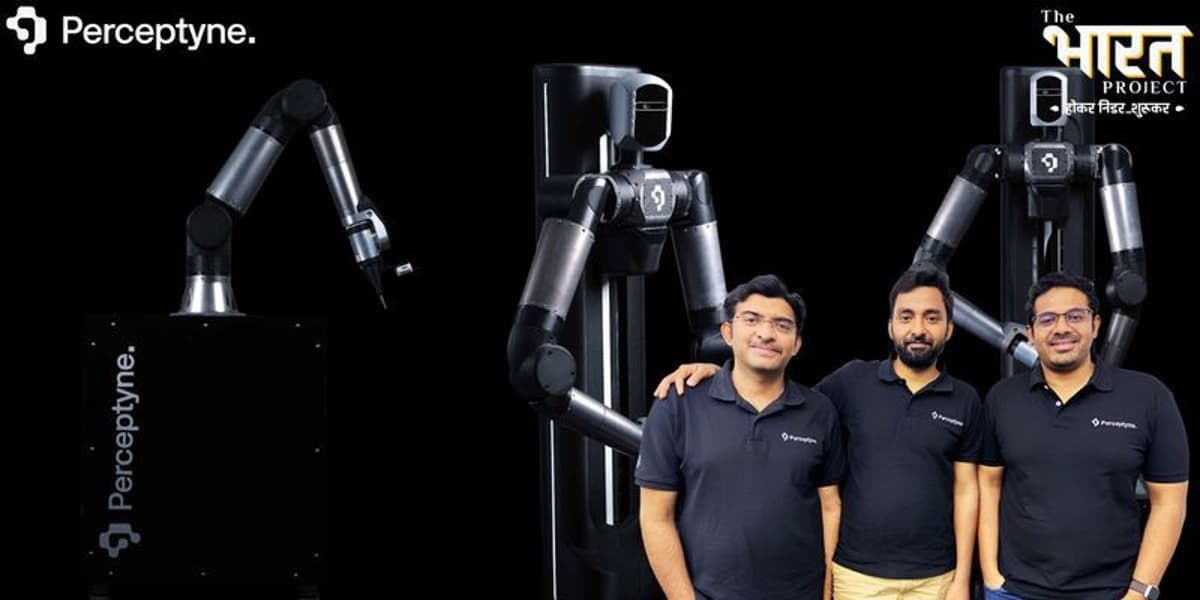
Perceptyne Raises $3M Seed Round Led by Endiya Partners and Yali Capital
Why It Matters
Perceptyne’s adaptable robots address labor shortages and lower capital barriers, speeding flexible automation across global manufacturing.
Key Takeaways
- •AI robots adapt to misaligned parts without new hardware
- •Tele‑operated training cuts programming time dramatically
- •Cost savings claim reaches up to 40% versus traditional robots
- •Seed round of $3 million backs pilot deployments
- •Pricing about 40% lower than imported automation alternatives
Pulse Analysis
Industrial automation has long excelled at repetitive, structured tasks, yet the majority of factory floor work still relies on human dexterity to manage part variability. This gap becomes costly when suppliers deliver components with slight misalignments or when product designs evolve rapidly. Perceptyne targets this niche by creating robots that perceive, adjust, and act in real time, effectively bridging the divide between rigid automation and manual labor. By embedding vision, force sensing, and tactile feedback into dual‑arm platforms, the company offers a plug‑in solution that integrates with existing production lines without extensive retooling.
The technical edge of Perceptyne lies in its tele‑operation training loop. Human operators guide the robot through a task once, allowing AI models to capture the nuanced motions and force profiles required for each operation. This reduces the traditionally lengthy programming phase and enables rapid deployment across diverse applications such as assembly, inspection, and component insertion. Compared with legacy robotic systems that often demand custom hardware for each new part, Perceptyne’s flexible end effectors and software‑centric approach promise up to 40% lower operational costs and pricing roughly 40% below imported alternatives, positioning it competitively against firms like Agile Robots and Doosan Robotics.
From a market perspective, the startup’s $3 million seed round, led by Endiya Partners and Yali Capital, validates investor confidence in flexible automation amid global labor shortages. Pilot projects in electronics and automotive sectors demonstrate tangible benefits, and the planned rollout to the United States and Europe aligns with manufacturers’ shift toward adaptable, low‑capex solutions. If Perceptyne can scale beyond pilots, its model could accelerate the transition of mid‑tier factories from labor‑intensive processes to smarter, cost‑effective production, reshaping supply‑chain dynamics worldwide.
Deal Summary
Indian AI robotics startup Perceptyne announced it has closed a $3 million seed funding round. The round was led by Endiya Partners and Yali Capital, with participation from Whiteboard Capital. The capital will support scaling its flexible factory automation robots.
Comments
Want to join the conversation?
Loading comments...