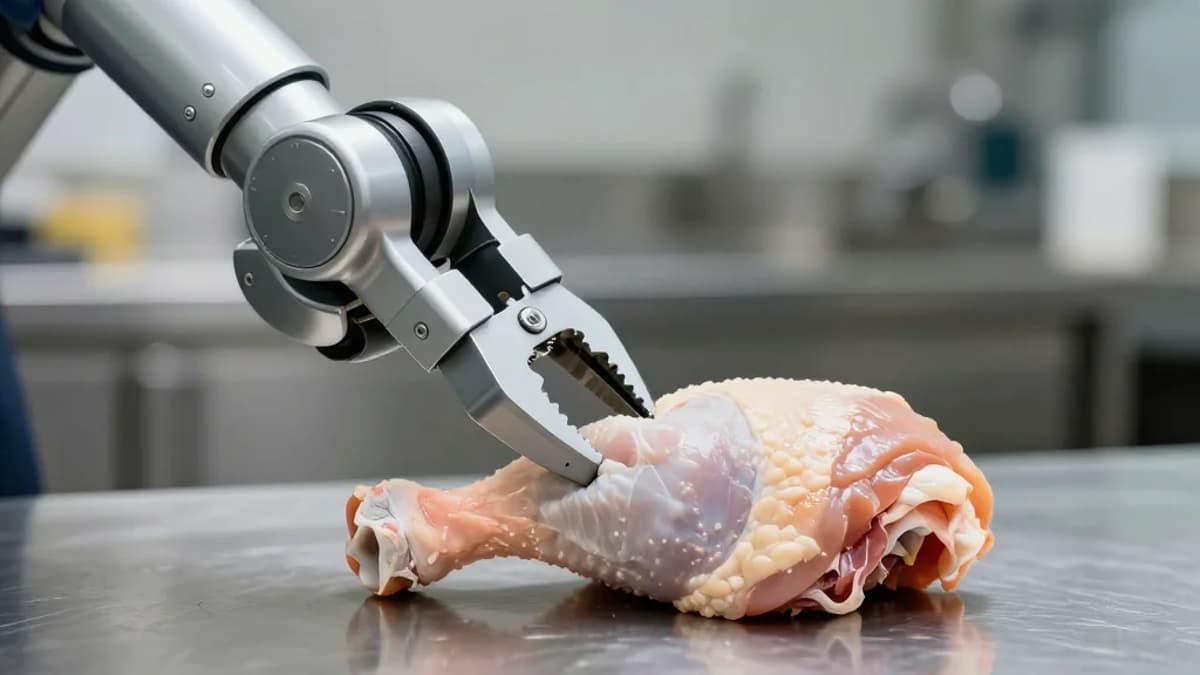
Poultry Processing Robotics Advances with ChicGrasp
•March 10, 2026
0
Why It Matters
ChicGrasp demonstrates a scalable path to automate labor‑intensive poultry processing, addressing chronic workforce shortages and setting a new standard for adaptable food‑industry robotics.
Key Takeaways
- •ChicGrasp uses diffusion‑policy imitation learning.
- •Achieves 81% grasp success on irregular chicken carcasses.
- •Cycle time 38 seconds, far slower than humans.
- •Prototype cost roughly $59,000 using off‑the‑shelf parts.
- •All hardware designs and data released open source.
Pulse Analysis
The pandemic‑driven labor crunch has accelerated interest in robotic solutions for meat processing, yet traditional automation—suction cups or pre‑programmed motions—fails on the slippery, variable nature of poultry carcasses. ChicGrasp tackles this gap by integrating embodied AI with a dual‑jaw gripper that mimics a human operator’s trajectory, allowing the robot to adapt to each bird’s unique pose. By leveraging a diffusion‑policy framework, the system treats control as a conditional denoising process, enabling rapid refinement of grasp strategies without exhaustive re‑programming.
Technical validation shows ChicGrasp reaching an 81% success rate, a notable improvement over prior learning methods that collapsed under similar conditions. The gripper’s camera‑guided perception captures low‑dimensional trajectory data, which the diffusion policy translates into joint commands for the robotic arm. Although the prototype demonstrates reliable handling, its 38‑second cycle remains a bottleneck compared to the three‑second human benchmark, highlighting the need for higher velocity limits and tighter motion planning to meet industrial throughput demands.
Beyond performance metrics, the project’s open‑source release of CAD files, training datasets, and algorithmic code establishes a reproducible benchmark for agricultural robotics research. At a build cost of roughly $59,000, ChicGrasp offers a relatively low‑entry point for processors seeking to pilot AI‑driven automation. As the industry grapples with workforce volatility and rising labor costs, such adaptable, data‑rich solutions could reshape supply‑chain efficiency, drive down per‑unit processing expenses, and spur broader adoption of intelligent robotics across food manufacturing.
Poultry processing robotics advances with ChicGrasp
0
Comments
Want to join the conversation?
Loading comments...