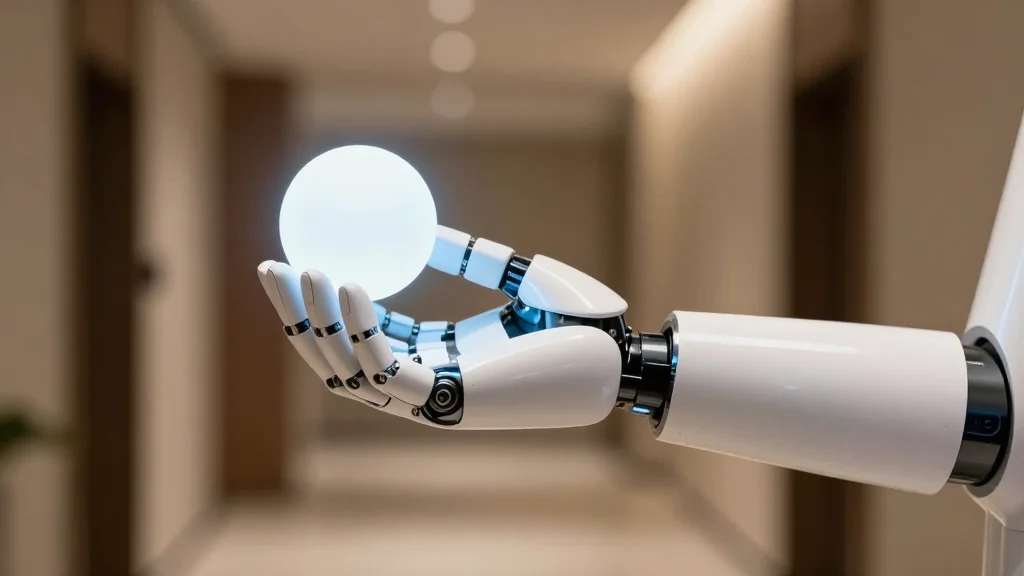
RLWRLD Harvests Hotel Staff Motions to Teach Service Robots

Companies Mentioned
Why It Matters
The RLWRLD project marks a concrete step toward bridging the gap between AI perception and physical actuation, a challenge that has long limited robot versatility. By converting human expertise into machine‑readable data, South Korea could accelerate the deployment of service robots in sectors that rely on nuanced manual skills, from hospitality to logistics. Success would not only bolster the country's AI leadership but also provide a template for other economies seeking to offset labor shortages with intelligent automation. Moreover, the initiative underscores a strategic shift in the robotics industry: moving from pre‑programmed, repetitive‑task bots to adaptable machines that learn from real‑world human behavior. If RLWRLD’s model proves scalable, it could reshape supply‑chain dynamics, reduce training costs for robot fleets, and open new markets for AI‑enhanced service robots worldwide.
Key Takeaways
- •RLWRLD records motions of Lotte Hotel staff and other frontline workers for robot training
- •South Korean government allocated $33 million to capture master‑technician know‑how for AI
- •Startup unveiled a robotics foundation model designed to interpret motion‑capture data
- •Industry timeline targets large‑scale robot deployment by 2028 across factories and service venues
- •Experts cite South Korea’s manufacturing base as a competitive edge in the global physical‑AI race
Pulse Analysis
RLWRLD’s motion‑capture strategy reflects a broader industry realization that data, not just hardware, will dictate the next wave of robotics. Historically, robot manufacturers have focused on improving actuators and sensors while assuming that programming could be hand‑crafted for each task. The South Korean approach flips that model: by amassing a massive, labeled dataset of human motions, the AI can learn generalized manipulation skills that transfer across robot platforms. This data‑first methodology mirrors how large language models were trained on text corpora, suggesting a convergence of AI disciplines.
From a competitive standpoint, RLWRLD’s progress could narrow the gap between Korean firms and U.S./Chinese rivals that have poured billions into humanoid development. While Tesla’s Optimus and China’s UBTech rely heavily on proprietary simulation environments, RLWRLD leverages real‑world expertise already embedded in the country’s service economy. If the startup can demonstrate reliable dexterity in unstructured settings—think a robot folding napkins as neatly as a veteran hotel server—it will validate the physical‑AI thesis and attract both domestic and foreign investment.
However, the path forward is fraught with challenges. Scaling motion capture from a handful of workers to thousands requires robust privacy safeguards, standardized data formats, and seamless integration with diverse robot hardware. Moreover, labor unions may push back if the technology is perceived as a prelude to job displacement. RLWRLD’s partnership model—working with employers to record, not replace, human skill—could mitigate resistance, but policymakers will need to balance productivity gains with workforce protection. The upcoming 2028 deployment horizon will be a litmus test: successful roll‑outs could cement South Korea’s status as a physical‑AI leader, while setbacks may reinforce the narrative that robot dexterity remains an elusive goal.
RLWRLD Harvests Hotel Staff Motions to Teach Service Robots
Comments
Want to join the conversation?
Loading comments...