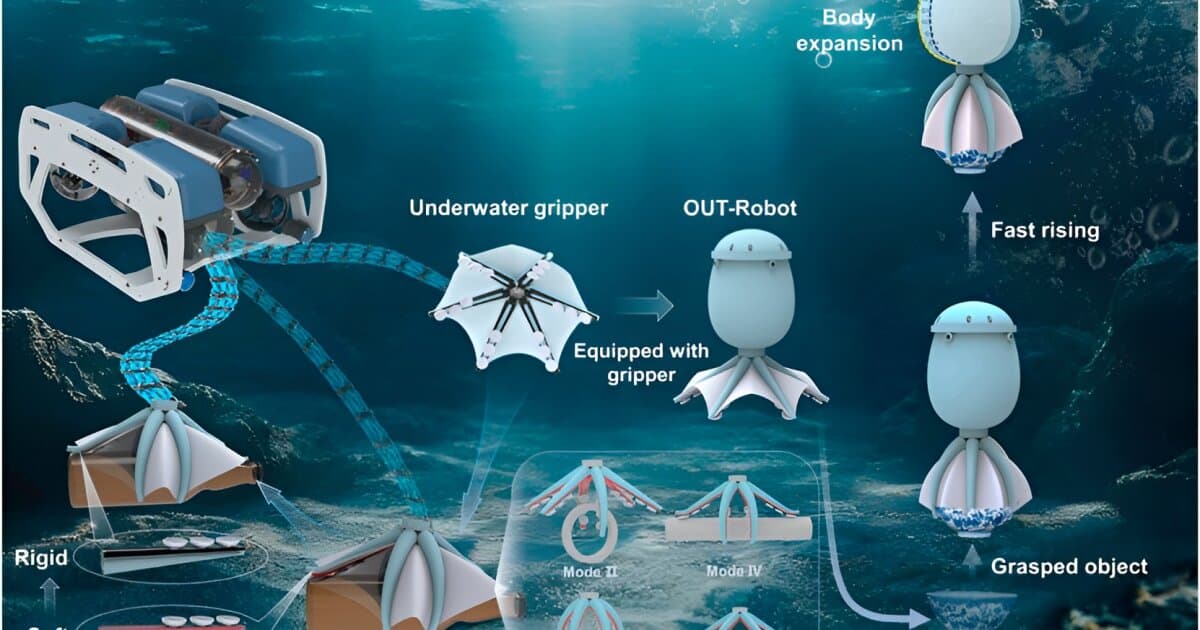
Robo-Octopus Gripper Goes Limp to Grapple, Stiffens to Lift
Why It Matters
The ultra‑fast stiffness transition and near‑zero lift energy make autonomous underwater handling far more efficient, enabling scalable, low‑impact solutions for oceanic debris removal and scientific sampling. This performance leap could accelerate commercial adoption of underwater robots in environmental and resource sectors.
Key Takeaways
- •Stiffness switches in 0.8 s (rigid) and 1.3 s (soft) via SMP
- •Six arms lift up to 500 g, handling objects from 1 g to 500 g
- •Grasping uses 75 J; ascent requires near‑zero energy thanks to buoyancy
- •Water acts as heat sink, cutting cooling time versus air‑cooled SMP
- •Researchers envision swarm deployment for ocean cleanup and resource recovery
Pulse Analysis
Biomimicry continues to reshape robotics, and the OUT‑Robot demonstrates how octopus‑inspired design can solve the age‑old grip dilemma of rigidity versus compliance. By embedding a shape‑memory polymer of polylactic acid within a three‑layer thermal interface, the robot softens under voltage and instantly hardens when the current stops. This rapid transition—under a second for each state—outpaces traditional SMP grippers that rely on slow air cooling, positioning the technology as a breakthrough for precise, adaptable handling in fluid environments.
Beyond speed, the OUT‑Robot’s energy profile sets a new benchmark. The grasping phase draws roughly 75 joules over 1.3 seconds, after which the device inflates a soft‑shelled head to achieve neutral buoyancy, essentially eliminating power draw for ascent. Compared with conventional underwater manipulators that must continuously power thrusters or hydraulic lifts, this near‑zero‑energy lift reduces operational costs and extends mission duration—critical factors for large‑scale ocean cleanup or long‑term scientific surveys. The water‑based cooling system further accelerates stiffness recovery, leveraging the surrounding medium as an active heat sink.
The implications extend across multiple markets. Environmental firms can deploy swarms of these robots to collect micro‑plastic debris, retrieve fragile marine specimens, or assist in coral reef restoration without disturbing habitats. Meanwhile, offshore energy and aquaculture sectors could use the technology for routine inspection and maintenance, cutting downtime and fuel consumption. As regulatory pressure mounts for greener maritime operations, the OUT‑Robot’s low‑energy, high‑precision capabilities position it as a compelling solution for the next generation of sustainable underwater robotics.
Robo-octopus gripper goes limp to grapple, stiffens to lift
Comments
Want to join the conversation?
Loading comments...