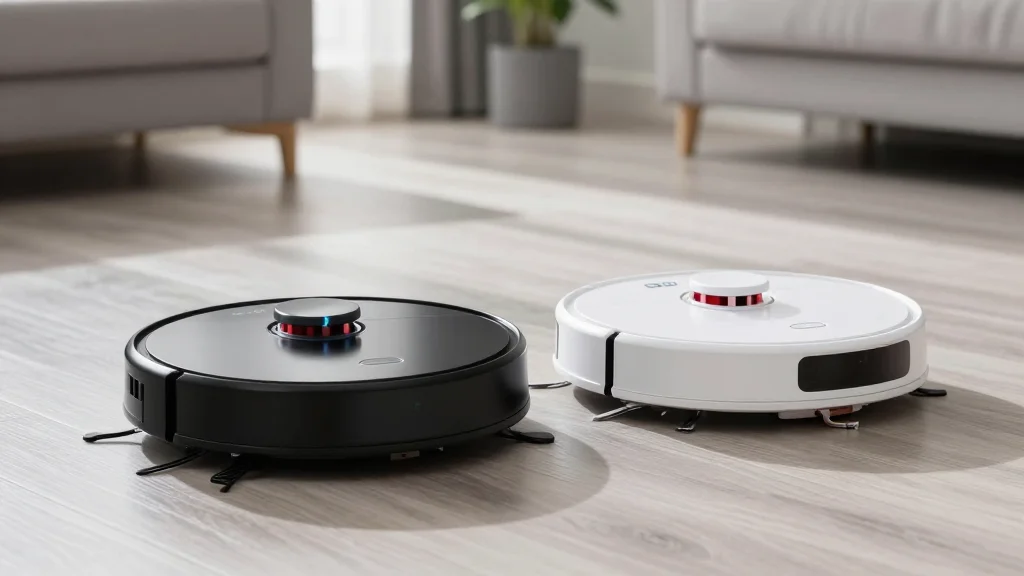
Roborock vs Ecovacs: ZDNET Review Highlights Diverging Strengths in Home Robot Vacuums

Companies Mentioned
Why It Matters
The Roborock‑Ecovacs rivalry illustrates how consumer robotics is evolving from a niche gadget market into a mainstream household staple. By emphasizing either software ecosystems or raw hardware performance, the two firms are testing which value proposition drives long‑term loyalty, a question that will influence design priorities across the entire domestic‑robot sector. If Roborock’s app‑centric model proves more sticky, we may see a wave of open‑platform standards that enable third‑party services to plug into robot vacuums, accelerating innovation in AI‑based cleaning algorithms. Conversely, Ecovacs’ hardware‑first approach could push competitors to invest heavily in suction technology and multi‑function modules, raising the performance ceiling for all home robots and expanding the overall addressable market.
Key Takeaways
- •Roborock’s app rated as one of the best for floor‑map customization and scheduling
- •Ecovacs’ app still considered less intuitive, with deeper settings harder to locate
- •Roborock’s Saros Z70 uses LiDAR, RGB cameras and a mechanical arm for obstacle handling
- •Ecovacs markets suction in high‑hundreds of Pascals, emphasizing raw vacuum force
- •Both brands are slated to release new premium models before the end of 2026, intensifying competition
Pulse Analysis
The ZDNET side‑by‑side review does more than list feature checkmarks; it signals a strategic inflection point for the home‑robot market. Roborock’s focus on a polished, data‑rich app experience mirrors the broader software‑as‑a‑service trend that has reshaped enterprise robotics. By locking users into a sophisticated mapping and scheduling ecosystem, Roborock can monetize future upgrades, data insights, and even third‑party integrations, turning a disposable appliance into a platform.
Ecovacs, meanwhile, is doubling down on hardware differentiation—a classic play in consumer electronics where tangible specs like suction pressure and mop flow rates are easy selling points. This approach may capture price‑sensitive segments and early adopters who equate higher Pascals with superior cleaning, but it risks commoditization as competitors catch up on raw power. The real test will be whether Ecovacs can translate hardware bragging rights into durable brand loyalty or if consumers will gravitate toward the smoother, more customizable experience that Roborock offers.
Looking ahead, the vacuum market’s growth trajectory suggests both strategies could coexist, feeding different buyer personas. However, the firms that successfully blend robust hardware with an open, user‑friendly software layer are likely to set the next standard for domestic robotics. Investors and analysts will be watching upcoming product launches and firmware rollouts closely, as they will reveal which model—software‑centric or hardware‑centric—will dominate the next wave of smart‑home adoption.
Roborock vs Ecovacs: ZDNET Review Highlights Diverging Strengths in Home Robot Vacuums
Comments
Want to join the conversation?
Loading comments...