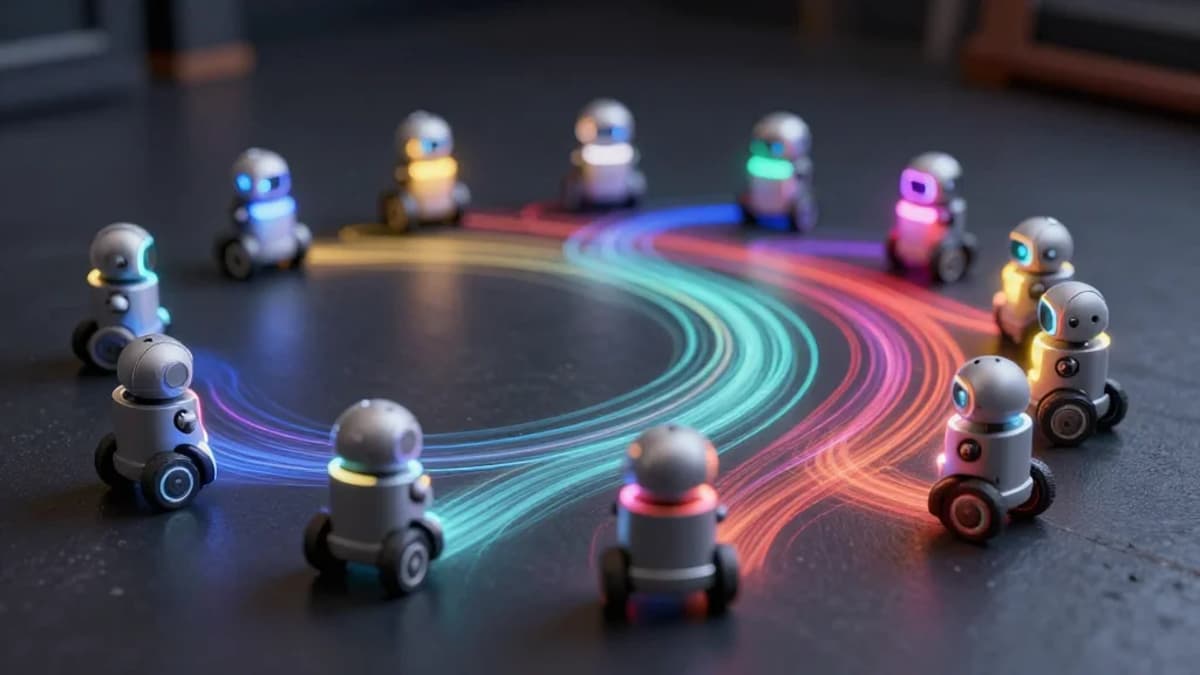
Robot Swarms Turn Music Into Moving Light Paintings
•February 9, 2026
0
Why It Matters
The project proves that real‑time, music‑driven swarm coordination is feasible, opening new avenues for interactive art and broader multi‑robot applications.
Key Takeaways
- •Swarm of 12 light‑emitting robots paints music‑driven visuals
- •System maps tempo, chords to color, speed, trail width
- •Human input adjusts robot trajectories during performance
- •Scalable algorithm applicable to agriculture, rescue, exploration
- •Published at IEEE 2025 conference, arXiv preprint available
Pulse Analysis
The Waterloo team’s robot swarm bridges auditory perception and visual expression by converting musical cues into dynamic light trails. Each robot, roughly the size of a soccer ball, interprets tempo, harmony and intensity, then modulates its LED hue, brightness and movement speed accordingly. A top‑down camera captures the collective motion, stitching together a fluid, ever‑changing canvas that mirrors the song’s emotional arc. This real‑time translation showcases advances in sensor fusion, decentralized control, and low‑latency communication among dozens of autonomous agents.
Beyond novelty, the system highlights a new paradigm for human‑robot co‑creation. By allowing participants to tweak trail width and robot placement on the fly, the platform fosters an interactive dialogue where artists and machines influence each other’s output. Such bidirectional control could reshape live performances, immersive installations, and educational workshops, offering audiences a tangible way to see music’s structure materialize. Planned user studies with professional painters and musicians aim to refine the interface, ensuring the technology supports artistic intent rather than imposing rigid algorithmic constraints.
The underlying coordination algorithm has implications far beyond the studio. Managing multiple agents within a confined arena while reacting to an external, time‑varying signal mirrors challenges in precision agriculture, environmental monitoring, and search‑and‑rescue missions where robots must adapt to dynamic data streams. By demonstrating scalable, emotion‑driven swarm behavior, the research provides a testbed for future deployments on larger fleets, including planetary rovers that could visualize scientific data in situ. As swarm robotics continues to mature, interdisciplinary projects like this illustrate how creative applications can accelerate technical breakthroughs.
Robot swarms turn music into moving light paintings
0
Comments
Want to join the conversation?
Loading comments...