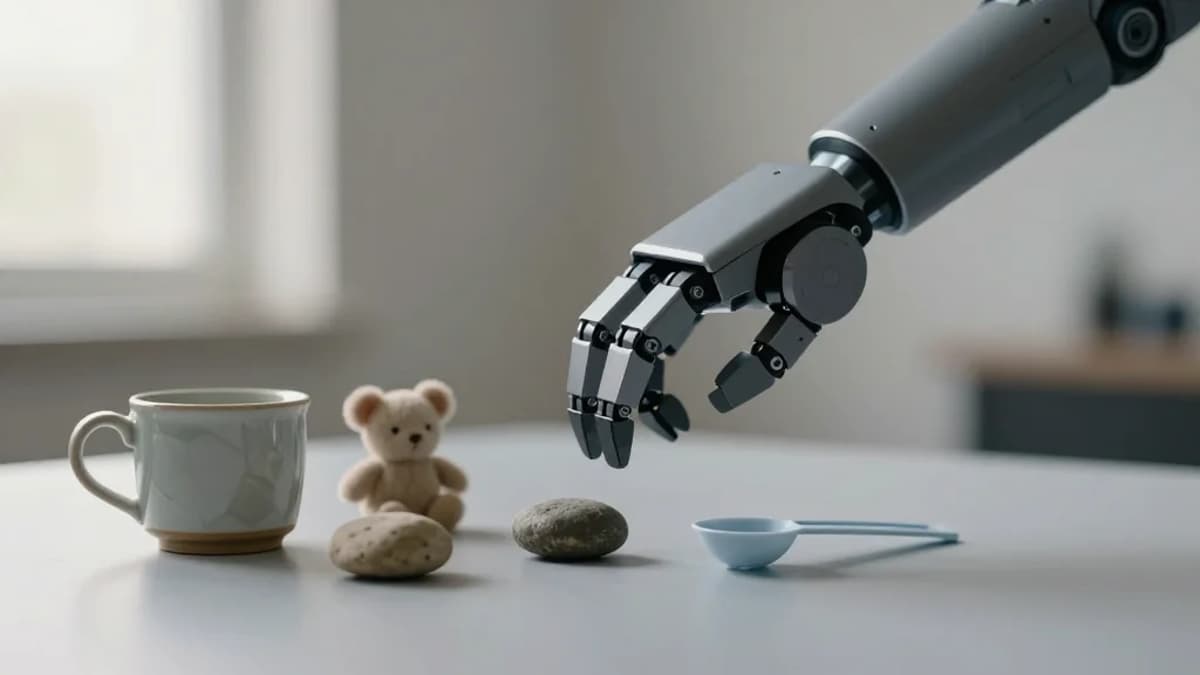
Robotic Arm Successfully Learns 1,000 Manipulation Tasks in One Day
•December 17, 2025
0
Why It Matters
The breakthrough slashes the time and cost of programming robots, speeding automation rollout in manufacturing and service domains. It also delivers transparent, trustworthy behavior compared with opaque deep‑learning approaches.
Key Takeaways
- •1,000 tasks learned with single demonstration each
- •MT3 combines trajectory decomposition and retrieval-based generalization
- •Training completed in under 24 hours on Sawyer robot
- •Approach removes need for large datasets or heavy models
- •Provides interpretable, instantly deployable policies for diverse manipulation
Pulse Analysis
The robotics community has long grappled with the data bottleneck: teaching a robot new skills typically demands hundreds of demonstrations or massive simulation pipelines. Conventional deep‑learning pipelines compensate with large neural networks, but they incur high compute costs and produce opaque policies that are difficult to validate in safety‑critical settings. By reframing imitation learning around memory‑based retrieval and modular trajectory phases, MT3 sidesteps these constraints, offering a leaner pathway to skill acquisition.
MT3’s core innovation lies in splitting each manipulation into an alignment phase and an interaction phase, allowing separate, lightweight controllers to handle positioning and execution. Coupled with a retrieval system that matches a task’s language description to the most relevant stored demonstration, the robot can instantly adapt a single example to new objects. This architecture not only reduces the required demonstrations per task to one but also preserves interpretability: engineers can visualize the planned pose before execution, ensuring compliance with operational safety standards.
For industry, the implications are immediate. Production lines can re‑tool robots on‑the‑fly, swapping out a single demonstration to teach a new assembly step without retraining a monolithic model. Service robots could expand their repertoire in homes or hospitals with minimal human oversight, lowering deployment costs. As the research team pursues adaptive trajectory replay for unseen geometries, the approach promises even broader generalization, positioning MT3 as a catalyst for scalable, data‑efficient automation across sectors.
Robotic arm successfully learns 1,000 manipulation tasks in one day
0
Comments
Want to join the conversation?
Loading comments...