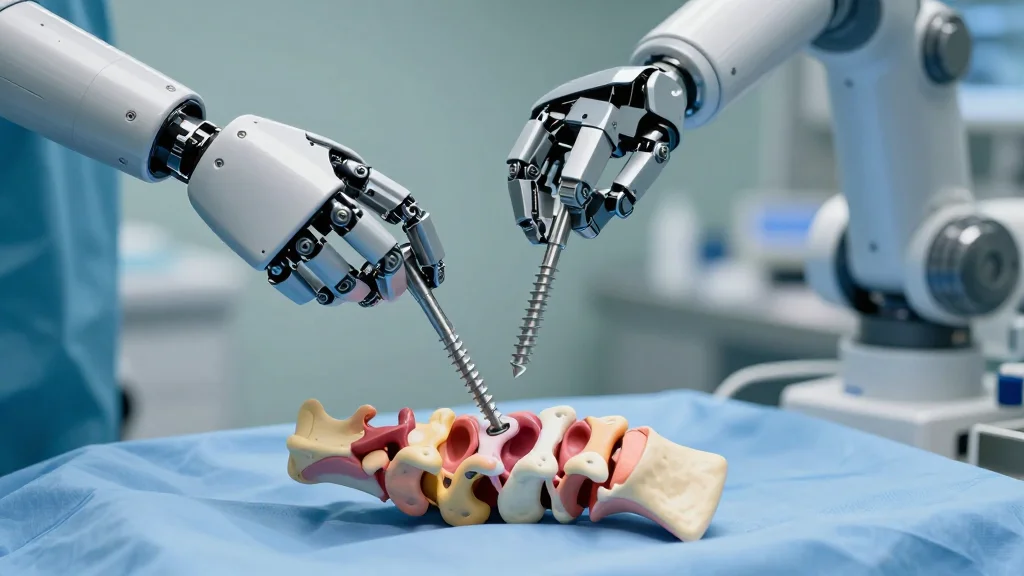
Robotic-Assisted Pedicle Screw Placement Achieves High Accuracy and Narrows the Experience Gap: A Preclinical Evaluation
Why It Matters
Higher screw accuracy cuts neurological complications and re‑operations, and the narrowed experience gap lets less‑seasoned surgeons achieve consistent results, speeding robotic spine adoption.
Key Takeaways
- •Mako Spine system raised optimal screw placement to 74% from 66%.
- •Fellows improved optimal placement from 64% to 83% using robotics.
- •Attendings' clinically acceptable screws rose to 97% with robotic assistance.
- •Mean positional deviation dropped to 1.4 mm, angular to 1.7°.
- •Robotic guidance narrowed experience gap, promising for training and standardization.
Pulse Analysis
Robotic assistance is reshaping spine surgery by tackling two persistent challenges: precision and surgeon variability. Pedicle screw misplacement has long been a source of neurological injury and costly revisions, prompting manufacturers to embed navigation and planning tools into operating rooms. The Mako Spine platform integrates intra‑operative CT imaging with a percutaneous workflow, allowing surgeons to pre‑plan trajectories and execute them with millimeter‑scale fidelity—an advantage that becomes critical as minimally invasive approaches gain market share.
The preclinical trial highlighted measurable gains over traditional fluoroscopy. Clinically acceptable screws climbed to 97.6% and optimal placement to 74%, with statistical significance for the latter. Notably, fellows—often the bottleneck for training programs—jumped from 64% to 83% optimal screws, essentially erasing the performance gap with attendings, who already hovered near 98% accuracy under robotic guidance. Low mean deviations of 1.4 mm (positional) and 1.7° (angular) demonstrate the system’s repeatability, suggesting that even in complex thoracolumbar anatomy, the robot can maintain consistent trajectories.
For hospitals and health systems, these findings translate into potential cost savings and quality improvements. Reduced breach rates mean fewer postoperative complications, shorter hospital stays, and lower readmission penalties. Moreover, the technology serves as a scalable training adjunct, allowing institutions to accelerate credentialing without compromising patient safety. While further clinical validation is required, the data positions robotic pedicle screw placement as a strategic investment for providers aiming to standardize outcomes and stay competitive in the evolving spine market.
Robotic-Assisted Pedicle Screw Placement Achieves High Accuracy and Narrows the Experience Gap: A Preclinical Evaluation
Comments
Want to join the conversation?
Loading comments...