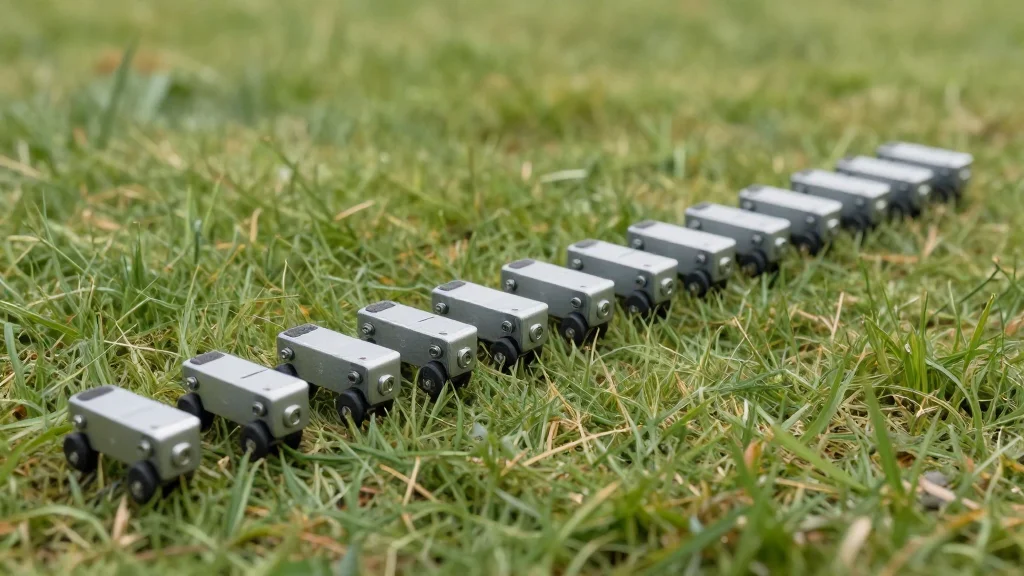
Robotic Collective Flows Like Matter, Adapting without Centralized Control
Why It Matters
By shifting coordination from computation to physics, the technology promises more resilient, low‑cost robot swarms for unpredictable real‑world environments, potentially reshaping fields from disaster response to soft‑matter manufacturing.
Key Takeaways
- •Cross‑Link Collective uses Velcro‑linked modules to self‑organize without central control
- •Chains outperform single units on slopes and through obstacle fields
- •Audible distress signals let isolated robots rejoin, boosting redundancy
- •Mechanical intelligence encodes behavior in physical interactions rather than software
- •Research bridges soft‑matter physics and robotics, enabling resilient swarm applications
Pulse Analysis
The Cross‑Link Collective represents a paradigm shift in swarm robotics by leveraging mechanical intelligence—where the physics of contact and shape drive emergent behavior. Unlike conventional swarms that rely on heavy computation and wireless coordination, these modules encode simple rules into their geometry and Velcro latches, allowing them to continuously form and dissolve connections much like active gels in soft‑matter science. This approach reduces hardware complexity, cuts power consumption, and opens new avenues for designing robots that can adapt to fluid, unstructured terrains without a central brain.
Performance tests reveal that when modules entangle into chains, they gain remarkable mobility advantages. On inclined planes, the collective maintains forward motion regardless of individual orientation, a feat that isolated units struggle to achieve. In cluttered obstacle fields, the swarm behaves like a flowing material, dynamically breaking and reforming links to avoid jamming. The addition of an audible distress signal further enhances robustness, enabling straggling robots to signal nearby peers, slow down, and re‑integrate—effectively providing redundancy without explicit fault‑tolerance algorithms. These capabilities suggest immediate applicability in search‑and‑rescue missions, infrastructure inspection, and agricultural monitoring where environments are unpredictable.
Beyond immediate use cases, the research blurs the line between soft‑matter engineering and robotics, hinting at a future where material properties themselves become computational substrates. By embedding intelligence in shape and contact dynamics, developers can create scalable swarms that are inexpensive to manufacture and maintain. Industries ranging from logistics to construction could adopt such collectives for tasks that demand flexibility, resilience, and low‑maintenance operation. As the field matures, we can expect tighter integration with AI‑driven perception layers, enabling hybrid systems that combine mechanical intelligence with selective high‑level decision making, ultimately expanding the market for adaptable, decentralized robotic solutions.
Robotic collective flows like matter, adapting without centralized control
Comments
Want to join the conversation?
Loading comments...