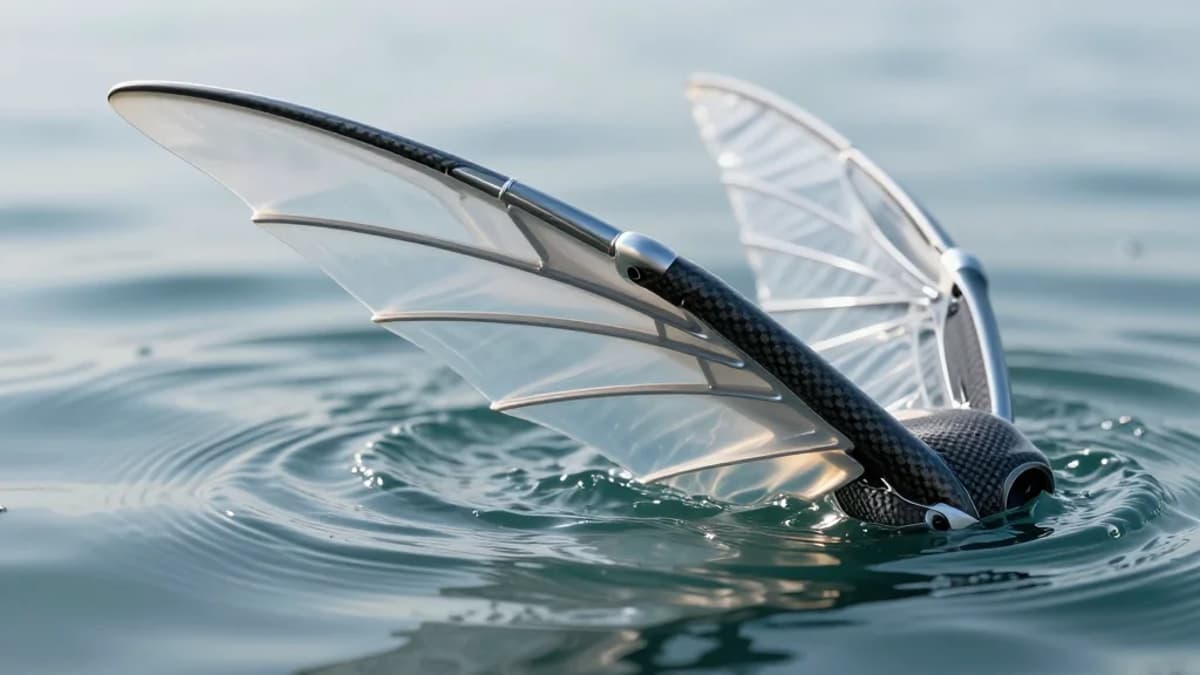
Robotic Wing Inspired by Nature Delivers Leap in Underwater Stability
•February 27, 2026
0
Why It Matters
The breakthrough dramatically boosts stability and cuts energy use, extending mission duration and safety for AUVs in turbulent seas. Faster, smarter soft robotics narrows the performance gap between machines and marine life, unlocking new commercial and scientific opportunities.
Key Takeaways
- •Wing cuts uplift impulse by 87% versus rigid AUV wings
- •Responds four times faster than comparable soft‑wing designs
- •Consumes five times less energy than thermal‑actuated systems
- •Integrated liquid‑metal e‑skin provides proprioceptive feedback
- •Could enable more agile, energy‑efficient underwater robots
Pulse Analysis
Stability has long been a weak point for autonomous underwater vehicles, which rely on rigid control surfaces that waste energy fighting unpredictable currents. Soft robotics offers a biologically inspired alternative, but early prototypes struggled with slow actuation and limited sensing. By embedding liquid‑metal wires within a silicone matrix, the Southampton team created an e‑skin that functions like a nervous system, delivering real‑time proprioceptive data and instant shape changes. This approach mirrors the way birds adjust feather camber and fish sense flow with their lateral line, translating natural efficiency into engineered performance.
The experimental wing demonstrated an 87% reduction in uplift impulse, a fourfold increase in response speed, and a fivefold drop in power consumption compared with thermal‑actuated soft wings. These metrics translate into tangible operational gains: AUVs can maintain course with far less thruster input, preserving battery life and extending survey windows. Moreover, the hybrid passive‑active control strategy enables the vehicle to absorb disturbances passively while still executing precise maneuvers, a balance that traditional rigid designs cannot achieve without heavy energy penalties.
Beyond laboratory validation, the technology could reshape several marine sectors. Offshore inspection drones, marine‑science gliders, and defense‑grade surveillance platforms all demand long endurance and resilience in rough water. Integrating proprioceptive e‑skin with existing hulls could reduce payload weight and simplify control algorithms. Scaling challenges—such as durability of liquid‑metal conductors and seamless coupling with rigid frames—remain, but ongoing advances in soft actuators and additive manufacturing suggest a clear pathway toward commercial deployment. As the ocean becomes a more contested and data‑rich environment, smarter, softer robots are poised to become indispensable tools.
Robotic wing inspired by nature delivers leap in underwater stability
0
Comments
Want to join the conversation?
Loading comments...