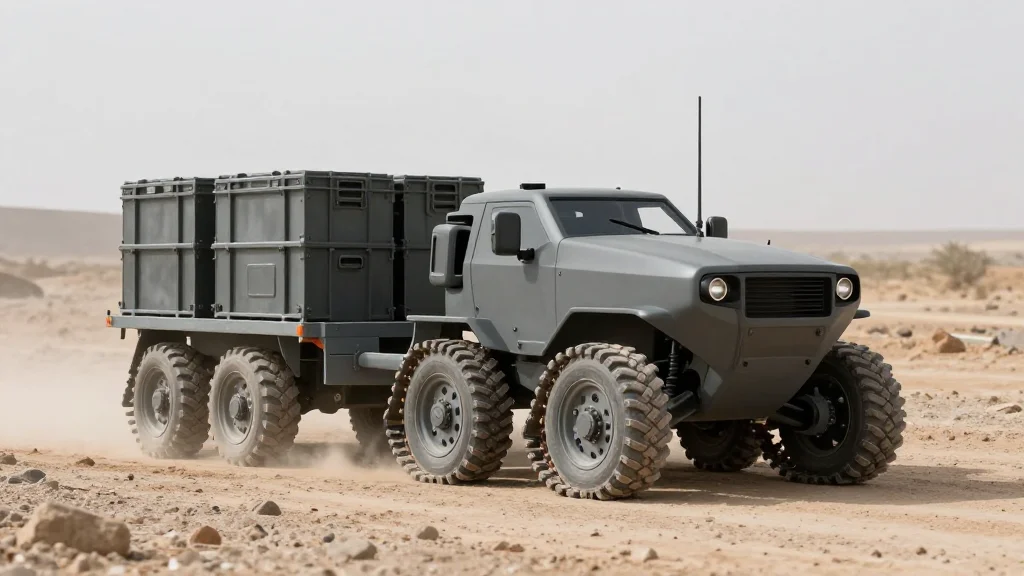
Russia’s ‘Courier’ Robot Doubles Payload to 400 Kg in Field Test

Why It Matters
The successful payload‑doubling test signals a maturing of Russia’s unmanned ground vehicle (UGV) capabilities, a sector that has lagged behind Western counterparts in terms of operational range and load capacity. By proving that a relatively lightweight robot can safely ferry 400 kg across rough terrain, the Ministry of Defence demonstrates a practical pathway to reducing soldier exposure during resupply missions. This development also showcases the modular nature of the platform, suggesting a future where a single chassis can be reconfigured for fire support, smoke generation, or logistics, thereby streamlining procurement and maintenance. For the broader robotics industry, the “Courier” test underscores the growing convergence of autonomous navigation, payload handling, and rugged mechanical design. As militaries worldwide seek to automate logistics, the Russian approach—leveraging a modest‑size robot with a trailer to achieve higher payloads—offers a cost‑effective alternative to larger, more complex autonomous trucks. The demonstration may accelerate interest in hybrid payload solutions that combine small UGVs with detachable cargo modules, influencing both defense and commercial markets.
Key Takeaways
- •Russian Ministry of Defence released video on April 11 showing the “Courier” robot hauling 400 kg with a trailer.
- •Standard payload is 200 kg; trailer doubles capacity to 400 kg while maintaining mobility across fields, sand, and hills.
- •Operator Dymok quoted saying the robot “effectively performs its functions, and a person does not have to risk himself.”
- •Earlier tests equipped “Courier” with a 107‑mm MLRS, mortar, and smoke‑screen modules, highlighting modular design.
- •Future trials will assess winter performance and integration with autonomous navigation systems.
Pulse Analysis
The “Courier” field test reflects a strategic shift toward distributed logistics in modern warfare. Historically, heavy‑payload transport has relied on manned trucks or large unmanned platforms that are costly and logistically cumbersome. By opting for a smaller, modular robot that can be paired with a simple trailer, Russia is betting on scalability and rapid reconfiguration. This approach mirrors trends in the commercial sector, where last‑mile delivery drones are paired with detachable cargo pods to increase flexibility without inflating vehicle size.
From a competitive standpoint, the demonstration narrows the technology gap with Western UGV programs such as the U.S. Army’s RCV (Robotic Combat Vehicle) and the UK’s THeMIS. While those platforms aim for multi‑ton payloads, they also require extensive support infrastructure. “Courier” offers a lower‑threshold entry point that could be fielded more quickly and at a reduced cost, potentially prompting NATO to reconsider the balance between high‑capacity autonomous trucks and agile, modular systems.
Looking ahead, the key to the robot’s broader adoption will be its ability to operate autonomously for extended periods and to integrate seamlessly with existing command networks. If the upcoming winter trials prove successful, the “Courier” could become a template for a new class of lightweight, high‑payload UGVs that serve both military and civilian markets, driving a wave of innovation in rugged autonomous logistics.
Russia’s ‘Courier’ Robot Doubles Payload to 400 kg in Field Test
Comments
Want to join the conversation?
Loading comments...