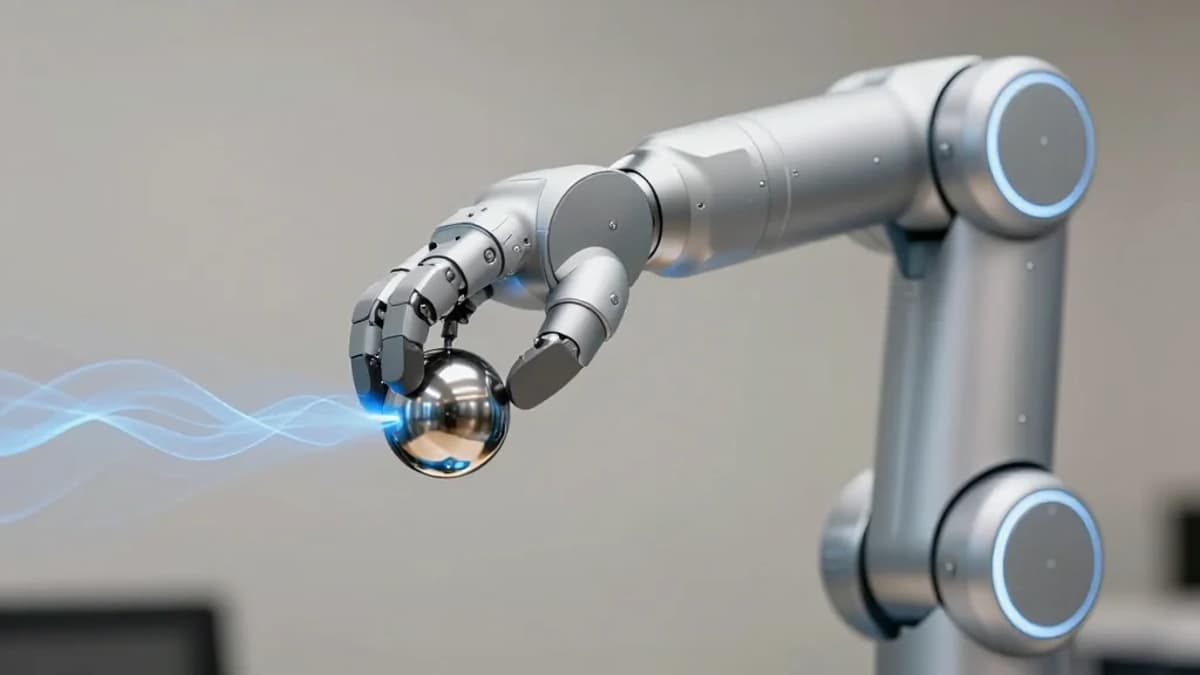
Scientists Develop Advanced Low-Damping Impedance Control for Collaborative Robots
•January 27, 2026
0
Why It Matters
The breakthrough enables cobots to perform high‑precision, high‑force tasks safely, expanding their role in advanced manufacturing and human‑robot collaboration.
Key Takeaways
- •Adaptive jerk control reduces force‑tracking errors.
- •Biased sliding surface estimates force offsets in real time.
- •Enables high stiffness with low damping in cobots.
- •Expands stable impedance parameter selection range.
- •Experimental validation shows improved contact stability.
Pulse Analysis
The new low‑damping impedance control framework addresses a long‑standing gap in collaborative robot technology. Traditional impedance schemes often suffer from model uncertainties that generate force‑tracking errors, limiting their use in high‑speed, high‑force applications such as impact riveting or spot welding. By integrating a biased sliding surface, the system continuously monitors dynamic force‑position relationships, providing a real‑time correction mechanism that keeps the robot’s interaction compliant yet precise.
At the core of the advancement is the adaptive jerk controller, which leverages jerk— the rate of change of acceleration— to suppress residual force offsets exponentially. This approach not only improves tracking fidelity but also broadens the admissible range of impedance parameters, allowing engineers to select higher stiffness values without sacrificing low damping. The result is a cobot that can react swiftly to sudden disturbances while maintaining stable contact, a critical requirement for delicate assembly and human‑robot collaboration in modern factories.
Experimental validation confirms the method’s superiority over conventional controllers, delivering measurable gains in contact stability and force accuracy. For manufacturers, this translates into reduced cycle times, higher product quality, and safer shared workspaces. As industries push toward greater automation and flexible production lines, the ability to fine‑tune cobot dynamics with low‑damping, high‑stiffness impedance control positions this technology as a catalyst for next‑generation industrial robotics.
Scientists develop advanced low-damping impedance control for collaborative robots
0
Comments
Want to join the conversation?
Loading comments...