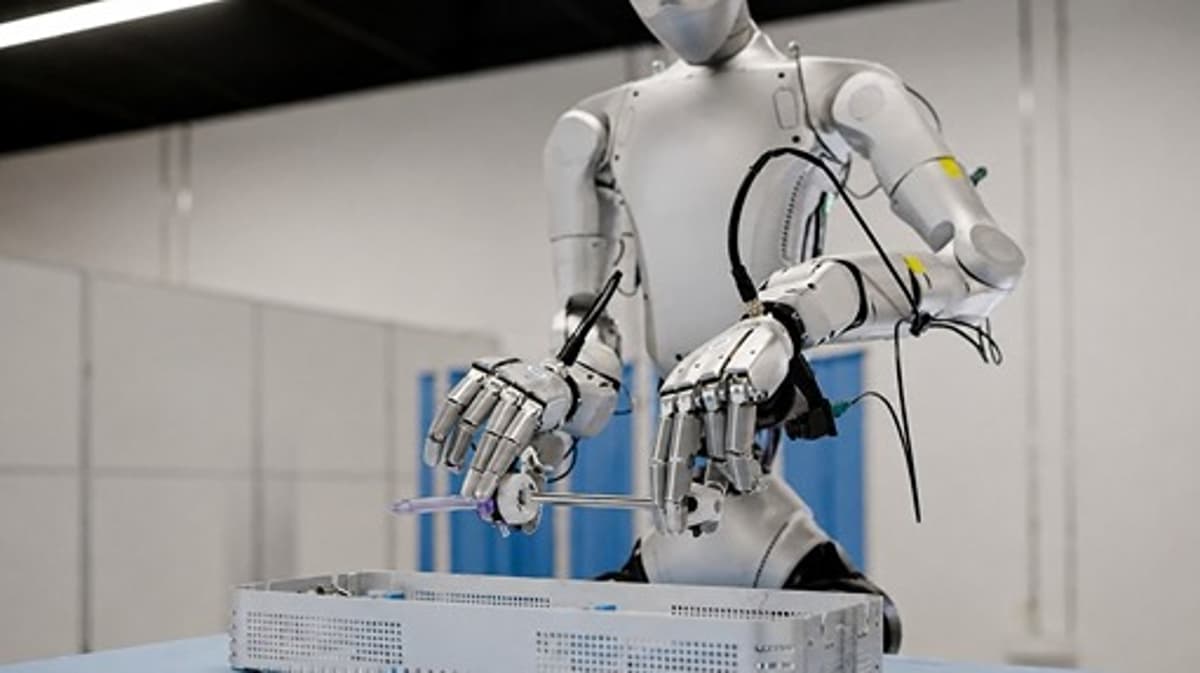
Sharpa Hands Added to NVIDIA Humanoid Robot Design
Why It Matters
The integration accelerates humanoid AI development by unifying hardware, simulation, and on‑board compute, lowering barriers for researchers and speeding time‑to‑market for advanced robotic applications.
Key Takeaways
- •Sharpa Wave adds 22 DOF per hand, total 75 DOF.
- •Integrated design cuts robot setup from days to hours.
- •Jetson AGX Thor provides Blackwell AI compute on‑board.
- •Over 1,000 tactile pixels per fingertip enable fine manipulation.
- •Seamless sim‑to‑real workflow via Isaac Sim and Lab.
Pulse Analysis
The partnership between Sharpa and NVIDIA marks a pivotal step in the race to commercialize general‑purpose humanoid robots. By embedding Sharpa’s Wave tactile hands into the Isaac GR00T reference platform, developers gain a ready‑made, human‑scale body that can grasp, rotate, and manipulate objects with a fidelity previously limited to lab‑only prototypes. This convergence addresses a long‑standing bottleneck: the fragmented workflow that forced teams to stitch together disparate hardware, collect data, and manually bridge simulation gaps.
Technical depth sets this reference design apart. Each Wave hand delivers 22 degrees of freedom and a high‑resolution tactile array exceeding 1,000 pressure‑sensitive pixels per fingertip, offering 0.02 N sensitivity. Coupled with the Unitree H2 Plus chassis’s 31 body DOF and NVIDIA’s Jetson AGX Thor powered by the Blackwell architecture, the robot can run sophisticated AI models locally, enabling real‑time inference and closed‑loop control. Researchers can now capture demonstration data, train policies in Isaac Sim or Isaac Lab, and transition to physical deployment with minimal sim‑to‑real discrepancy.
From a market perspective, the integrated solution lowers entry costs and development timelines, making advanced humanoid research more accessible to universities, startups, and enterprise labs. It also strengthens NVIDIA’s ecosystem, positioning the company as the de‑facto platform for physical AI while giving Sharpa a flagship showcase for its tactile technology. As industries—from logistics to healthcare—seek robots capable of nuanced, human‑like interaction, this reference design could become a foundational building block for the next generation of service robots.
Sharpa hands added to NVIDIA humanoid robot design
Comments
Want to join the conversation?
Loading comments...