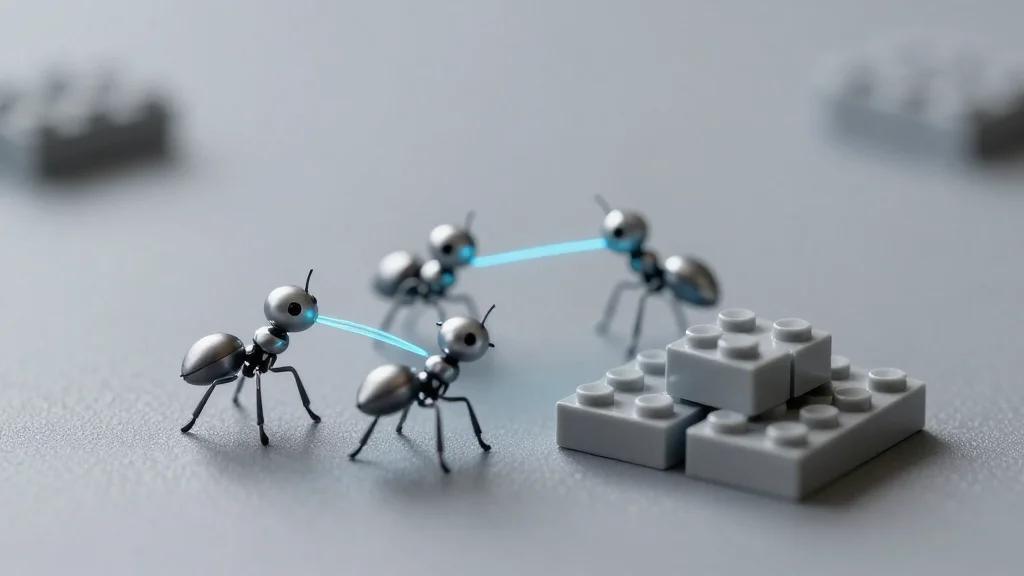
Simple Robots Inspired by Ants Collectively Build and Excavate
Why It Matters
The work shows that decentralized, rule‑based swarms can perform complex construction tasks, opening pathways for autonomous building in hazardous or extraterrestrial settings. It also provides a physical testbed for studying emergent behavior in biological and artificial systems.
Key Takeaways
- •Robotic 'RAnts' use light cues to mimic ant pheromone communication.
- •Swarm switches between building and excavating by adjusting cooperation strength.
- •Simple local rules generate complex, self‑organized structures without central control.
- •Study introduces 'exbodied intelligence' linking agents to evolving environment.
- •Potential applications include hazardous‑site construction and planetary exploration.
Pulse Analysis
Ant colonies have long inspired engineers because their collective actions arise from simple, local interactions—a principle known as stigmergy. Harvard’s RAnt platform translates this biology into hardware by replacing chemical pheromones with programmable light fields, or photormones, that each robot can sense and modify. This minimalistic communication scheme lets dozens of units coordinate their movements and material handling without a master algorithm, offering a scalable model for swarm robotics that mirrors nature’s efficiency.
The researchers identified two pivotal parameters—cooperation strength and deposition rate—that dictate whether the swarm builds up or tears down structures. By fine‑tuning how strongly robots follow light gradients and whether they add or remove blocks, the collective can transition seamlessly between construction and excavation. This tunability exemplifies the newly coined “exbodied intelligence,” where cognition is not confined to individual agents but emerges from their ongoing dialogue with an evolving environment. The study’s theoretical framework extends classic aggregation models to account for dynamic feedback loops, providing a quantitative lens on emergent swarm behavior.
Beyond academic intrigue, the technology promises real‑world impact. Autonomous swarms could erect shelters in disaster zones, assemble habitats on the Moon or Mars, and perform maintenance in radioactive sites where human presence is risky. Moreover, the RAnt system serves as a physical sandbox for testing hypotheses about animal group dynamics, bridging robotics and biology. As industries seek resilient, adaptable automation, the ability to program collective intelligence through simple rules could become a cornerstone of next‑generation manufacturing and exploration strategies.
Simple robots inspired by ants collectively build and excavate
Comments
Want to join the conversation?
Loading comments...