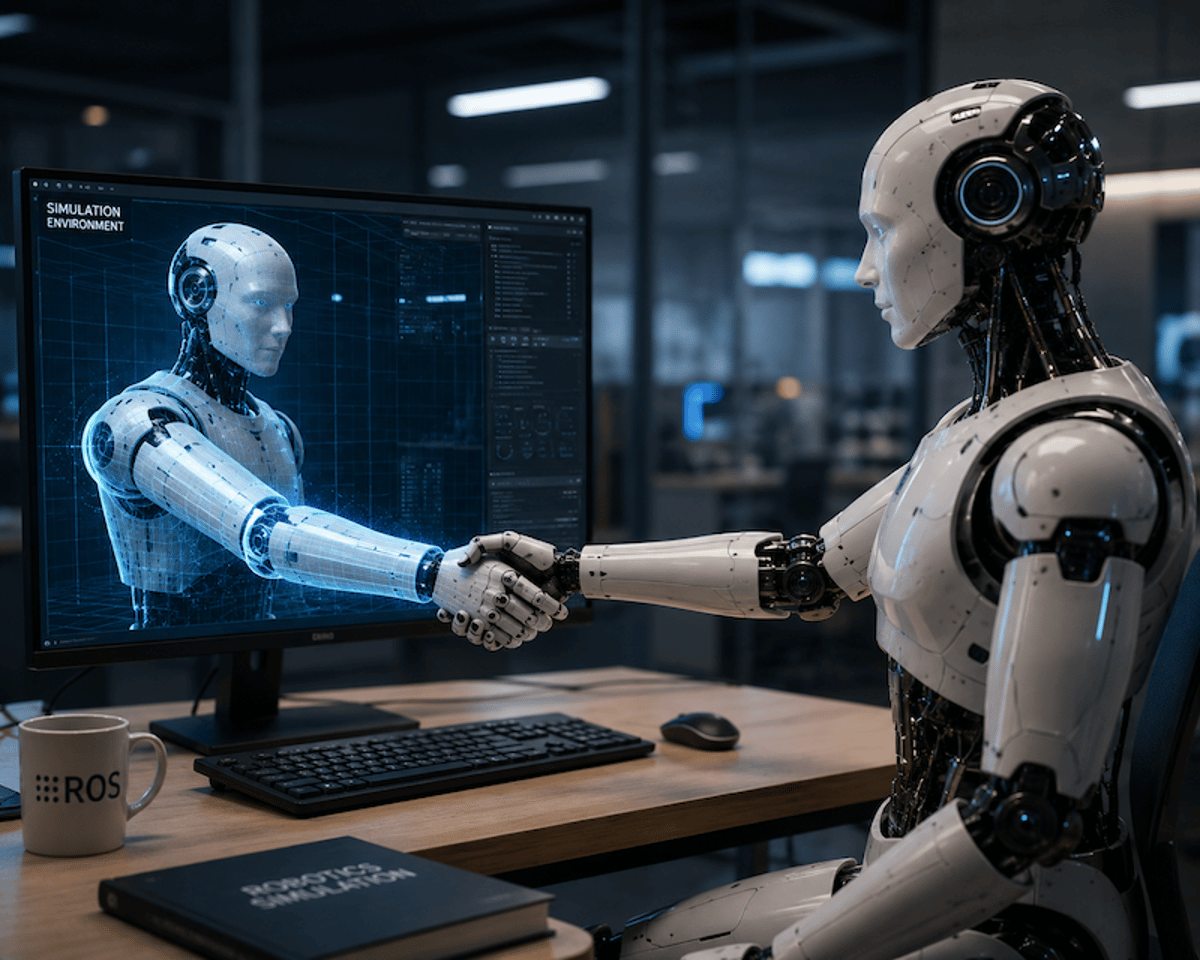
Simulation Tools in the ROS Ecosystem: Testing and Validating Robots Virtually
Why It Matters
Simulation slashes development costs and accelerates time‑to‑market while reducing safety risks, making advanced robotics accessible to a broader range of innovators. Its growing fidelity also bridges the simulation‑to‑reality gap, a critical hurdle for AI‑driven autonomous systems.
Key Takeaways
- •ROS and Gazebo democratize robot development for startups and academia
- •Modern Gazebo (Ignition) offers modular architecture aligned with ROS 2
- •Simulation narrows the reality gap via domain randomization and synthetic data
- •Digital twins extend simulation from robot design to whole‑factory optimization
- •Nvidia Isaac Sim adds advanced AI integration to open‑source workflows
Pulse Analysis
The convergence of ROS and simulation tools has reshaped how robots are engineered. By providing a common set of libraries, messaging protocols, and a realistic physics engine, Gazebo lets developers prototype navigation, manipulation, and perception entirely in software. This open‑source ecosystem lowers entry barriers, allowing university labs and fledgling startups to compete with legacy industrial players without massive capital outlays. As ROS 2 introduces deterministic scheduling and enhanced security, the latest Ignition Gazebo version leverages a plug‑in architecture that lets teams swap physics, rendering, or sensor models without rewriting core code.
Beyond convenience, simulation addresses the most stubborn obstacle in robotics: the gap between virtual performance and real‑world behavior. High‑fidelity engines such as Bullet, ODE, and Nvidia PhysX model friction, contact dynamics, and sensor noise, yet subtle mismatches can still derail deployments. Researchers mitigate this through domain randomization—systematically varying lighting, textures, and sensor parameters—to produce models that generalize across unpredictable environments. Autonomous‑vehicle developers exemplify the payoff, accumulating millions of virtual miles to expose self‑driving stacks to rare edge cases that would be impractical or unsafe to capture on physical roads.
Looking ahead, simulation is evolving from a testing sandbox into a strategic asset. Digital twins now mirror entire factories, enabling real‑time optimization of robot cells, workflow bottlenecks, and layout changes before any metal is cut. Commercial platforms like Nvidia Isaac Sim complement the open‑source stack by delivering photorealistic rendering and synthetic data pipelines tailored for machine‑learning pipelines. As physical AI matures—robots that learn tasks through reinforcement learning—simulation will supply the massive, varied datasets required for robust training, cementing its role as the primary workplace for tomorrow’s robotic innovators.
Simulation tools in the ROS ecosystem: Testing and validating robots virtually
Comments
Want to join the conversation?
Loading comments...