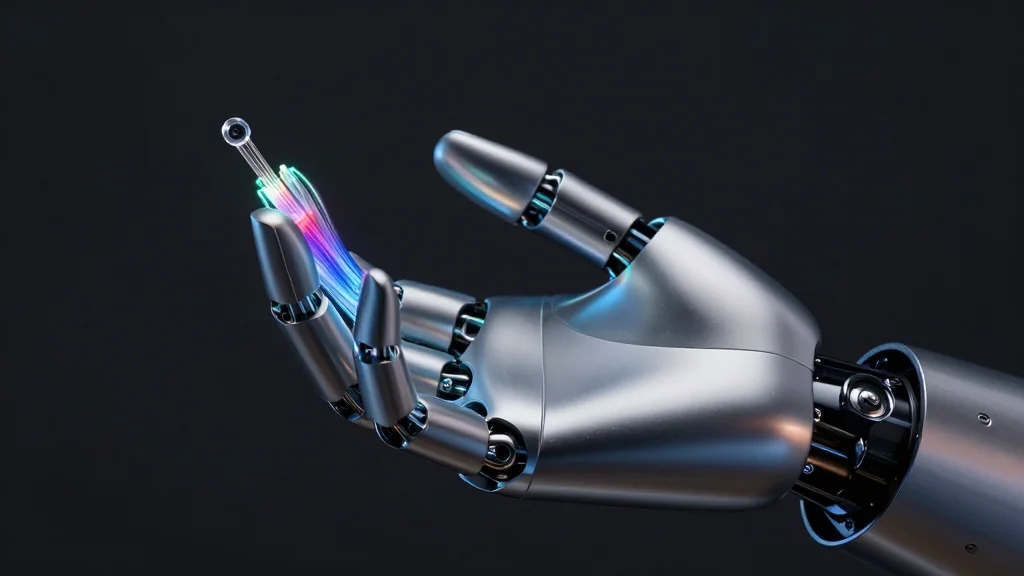
Soft Sensor Gives Robots a Better Sense of Touch

Why It Matters
Accurate proprioception transforms robotic hands from simple grippers into dexterous manipulators, opening new service, industrial and medical applications that demand human‑level precision.
Key Takeaways
- •Omnidirectional sensor decouples pitch and yaw simultaneously
- •Measurement error under 2.5° for both axes
- •Hand performs scissors, mouse, piano tasks accurately
- •Low crosstalk ratios exceed 30 dB, ensuring signal clarity
- •18 DOF rigid‑soft hand mimics human finger motion
Pulse Analysis
The breakthrough stems from a soft optical sensor that leverages three‑color light attenuation through segmented PMMA fibers. By assigning each color channel to a distinct bending direction, the system isolates pitch from yaw without the coupling that plagues traditional soft sensors. This design preserves the compliance of soft materials while delivering the high‑resolution feedback typically reserved for rigid encoders, positioning it as a versatile solution for next‑generation humanoid hands.
Performance data underscores the sensor’s practicality. Over a hundred loading cycles the device maintained an RMSE below 2.1 % across all optical channels, and single‑axis tests recorded angular errors of just ±2.13° for pitch and ±2.34° for yaw. Crosstalk measurements stayed under 5 %, translating to signal‑to‑crosstalk ratios above 30 dB. Integrated into an 18‑DOF hand, the sensor enabled real‑time closed‑loop control for tasks that demand fine motor skills—cutting with scissors, navigating a computer mouse, and striking piano keys—demonstrating a level of finesse previously limited to human operators.
Beyond the laboratory, this technology could reshape markets where delicate manipulation is critical. Service robots in hospitality or healthcare can now handle fragile objects without damaging them, while manufacturers gain a tool for assembling intricate components at higher speeds. Rehabilitation devices may also benefit, offering patients more naturalistic hand assistance. As the industry pushes toward collaborative robots that work safely alongside people, the ability to sense and correct finger posture in real time will be a decisive competitive advantage.
Soft Sensor Gives Robots a Better Sense of Touch
Comments
Want to join the conversation?
Loading comments...