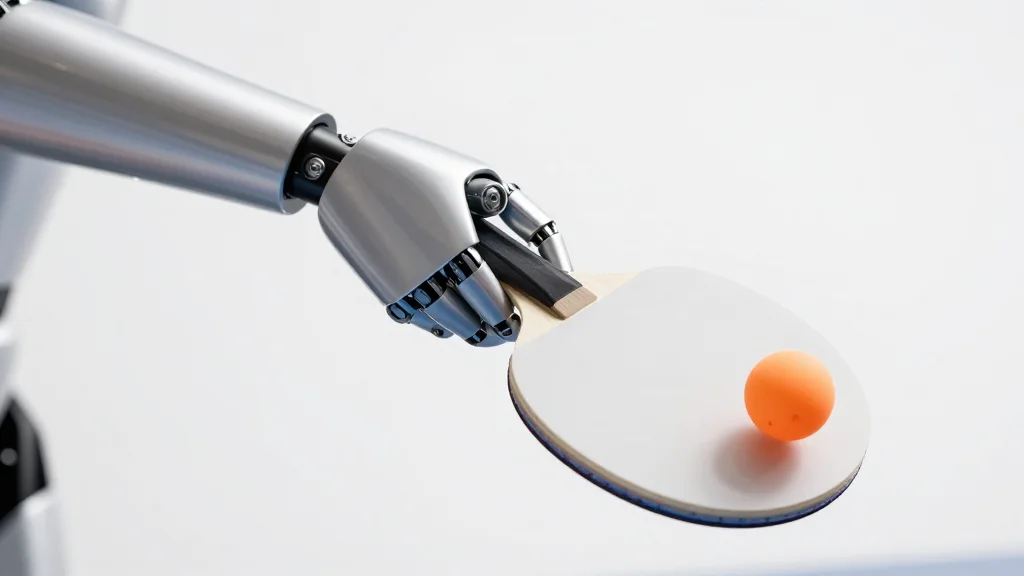
Sony’s ‘Ace’ Robot Arm Beats Pro Table‑Tennis Players, Showcasing Real‑Time AI Speed

Companies Mentioned

Why It Matters
Ace’s victory over professional athletes demonstrates that robots can now operate with human‑level perception and decision‑making in fast‑changing environments. This breakthrough narrows the gap between static industrial automation and truly collaborative robots that can safely and efficiently share workspaces with humans. By proving that reinforcement learning can be applied to split‑second physical tasks, Sony sets a benchmark that could accelerate adoption of adaptive robotics across logistics, healthcare, and manufacturing, sectors where latency and flexibility have been limiting factors. Furthermore, the public nature of the demonstration raises the profile of AI‑driven robotics among investors and corporate decision‑makers, potentially unlocking new funding streams for startups focused on real‑time perception. As more firms chase the same performance metrics, the competitive pressure could drive rapid innovation, lowering costs and expanding the range of viable applications for high‑speed robotic arms.
Key Takeaways
- •Sony’s robot arm ‘Ace’ regularly beats professional table‑tennis players.
- •Uses a mirror‑based camera and reinforcement‑learning algorithms for millisecond‑level reaction.
- •President Michael Spranger highlights the shift from repetitive to adaptive robot speed.
- •Demonstration marks the first expert‑level performance in a mainstream sport by a robot.
- •Potential rollout in dynamic manufacturing and collaborative settings within 12‑18 months.
Pulse Analysis
Sony’s Ace is more than a novelty; it is a proof‑point that the convergence of ultra‑fast visual processing and reinforcement learning can produce robots capable of human‑level agility. Historically, robotics has excelled in repeatable, high‑throughput tasks but struggled with variability. Ace’s success suggests that the next generation of industrial robots will be judged on their ability to learn on the fly, not just on their raw speed. This paradigm shift could erode the competitive advantage of firms that rely solely on deterministic programming, pushing the market toward AI‑centric solutions.
From a strategic perspective, Sony’s move positions it against traditional automation giants like FANUC and KUKA, which have invested heavily in precision but less in adaptive AI. By showcasing a system that can handle unpredictable ball trajectories, Sony signals readiness to enter markets where flexibility is premium, such as e‑commerce fulfillment centers that must handle a constantly changing mix of SKUs. If Sony can commercialize the underlying technology, it may capture a slice of the $150 billion global industrial robotics market that is currently dominated by hardware‑first players.
Looking forward, the real test will be scalability. Training a robot to master table tennis required massive simulation and real‑world data; replicating that pipeline for each new application could be cost‑prohibitive unless Sony develops a modular AI stack that can be fine‑tuned with minimal data. Competitors are likely to respond with their own fast‑perception platforms, potentially leading to an industry‑wide arms race in low‑latency sensing and edge AI. The outcome will shape the next decade of robotics, determining whether adaptive, AI‑driven machines become the new standard on factory floors worldwide.
Sony’s ‘Ace’ Robot Arm Beats Pro Table‑Tennis Players, Showcasing Real‑Time AI Speed
Comments
Want to join the conversation?
Loading comments...