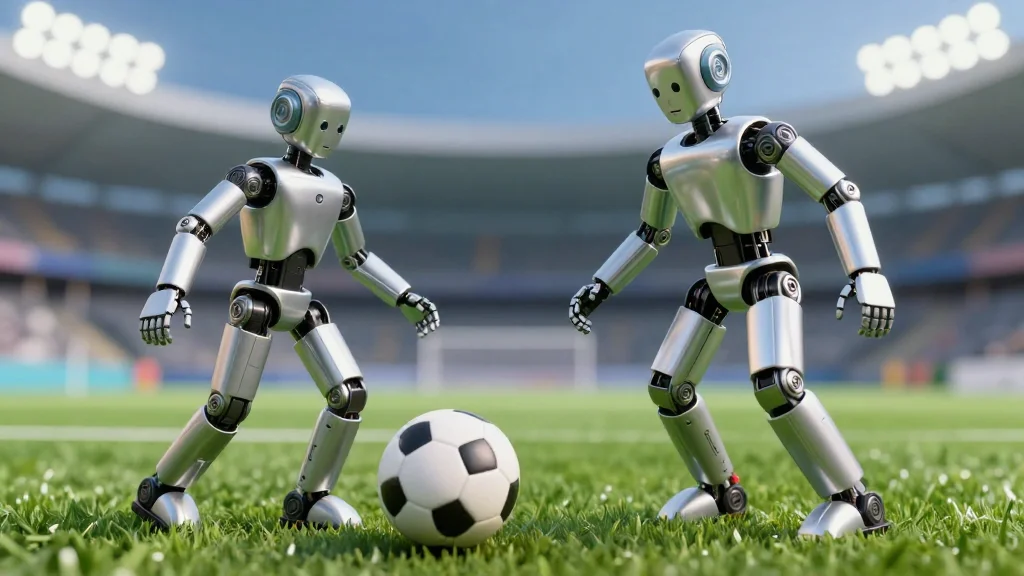
Student‑Programmed Humanoid Robots Clash in Beijing Football Match

Why It Matters
The Beijing football match demonstrates that sophisticated robotics capabilities are no longer confined to research labs or large corporations. By empowering middle‑school students to develop vision‑based, real‑time control systems, the event signals a democratization of the technology that could accelerate innovation across sectors such as manufacturing, logistics and personal assistance. Moreover, the public showcase helps shift cultural perceptions of robotics from futuristic novelty to an attainable skill set for the next generation. If educational institutions and industry partners can harness this enthusiasm, the pipeline of talent equipped to tackle challenges in autonomy, AI integration and human‑robot interaction will deepen. This could translate into faster adoption of collaborative robots (cobots) on factory floors, more robust autonomous vehicle algorithms, and new consumer products that blend physical presence with intelligent behavior.
Key Takeaways
- •Middle‑school students wrote the code that powered humanoid robots in a Beijing football match.
- •Robots used vision and multi‑agent coordination to locate the ball and execute plays.
- •The event underscores growing accessibility of advanced robotics education in China.
- •Public exposure may spur more industry‑academic partnerships for student competitions.
- •Future tournaments could expand participation to high‑school and university teams.
Pulse Analysis
The Beijing showdown is more than a novelty; it is a litmus test for how quickly advanced robotics can be taught at the K‑12 level. Historically, robotics curricula have focused on kit‑based platforms with limited autonomy. This event flips that script by demanding full perception‑action loops, a hallmark of cutting‑edge research. The fact that middle‑school coders delivered functional humanoid agents suggests that educational tools, open‑source libraries and low‑cost hardware have matured to a point where complex algorithms are no longer the exclusive domain of PhDs.
From a market perspective, the competition could catalyze a new segment of educational robotics services. Companies that provide simulation environments, sensor suites and cloud‑based training pipelines may find a ready customer base among schools eager to replicate the Beijing model. At the same time, larger robotics firms might scout these events for recruitment, tapping into a talent pool already fluent in real‑time systems and AI integration.
Looking forward, the key challenge will be scaling the model while maintaining safety and educational value. As robot capabilities expand, so does the risk of unintended behavior, especially in crowded or public settings. Establishing standardized testing frameworks and certification pathways will be essential to ensure that the excitement generated by student competitions translates into responsible, industry‑ready expertise. The Beijing match, therefore, is both a celebration of youthful ingenuity and a preview of the governance structures the robotics ecosystem will need to develop.
Student‑Programmed Humanoid Robots Clash in Beijing Football Match
Comments
Want to join the conversation?
Loading comments...