Why It Matters
The breakthroughs demonstrate that micro‑robots can now operate at unprecedented speeds and with assembly accuracy comparable to macro‑scale systems, opening pathways for high‑throughput manufacturing and minimally invasive medical procedures. Industry stakeholders see the competition as a benchmark for future commercial micro‑robotic solutions.
Key Takeaways
- •French team set 32 ms record in 2 mm dash.
- •ETH Zurich won assembly with perfect 12‑peg score.
- •Carnegie Mellon broke record then placed second in freestyle.
- •Stevens Institute secured third place in freestyle competition.
- •NIST hosted challenge with IEEE and Georgia Tech partnership.
Pulse Analysis
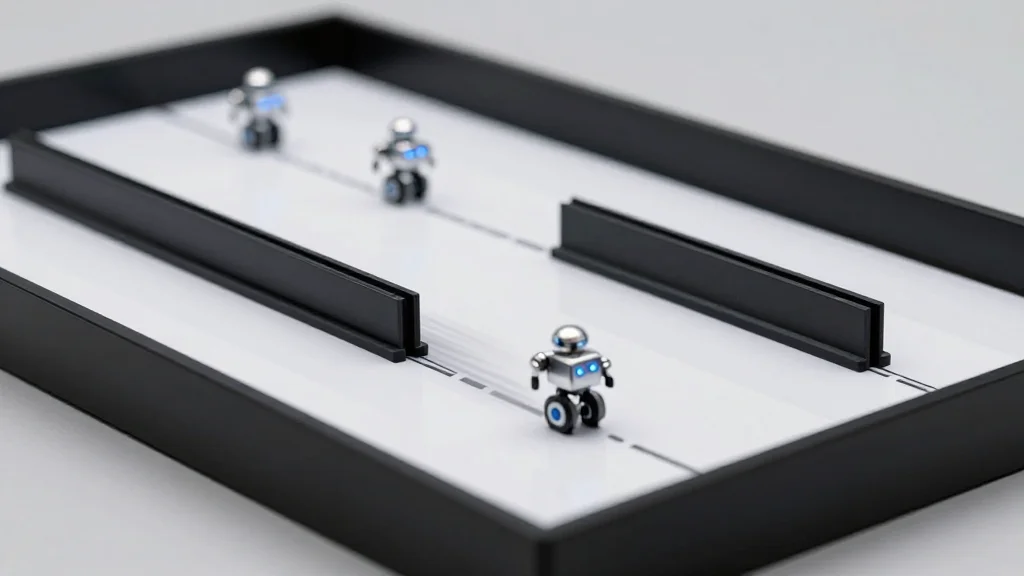
The Mobile Microrobotics Challenge, organized by NIST in collaboration with IEEE and Georgia Tech, gathered six research teams from North America and Europe to showcase sub‑millimeter robots. Competitors faced three distinct tests—a 2 mm dash, an assembly task, and a freestyle maneuvering round—each designed to push the limits of speed, precision, and three‑dimensional control. By staging the event in a controlled water‑filled arena, the organizers created a realistic micro‑environment that mirrors the conditions of future biomedical and manufacturing applications, drawing attention from industry leaders and academic institutions alike.
The dash portion produced a dramatic leap in performance. Carnegie Mellon’s microbot initially eclipsed ETH Zurich’s record with a 78 ms run, only to be overtaken minutes later by a French team that clocked an astonishing 32 ms average. Such sub‑100 ms transit times at the 2 mm scale signal a breakthrough in actuation and power‑density technologies, enabling rapid positioning of sensors or drug‑delivery capsules. Meanwhile, ETH Zurich’s flawless 12‑peg assembly demonstrated that micro‑robots can now execute repeatable, high‑precision tasks previously limited to macro‑scale automation.
The freestyle segment highlighted the next frontier: true three‑dimensional locomotion in fluidic media. ETH Zurich’s robot not only swam beyond the arena’s edge but also retrieved previously placed pegs, illustrating autonomous decision‑making and environmental interaction. Carnegie Mellon’s modular swarm, which assembled and disassembled on demand, points toward scalable micro‑robot collectives capable of complex tasks such as tissue scaffolding or micro‑fabrication. As standards bodies like NIST continue to benchmark performance, the rapid progress seen at this competition suggests that commercial micro‑robotic platforms could emerge within the next five years, reshaping sectors from healthcare to semiconductor manufacturing.
Swiss And Euro Microbots Win Gold
Comments
Want to join the conversation?
Loading comments...