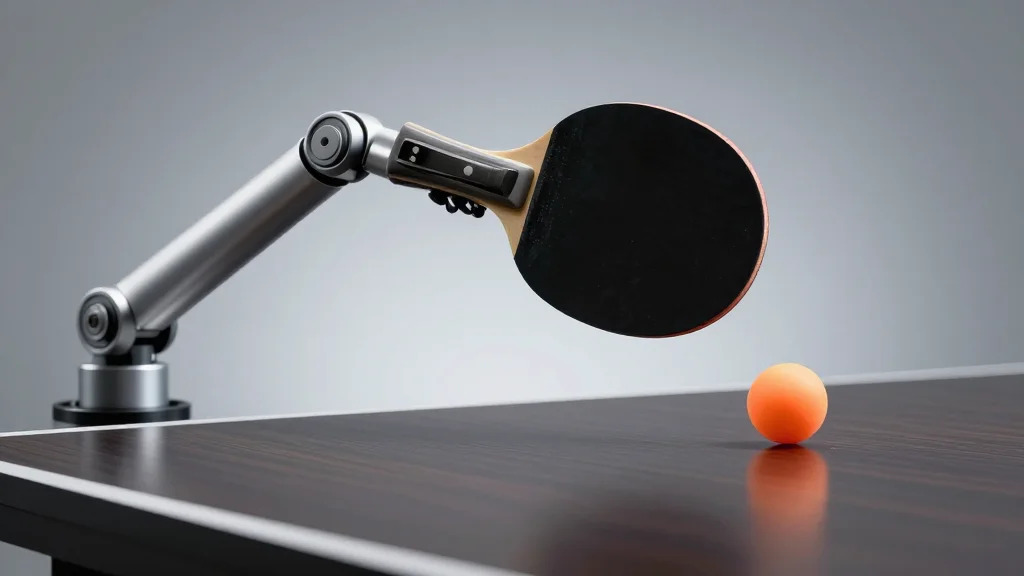
Table Tennis Robot Defeats some of World's Best Players. Why This Has Major Implications for Robotics
Companies Mentioned
Why It Matters
Ace proves AI can operate reliably in fast, uncertain physical environments, opening pathways for flexible automation and safer human‑robot collaboration across industries.
Key Takeaways
- •Ace uses event‑based vision and high‑speed cameras for real‑time spin detection
- •Deep reinforcement learning trained in simulation enables sub‑100 ms decision cycles
- •Multi‑joint arm achieves 20 m/s returns, rivaling elite human players
- •Demonstrates viable sim‑to‑real transfer for robotics in unstructured settings
- •Highlights potential for safe human‑robot collaboration in shared workspaces
Pulse Analysis
The breakthrough behind Ace lies in its sensory stack. By pairing three event‑based vision sensors with nine high‑speed cameras, the robot captures millisecond‑level changes in ball trajectory and spin—data that traditional frame‑based cameras miss. This rich perception feeds a deep reinforcement‑learning controller that was honed in millions of simulated rallies, allowing the system to recompute optimal joint trajectories every few tens of milliseconds. The result is a fluid, sub‑100 ms response that rivals human reflexes on a regulation table.
Beyond sport, Ace’s capabilities signal a shift for industrial and service robotics. Current factory arms excel in repetitive, structured tasks but falter when confronted with variability. The robot’s ability to predict, adapt, and act on unpredictable, high‑speed objects demonstrates a template for machines that must handle irregular parts, dynamic environments, or direct human interaction. In sectors such as healthcare, construction, and home assistance, this translates to robots that can safely share workspaces, adjust on the fly, and reduce the need for protective barriers.
Historically, AI milestones—Deep Blue, AlphaGo—proved intelligence in abstract, rule‑bound domains. Ace extends that narrative into the physical world, where noise, latency, and biomechanics complicate decision‑making. Closing the simulation‑to‑real gap is now a tangible engineering problem rather than a theoretical one, accelerating research into robust perception, real‑time planning, and compliant actuation. As these technologies mature, we can expect a new generation of autonomous systems that not only solve puzzles but also navigate the messy realities of everyday tasks, reshaping productivity and safety standards across the economy.
Table tennis robot defeats some of world's best players. Why this has major implications for robotics
Comments
Want to join the conversation?
Loading comments...