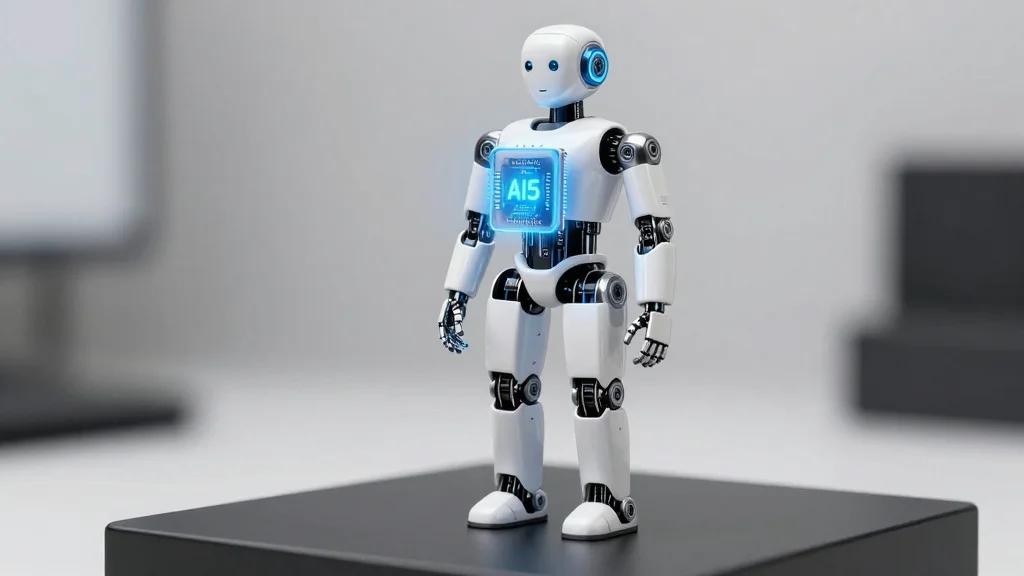
Tesla Deploys AI5 Chip to Accelerate Optimus Humanoid Robot Rollout

Companies Mentioned
Why It Matters
Tesla’s decision to prioritize the AI5 chip for Optimus marks a watershed moment for the robotics industry, demonstrating that a major automaker is now betting its future on humanoid robots. By integrating custom silicon directly into robots, Tesla aims to lower the cost of high‑performance AI perception, potentially accelerating the commercialization of autonomous service robots across logistics, manufacturing, and consumer markets. The move also intensifies competition with established robot makers such as Boston Dynamics and emerging AI‑chip startups, forcing the sector to confront the economics of in‑house versus outsourced silicon. If Optimus can deliver on Musk’s promise of reliable, real‑time environmental processing, it could validate a new business model where robotics revenue supplements or even surpasses automotive sales. This would reshape investor expectations for legacy manufacturers and could spur a wave of capital toward AI‑centric hardware platforms, influencing supply‑chain dynamics, talent allocation, and regulatory scrutiny around autonomous machines operating in public spaces.
Key Takeaways
- •Tesla’s AI5 chip, comparable to NVIDIA’s $30,000 H100 GPU, will first power Optimus humanoid robots.
- •The AI5 delivers up to 10× the compute of AI4 and includes 192 GB of LPDDR5X memory.
- •Tesla’s stock jumped nearly 8% after the AI5 announcement, later stabilizing at $407 per share.
- •Terafab, a $20‑$25 billion vertically integrated fab, aims to produce 1 TW of AI compute annually for robots and data centers.
- •Elon Musk predicts AI‑driven “universal high income,” tying robot deployment to broader economic transformation.
Pulse Analysis
Tesla’s pivot to robotics is more than a product diversification; it is a strategic re‑branding of the company as an AI‑infrastructure provider. By keeping the AI5 chip in‑house, Tesla sidesteps the supply‑chain bottlenecks that have plagued other chip‑dependent robot manufacturers. This vertical integration could translate into lower per‑unit costs for Optimus, a critical factor for scaling beyond niche industrial applications.
Historically, robot makers have relied on off‑the‑shelf processors, limiting their ability to tailor compute to the unique latency and power constraints of humanoid platforms. Tesla’s approach mirrors its earlier disruption of the automotive supply chain, where custom silicon enabled rapid iteration of Full Self‑Driving capabilities. If the AI5 can indeed match H100 performance in a fraction of the footprint, Optimus may achieve a cost‑performance sweet spot that makes it viable for mass‑market services such as last‑mile delivery or retail assistance.
However, the roadmap is fraught with execution risk. The Terafab’s ambitious 1 TW output target dwarfs current global AI compute capacity and will require massive capital, skilled labor, and flawless yield management. Any delay could push Optimus’s commercial launch further out, eroding the market premium investors have already priced in. Moreover, Musk’s broader economic narrative—linking robot deployment to universal high income—adds a layer of public policy uncertainty. Regulators may scrutinize the societal impact of widespread humanoid automation, potentially imposing standards that affect design and deployment timelines.
In the short term, Tesla’s stock reaction underscores that the market is already valuing the robot bet heavily. The next earnings release will be a litmus test: strong guidance on Optimus production volumes and Terafab ramp‑up could cement Tesla’s status as a dual‑play on EVs and AI‑driven robotics. Conversely, muted guidance may reignite concerns that the robot vision is more hype than hard‑wired reality. For competitors, Tesla’s move forces a strategic choice—either double down on custom silicon or double up on partnerships with existing chipmakers—to stay relevant in the fast‑approaching era of humanoid automation.
Tesla Deploys AI5 Chip to Accelerate Optimus Humanoid Robot Rollout
Comments
Want to join the conversation?
Loading comments...