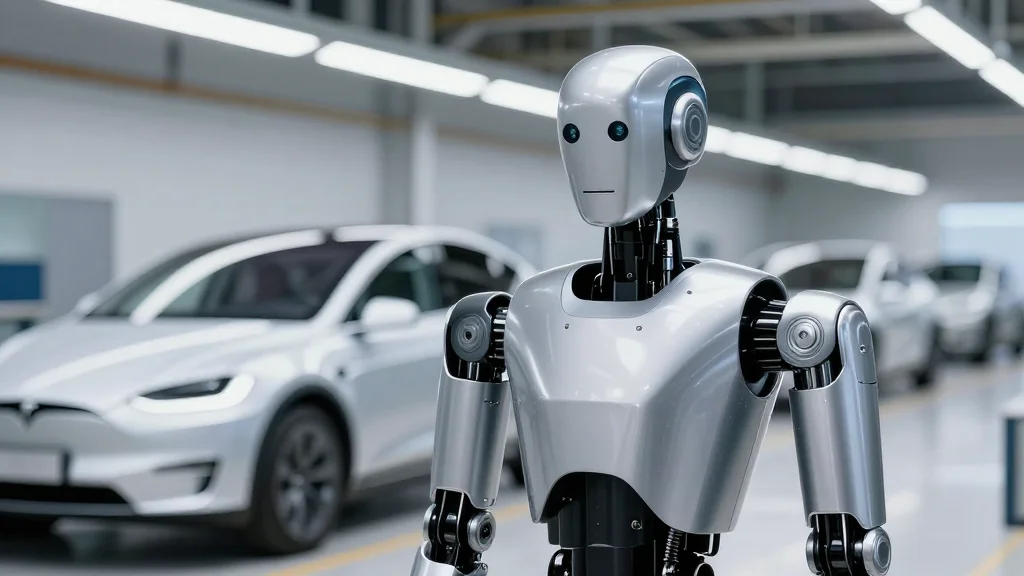
Tesla Halts Model S/X Production, Shifts Fremont to Humanoid Robots in July

Companies Mentioned
Why It Matters
Tesla’s decision to halt production of its most iconic luxury models and devote a historic EV plant to humanoid robots signals a bold redefinition of the company’s core business. If successful, the move could accelerate the commercialization of general‑purpose robots, a sector that has struggled to achieve scale beyond industrial automation. The shift also underscores the growing convergence of AI, robotics, and electric powertrains, positioning Tesla to compete not only with traditional automakers but also with tech firms such as Boston Dynamics, Amazon’s Astro, and emerging Chinese robot manufacturers. The pivot may also influence broader industry investment patterns. A rising share price despite a recall suggests that capital markets are willing to reward bets on robotics over conventional vehicle sales, potentially spurring other manufacturers to explore similar reallocations of factory capacity. Moreover, the integration of Tesla’s AI expertise into a physical robot could set new standards for perception, navigation, and human‑robot interaction, raising the bar for competitors and accelerating the overall pace of innovation in the robotics ecosystem.
Key Takeaways
- •Tesla ends Model S and Model X production at Fremont, converting lines for Optimus robots by late July.
- •Elon Musk emphasized the shift: "Tesla is not a car company, but an AI and robotics company."
- •Shares rose over 4% on the news despite a recall of 173 Cybertrucks for wheel‑stud issues.
- •Analysts maintain a Moderate Buy rating with a $410.21 mean price target, reflecting optimism about robotics margins.
- •Long‑range Tesla Semi disclosed with 822 kWh usable battery capacity, highlighting continued EV focus.
Pulse Analysis
Tesla’s Fremont pivot is more than a production shuffle; it is a strategic bet that the higher‑margin, lower‑volume robotics business can outpace the diminishing returns of its luxury EV segment. Historically, automakers have struggled to diversify into unrelated hardware categories, but Tesla’s deep integration of AI across its product stack gives it a unique advantage. The Optimus robot leverages the same neural‑network training pipelines that power Full Self‑Driving, potentially delivering perception capabilities that are orders of magnitude ahead of current industrial bots.
However, the path to profitability is fraught with risk. Humanoid robots have historically suffered from high unit costs, limited use cases, and regulatory uncertainty. Tesla will need to achieve economies of scale quickly to justify the capital outlay required to retool Fremont. The company’s ability to price Optimus competitively while maintaining a healthy gross margin will be the ultimate test of the pivot’s financial logic. Moreover, the recall of Cybertrucks, albeit small in absolute numbers, highlights the operational challenges of scaling new hardware under tight timelines.
If Tesla can demonstrate a viable production model for Optimus, it could catalyze a wave of investment into consumer‑focused robotics, prompting legacy automakers and pure‑play tech firms to accelerate their own robot programs. The move also forces investors to reassess valuation metrics for Tesla, shifting focus from vehicle delivery numbers to robot unit shipments and AI service revenue. In the short term, the market’s positive reaction suggests confidence, but the real verdict will come when the first Optimus units leave the line and begin real‑world deployments.
Tesla Halts Model S/X Production, Shifts Fremont to Humanoid Robots in July
Comments
Want to join the conversation?
Loading comments...