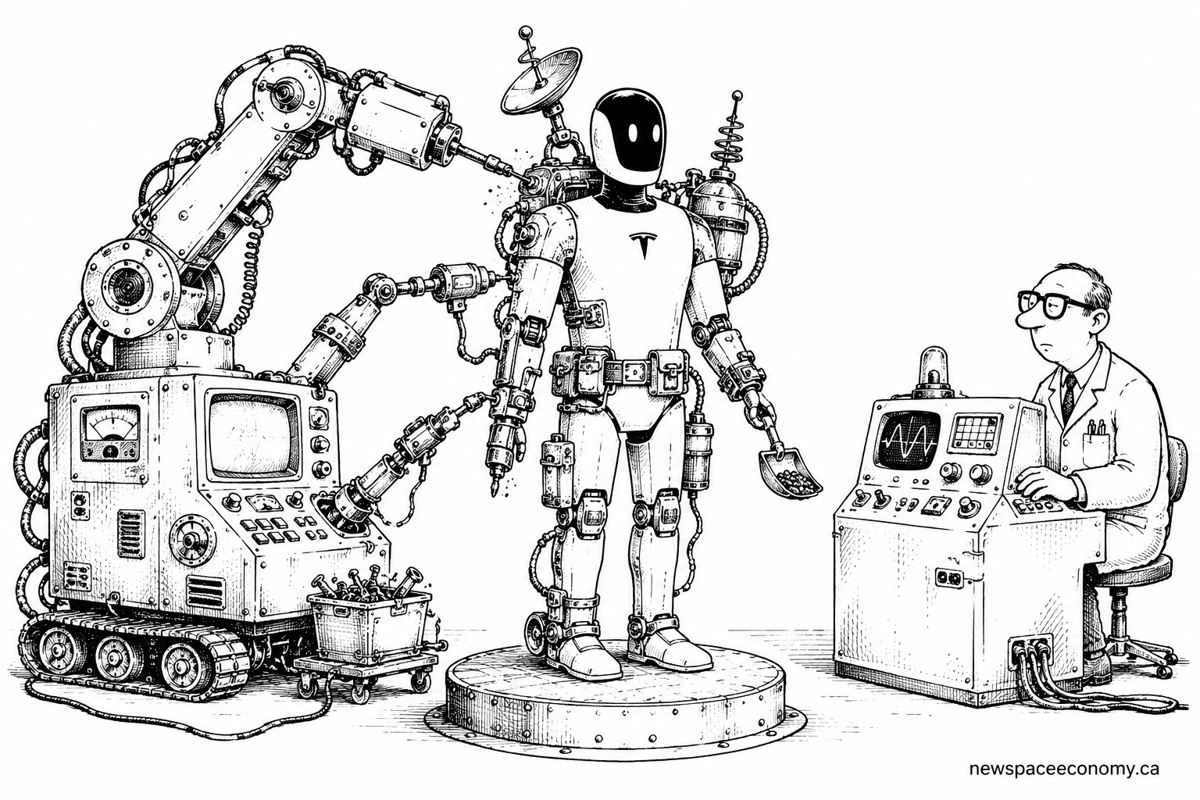
Tesla Robot and Space Exploration Applications
Why It Matters
If Tesla can translate its high‑volume manufacturing and AI expertise into space‑ready humanoids, the economics of robotic assistance for lunar bases, orbital stations, and future Mars missions could shift dramatically, reducing crew workload and mission risk.
Key Takeaways
- •Optimus designed for factories, not vacuum or radiation environments
- •Space adaptation requires redesign of power, thermal, and dust protection
- •Mass production could lower cost of space‑qualified humanoids
- •Near‑term value lies in internal station and habitat tasks
Pulse Analysis
The push toward humanoid robotics in space builds on two parallel histories. NASA’s Robonaut and Valkyrie programs proved that a human‑shaped machine can manipulate existing spacecraft interfaces, but they were engineered for mission‑specific constraints and low‑volume production. Tesla, by contrast, approaches the problem from a commercial angle, leveraging its automotive supply chain, battery technology, and large‑scale AI training pipelines. This divergence creates a potential synergy: the same perception and control software that powers factory lines could be repurposed for the constrained, unstructured environments of lunar habitats or orbital modules.
Technical gaps remain formidable. A terrestrial Optimus relies on ambient air cooling, regular maintenance, and predictable lighting—conditions absent on the Moon or Mars. To become space‑qualified, the robot would need hardened electronics, radiation‑tolerant processors, thermal radiators, and sealed joints that resist abrasive regolith. Power management must shift from grid‑connected charging to low‑draw, high‑efficiency batteries capable of surviving extreme temperature cycles. Moreover, autonomy must evolve from supervised factory tasks to fully self‑directed operations, handling communication delays and fault recovery without human intervention. Tesla’s expertise in battery chemistry and AI‑driven perception could accelerate these adaptations if it commits resources to rigorous vacuum and dust‑chamber testing.
Commercial implications extend beyond government programs. As private lunar landers, commercial space stations, and tourism ventures mature, operators will seek cost‑effective ways to offload routine chores—inventory checks, equipment inspections, and cargo handling—from crew members. A mass‑produced humanoid, even if initially limited to interior tasks, could provide a scalable solution, lowering per‑mission robot costs and creating a new market for software updates and maintenance services. The realistic development path—industrial deployment, analog testing, internal habitat trials, followed by limited uncrewed lunar demonstrations—offers a roadmap that balances risk with the promise of a versatile, affordable robotic workforce for the next era of space exploration.
Tesla Robot and Space Exploration Applications
Comments
Want to join the conversation?
Loading comments...