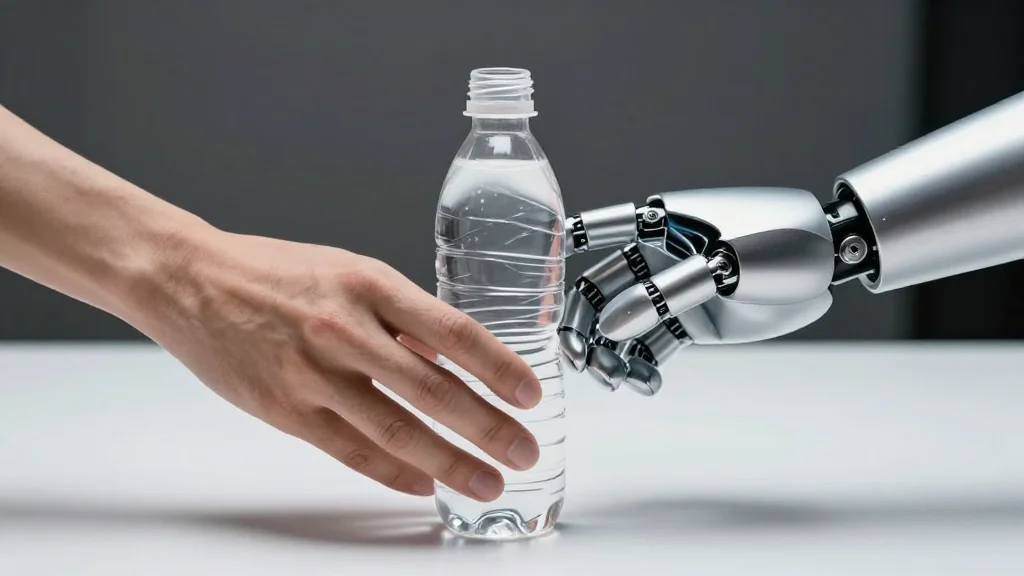
Tesla's Optimus Hands Water Bottles in New Demo Ahead of Fremont Production Ramp

Companies Mentioned
Why It Matters
The water‑handoff demonstration addresses a core capability gap for humanoid robots: reliable object transfer to humans in uncontrolled environments. Mastering this function is a prerequisite for deploying robots in sectors like retail, healthcare, and manufacturing, where safe, intuitive interaction is essential. Tesla's progress could accelerate industry adoption, prompting competitors to prioritize similar perception‑manipulation pipelines. Moreover, the timing aligns with Tesla's strategic shift toward diversifying beyond electric vehicles. A successful mass‑production line for Optimus would validate the company's claim that robotics can become a major revenue pillar, potentially reshaping its financial outlook and influencing investor sentiment across the broader automation market.
Key Takeaways
- •May 21 video shows Optimus handing water bottles to strangers without visible glitches
- •Demo occurs five weeks before Fremont line conversion to Optimus manufacturing
- •Grasp‑transfer task demonstrates perception, navigation, grip control, and release coordination
- •Previous Miami demo in Dec 2025 highlighted instability and raised doubts about autonomy
- •Tesla has not officially confirmed the clip's unscripted nature or production readiness
Pulse Analysis
Tesla's Optimus has long been a litmus test for the company's ability to translate its AI expertise into physical agents. The water‑handoff clip suggests that the VLA models powering Full Self‑Driving are now being repurposed for manipulation, a convergence that could give Tesla a unique competitive edge. While legacy robotics firms rely on modular sensor stacks and deterministic planning, Tesla's end‑to‑end neural approach promises faster iteration cycles and potentially lower unit costs once the manufacturing line ramps up.
However, the absence of an official validation leaves room for skepticism. Past incidents—most notably the Miami stumble—have eroded confidence among analysts who suspect hidden tele‑operation. If the upcoming Fremont rollout reveals a high defect rate or requires extensive human supervision, the market may penalize Tesla's valuation, especially given the capital intensity of retooling an automotive line for humanoids. Conversely, a smooth transition with demonstrable repeatability could trigger a wave of partnership talks with logistics firms and retailers eager to offset labor shortages.
In the broader context, Optimus' progress forces the robotics sector to confront a new benchmark: autonomous grasp‑transfer in everyday settings. Companies like Boston Dynamics and Agility Robotics have showcased impressive locomotion, but few have publicly demonstrated reliable handoffs to humans. Tesla's move could catalyze a shift toward integrated perception‑action pipelines, prompting a reallocation of R&D budgets toward data‑centric training regimes. The next quarter will be pivotal in determining whether Optimus remains a high‑profile prototype or becomes a mass‑produced workhorse reshaping the economics of human‑robot collaboration.
Tesla's Optimus Hands Water Bottles in New Demo Ahead of Fremont Production Ramp
Comments
Want to join the conversation?
Loading comments...